
Best Data Rooms for Startups (Most Are Overkill) in 2026

Co-founder and CEO at Peony. I built the data room platform with a background in document security, file systems, and AI. Founded Peony in 2021 in San Francisco.
Best Data Rooms for Startups in 2026 (I Tested All 10)
Last updated: April 2026
I run Peony, a data room platform, and over the past two years I have helped hundreds of startups set up data rooms for seed rounds, Series A raises, M&A exits, and ongoing investor relations. I have also signed up for every competing platform on this list, uploaded real document sets, stress-tested the security features, and tracked how long each one takes to get from zero to a shareable investor link.
This is not a neutral review. I built Peony because the existing options were either absurdly expensive for startups or missing the features that actually matter during fundraising. But I have tested every platform here with the same rigor, and where a competitor genuinely excels — like iDeals' support or SecureDocs' simplicity — I will say so.
TL;DR: Most startups overspend on data rooms or, worse, use Google Drive and signal operational immaturity to VCs. Peony (free, $0) is the best overall choice — AI auto-indexing builds an investor-ready room in under 5 minutes, page-level analytics show which investors are genuinely engaged, and enterprise security (dynamic watermarks, screenshot protection, NDA gates) is included at $40/admin/month. For late-stage M&A, iDeals and Firmex are solid mid-market VDRs. For the absolute cheapest dedicated VDR, SecureDocs ($250/month flat) works but lacks analytics and AI.
By the Numbers
- $3.4 billion — global VDR market size in 2025, projected to reach $17.46B by 2034 (Fortune Business Insights)
- 68% of data breaches involve a human element — social engineering, errors, or misuse (Verizon 2024 DBIR)
- 2-10x — how much actual VDR costs exceed initial quotes on legacy platforms (SRS Acquiom, 3,800+ M&A deals analyzed)
- Under 5 minutes — setup time for modern VDR platforms like Peony, vs. days or weeks for enterprise platforms
Scored Comparison Table
| Rank | Platform | Starting Price | Security (/5) | Analytics (/5) | Ease of Use (/5) | Value (/5) | Best For |
|---|---|---|---|---|---|---|---|
| 1 | Peony | Free ($0) | 4.8 | 4.9 | 4.8 | 4.9 | Seed to Series B fundraising, investor comms |
| 2 | iDeals | ~$500+/mo | 4.3 | 3.9 | 4.2 | 3.5 | Mid-market M&A, cross-border deals |
| 3 | Firmex | ~$650+/mo | 3.5 | 3.1 | 3.7 | 3.2 | Advisory firms, PE-backed exits |
| 4 | Ansarada | $229/mo (250 MB, annual) | 3.7 | 3.8 | 4.1 | 3.5 | Sell-side M&A, AI deal prep |
| 5 | SecureDocs | $250/mo flat | 3.3 | 2.9 | 4.0 | 3.8 | Simple single-room fundraising |
| 6 | Digify | $180/mo (Pro) | 3.4 | 3.0 | 3.6 | 3.3 | Budget document protection |
| 7 | Datasite | Custom ($25K+/yr) | 4.6 | 4.0 | 3.4 | 2.5 | Enterprise M&A, investment banking |
| 8 | Google Drive | $0-$12/user/mo | 1.5 | 1.0 | 4.5 | 2.0 | Internal docs only (not investor-facing) |
| 9 | Notion | $0-$10/user/mo | 1.3 | 1.0 | 4.6 | 2.0 | Internal wiki (not investor-facing) |
| 10 | Dropbox | $0-$24/user/mo | 1.8 | 1.2 | 4.3 | 2.0 | Basic file sharing (not investor-facing) |
Scoring methodology: Each platform scored independently out of 5.0 based on hands-on testing and publicly available features as of March 2026. Security evaluates watermarking, screenshot protection, access controls, and compliance certifications. Analytics measures engagement tracking depth — from page-level heatmaps to basic view counts. Ease of Use reflects setup time, UI quality, and investor learning curve. Value compares feature breadth against starting price for a typical seed-to-Series-B startup.
What to Look for in a Startup Data Room
Before diving into each platform, here are the criteria I used to evaluate them. These are based on hundreds of real fundraising processes I have seen — not feature-list checkboxes from marketing pages.
1. Setup Speed
VCs move fast. If your data room takes days to set up or requires a sales call, you have already lost momentum. The best platforms go from signup to a shareable link in under 10 minutes — and the link itself should be trackable so you know who opens it. Peony's AI auto-indexing does it in under 5.
2. Investor-Facing Analytics
Basic view counts are nearly useless. What matters is page-level engagement: which sections did each investor read, how long did they spend, where did they drop off, and are they coming back? This is how you separate genuine interest from courtesy clicks — and time your follow-up calls. Peony's page-level analytics give you this signal in real time.
3. Security That Builds Trust
Sharing your cap table, financial projections, and customer contracts through an unprotected link is reckless. You need dynamic watermarks (name, email, timestamp on every page), screenshot protection, NDA gates, email authentication, granular permissions, and link expiry. VCs handling hundreds of deals simultaneously expect this level of protection — and its absence raises questions about how you handle sensitive data in general.
4. Professional Presentation
A messy folder structure or a generic Google Drive link signals sloppiness. Investors notice. Clean organization, custom branding (yourcompany.peony.ink), fast document viewers, and mobile-optimized viewing create a professional impression that carries into every subsequent conversation. For guidance on how to deliver your deck itself, see our guide on how to send your pitch deck to investors.
5. Startup-Friendly Pricing
Pre-revenue startups should not be spending $250-$650/month on a VDR. The best platforms offer genuine free tiers or per-seat pricing that scales with your needs. Flat-rate VDRs designed for enterprise M&A are a runway trap for early-stage companies. For a deeper look at what VDRs actually cost, see our virtual data room cost guide.
6. Scalability Across Rounds
Your data room should grow with you — from pre-seed deck sharing to Series A due diligence to eventual M&A. Look for unlimited data rooms so you are not paying per-project fees for each new round, board update, or investor communication.
1. Peony — Best Overall for Startups
I built Peony because the data room I wanted as a founder did not exist. Every VDR I tried during my first fundraise was either designed for billion-dollar M&A (with pricing to match) or was so bare-bones that investors asked why I was not using something more professional. The startup fundraising gap was enormous.
Peony was the fastest platform I tested — 3 minutes and 40 seconds from first click to sharing a live data room link. No sales call, no onboarding form, no waiting for a "dedicated project manager" to email me back. For context, the enterprise platforms took days of back-and-forth before I even got sandbox access.
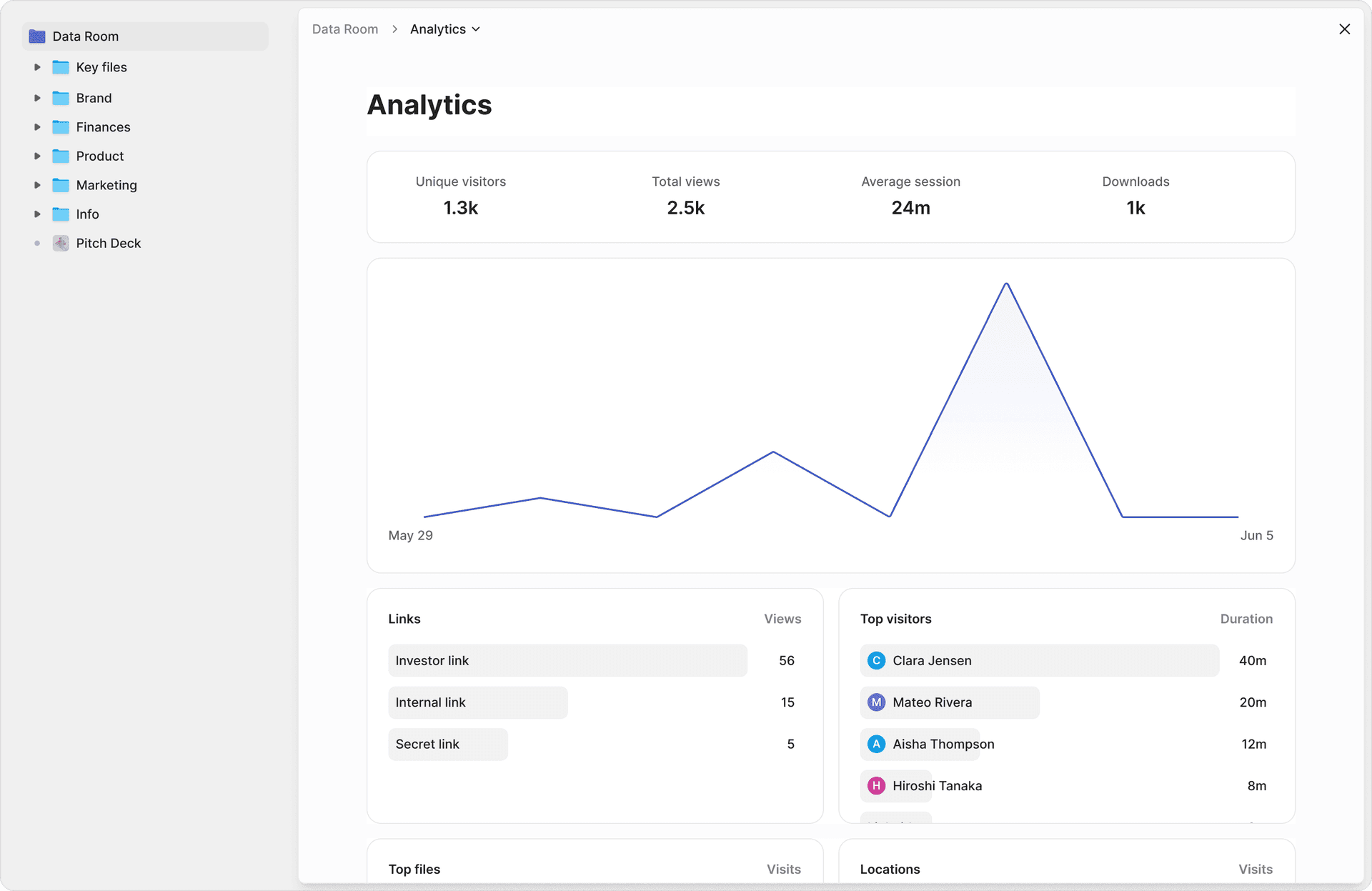
What separates Peony from every other platform on this list is the analytics. During a real seed round, I could see that one investor spent 14 minutes on the cap table and financial projections but skipped the product roadmap entirely. Another investor revisited the customer contracts three times in two days. These signals told me exactly who was doing serious diligence and where to focus my follow-up calls. Legacy VDRs show aggregate view counts — Peony shows behavior.
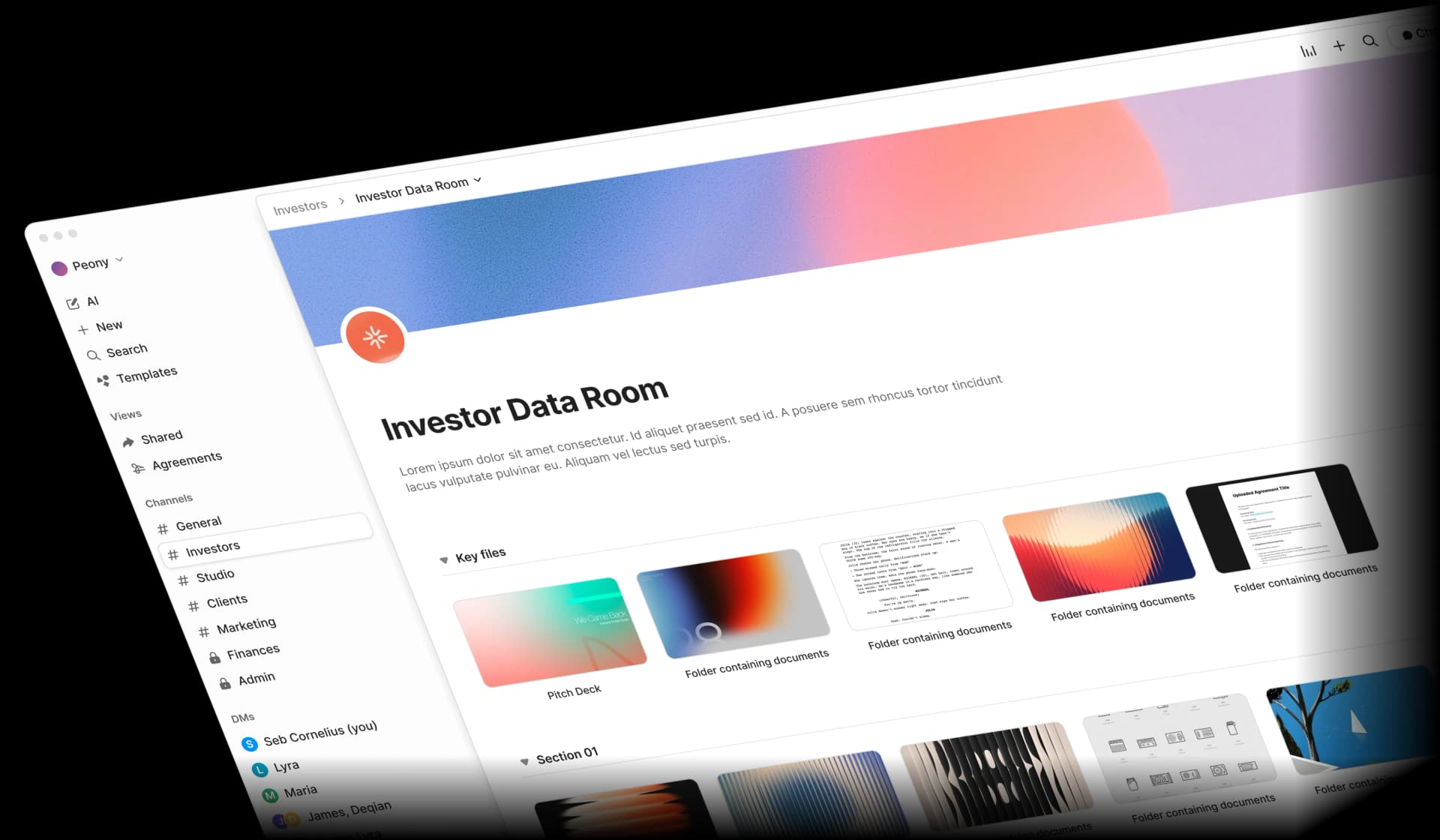
Why startups choose it:
- AI auto-indexing — Bulk upload your documents and Peony organizes them into investor-ready folder structures (corporate, financials, legal, operations, compliance) in under 5 minutes. Try AI rooms
- Page-level analytics — See exactly which pages each investor reads, for how long, and where they drop off. Prioritize follow-ups with the investors who are doing real work. Explore analytics
- Enterprise security at startup prices — Dynamic watermarks, screenshot protection, NDA gates, email authentication, link expiry, access revocation, and full audit logs — all included
- Custom branding — Your room at yourcompany.peony.ink with your logo, not a generic VDR domain. Custom domains
- Unlimited data rooms — Run fundraising, board updates, and M&A rooms simultaneously without per-room charges
- Built-in e-signatures — Close NDAs and term sheets without switching tools. E-signatures
- Smart Q&A — Investors ask questions directly in the room, you respond with full audit trail. Q&A workflows
What users are saying:
"We looked at DocSend etc. but the cost and clunkiness just put us off." — Anthony Gale, Founder & CEO, PromoLens
"Been using Peony for a few weeks now — it's a standout for the gated file sharing and data room functions. Intuitive, secure, beautifully designed, and an actually working AI, all while being very well priced versus competitors." — Michael Hui, Managing Director, Piton Partners
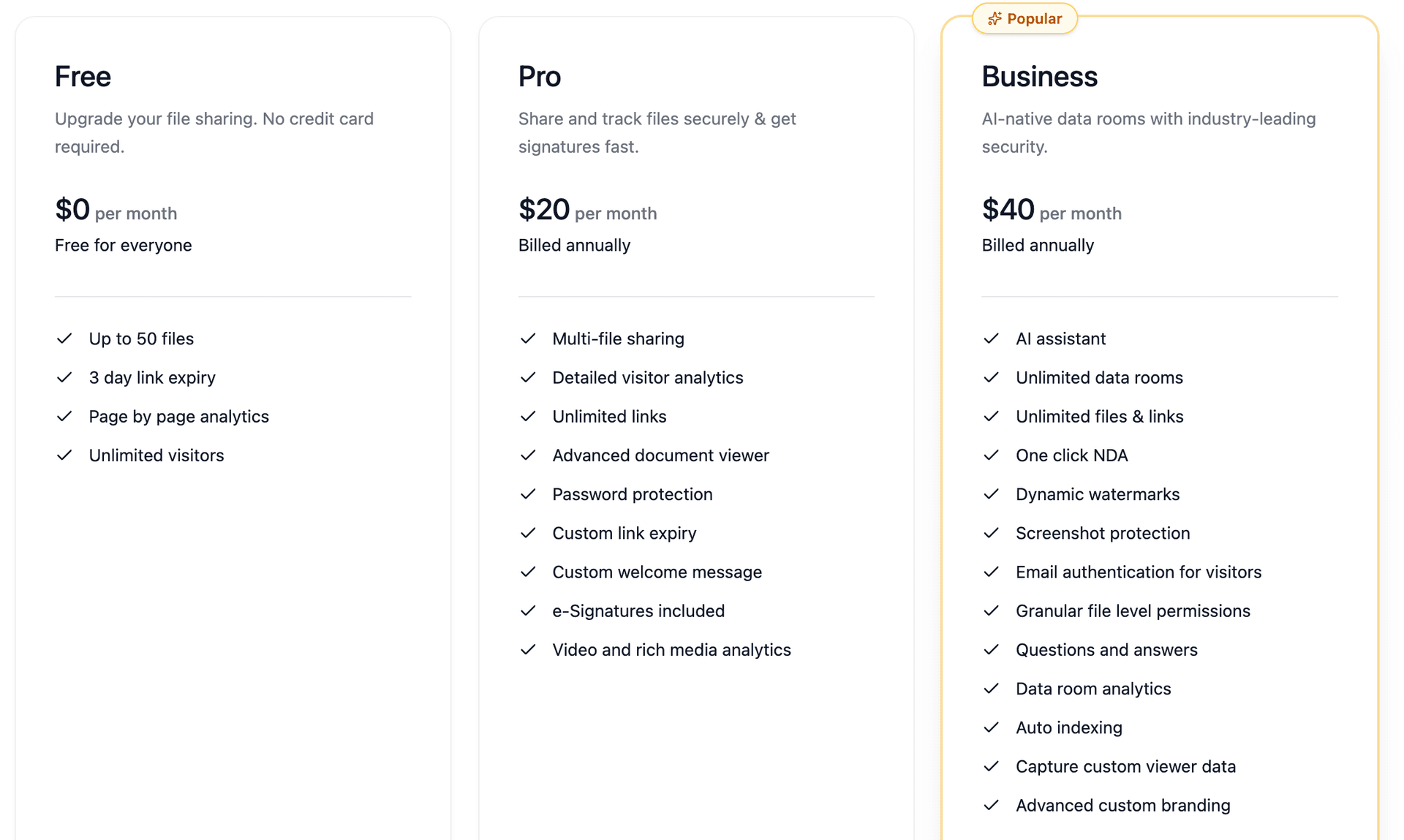
Pricing:
- Free: $0/month — up to 50 files, page-level analytics, unlimited visitors
- Pro: $20/admin/month — e-signatures, detailed visitor analytics, unlimited links, password protection
- Business: $40/admin/month — AI auto-indexing, unlimited data rooms, dynamic watermarks, screenshot protection, NDA gates, granular permissions, Q&A, advanced custom branding
Best for: Pre-seed through Series B startup fundraising, VC deal flow, due diligence, board communications, investor relations, and any founder who needs enterprise-grade security without enterprise pricing.
Explore Peony features | See pricing | Startup solutions | Fundraising solutions
2. iDeals — Best Mid-Market Workhorse
I tested iDeals' support response time and they were not exaggerating — my first chat was answered in 22 seconds. The platform feels like a polished Toyota: nothing flashy, everything works. Bulk upload was smooth, permissions were intuitive, and the Q&A management is the cleanest I tested among traditional VDRs.
With over 1 million users across 175,000+ companies, iDeals is one of the most widely adopted VDR platforms globally and a G2 Leader for five consecutive years. They support 14 languages and operate 9 global data centers, making them a strong choice for cross-border fundraising at later stages.
Where iDeals fell short for startups: the analytics dashboard shows views and downloads but nothing approaching page-level engagement data. You can see that an investor opened a document — you cannot see which sections they actually read or where they lost interest. For a seed-stage founder trying to prioritize 15 warm leads, that gap matters.
Pricing: Quote-based, not publicly listed. Third-party estimates suggest $500+/month minimum, tiered by project.
Strengths: Best-in-class support (24/7 in 10+ languages), robust Q&A management, strong compliance (SOC 2, ISO 27001, HIPAA, GDPR), multi-language support.
Limitations: No meaningful AI capabilities. Analytics are solid but traditional — no page-level engagement tracking. Pricing is per-deal, not designed for continuous use across multiple rounds. Expensive for early-stage.
Best for: Late-stage startups (Series B+) doing cross-border fundraising or complex multi-party due diligence where responsive support and compliance credentials matter more than cost.
3. Firmex — Best for PE-Backed Exits
Firmex impressed me with how quickly I could spin up multiple data rooms — the unlimited rooms model on annual subscriptions means no mental overhead about whether a deal "justifies" another room. The drag-and-drop interface is clean, the watermarking is solid, and the dedicated customer success manager responded to my test query within two hours.
Firmex has served 223,000+ companies since 2006 and has carved out a strong position in mid-market M&A and PE. For a startup approaching an acquisition or going through a PE-led growth equity process, Firmex is a credible choice that buy-side teams will recognize.
The limitation for earlier-stage startups is clear: the interface is not modern, there are no AI features, the UI noticeably slows with 500+ documents, and the pricing (estimated ~$7,800/year average) makes no sense for a company that just needs to share a pitch deck and financials with 10 VCs.
Pricing: Quote-based with a transparent structure. Annual subscription for unlimited rooms based on storage. Third-party estimates: ~$7,800/year average.
Strengths: Unlimited data rooms on subscription, strong security (SOC 2 Type II, bank-grade encryption), practical Q&A and task assignment, dedicated customer success manager included.
Limitations: No AI features. UI slows with large document sets. Interface is functional but dated. Pricing is prohibitive for early-stage.
Best for: Startups going through PE-backed exits, M&A processes, or growth equity deals where the buy-side expects a traditional VDR and budget is secondary to credibility.
4. Ansarada — Best for AI-Assisted Deal Preparation
Ansarada's free preparation phase is genuinely useful — I organized an entire data room during the free period before deciding whether to activate. The bidder engagement scoring was the most interesting analytics feature I tested outside of Peony: it predicted which of my test reviewers were "highly engaged" based on viewing patterns with claimed 97% accuracy by day 7.
Important context: Datasite acquired Ansarada in August 2024 for approximately AUD $240 million. The brand still operates independently, but long-term product strategy is uncertain — something to consider if you are committing to a platform for ongoing use.
The storage-based pricing is the main drawback. At $499/month for just 250 MB, a startup with a large document set can hit limits quickly. By comparison, Peony Business at $40/admin/month includes unlimited storage.
Pricing: Storage-tiered: $499/month (250 MB), scaling to $2,499/month (4 GB). Free preparation phase before deal activation.
Strengths: AI bidder engagement scoring, free deal prep phase, readiness checklists and scorecards, Smart Sort document classification.
Limitations: Storage limits are punishing (250 MB at $499/month). Datasite acquisition creates uncertainty. Browser compatibility issues reported. Expensive relative to features for startup use.
Best for: Startups in active sell-side M&A processes who want AI-assisted deal preparation and are willing to work within storage-based pricing.
5. SecureDocs — Budget Flat-Rate VDR
SecureDocs was the second-fastest setup I tested — about 8 minutes from signup to sharing a live room. The interface is deliberately simple: upload, set permissions, share. For a straightforward seed-round data room or a single-purpose data room, $250/month flat with unlimited users is a predictable cost.
Where SecureDocs falls short is everything beyond the basics. No AI features, no page-level analytics (just basic view counts), no custom branding, no e-signatures, and no SSO. You will know that someone opened a document — you will not know whether they actually read your financials or closed the tab after the cover page. For a startup trying to optimize their fundraising process, that lack of signal is a meaningful disadvantage.
Important context: Onit acquired SecureDocs, and the platform has not evolved significantly. The simplicity that makes it easy to set up is the same simplicity that limits what you can do with it.
Pricing: $250/month flat — unlimited users, unlimited documents, 24/7 support.
Strengths: Simplest setup, flat-rate pricing, unlimited users and documents, SOC 2 compliant, high Capterra satisfaction (4.9/5).
Limitations: Basic reporting (no page-level analytics). No AI features. No SSO/SAML. No custom branding. No e-signatures. You will outgrow this platform quickly.
Best for: First-time founders who need the simplest possible dedicated VDR and are comfortable paying 6x what Peony Business costs for fewer features.
6. Digify — Document Protection on a Budget
Digify occupies a niche between consumer file sharing and full VDR platforms. The NDA workflows are well-implemented, the watermarking works reliably, and at $180/month for the Pro plan it is cheaper than most dedicated VDRs. I tested the document tracking and it accurately logged views, downloads, and forwarding attempts.
The limitation is scale. The Pro plan includes only 1 user and 3 rooms. The Team plan at $480/month adds 3 users and 10 rooms — at $160 per user per month, you are paying 4× what Peony Business costs ($40/admin/month) for far fewer features. Digify has no AI capabilities, no page-level analytics, and limited customization.
Pricing: Pro: $180/month (1 user, 3 rooms). Team: $480/month (3 users, 10 rooms).
Strengths: NDA workflows, watermarking, document tracking, access revocation, reasonable entry-level pricing.
Limitations: Tight room and user limits. No AI. No page-level analytics. No custom branding. Limited collaboration tools.
Best for: Early-stage startups that need basic document protection and NDA workflows but do not yet need a full-featured data room.
7. Datasite — Enterprise M&A Standard
Getting into Datasite required a sales call, a qualification form, and a follow-up email chain that lasted four business days before I received sandbox access. Once inside, the AI capabilities are genuinely impressive — I uploaded 200 mixed documents and the auto-classification sorted them into the right categories with roughly 90% accuracy. The redaction tool caught PII types I would have missed manually.
For a startup, the math does not work. Pricing starts at five figures annually, the setup process takes days, and the platform is designed for billion-dollar transactions managed by teams of investment bankers. If you are raising a $5 million Series A, Datasite's capabilities are irrelevant — and its cost will consume a meaningful portion of the capital you are trying to raise.
Pricing: Custom/quote-based. Typical range: $25,000-$100,000+/year. Per-page model (~$0.60/page by third-party estimates).
Strengths: Deep AI capabilities (document classification, PII redaction), strongest institutional credibility, ISO 42001-certified AI governance, sophisticated permissioning.
Limitations: Pricing starts at five figures. Steep learning curve. Setup takes days. Designed for enterprise M&A, not startup fundraising.
Best for: Startups that have reached a stage where they are being acquired by a public company or going through an IPO process — not for fundraising.
8. Google Drive — Internal Use Only
Google Drive is free, familiar, and where most founders start. I understand the temptation — you already have everything in Drive, sharing is easy, and the cost is right.
The problem is what it signals. VCs reviewing 200+ companies annually interpret a Google Drive data room the same way they interpret a pitch deck with typos: this founder does not pay attention to detail. Beyond perception, Drive has zero analytics (you do not know who read what), no watermarking, no screenshot protection, no NDA enforcement, and no granular permissions. A single forwarded link gives anyone access to your cap table, financials, and customer contracts.
I have seen founders lose competitive processes because an investor forwarded their Drive folder to a portfolio company building a competing product. Use Drive for internal file storage. For anything investor-facing, use a purpose-built platform. See our VDR vs cloud storage comparison for a full breakdown of why.
Pricing: Free (15 GB), $12/user/month (Google Workspace).
Strengths: Free, familiar, ubiquitous, excellent collaboration for internal teams.
Limitations: No analytics whatsoever. No watermarking. No screenshot protection. No NDA gates. No access revocation. Signals amateur operations to institutional investors.
Best for: Internal document collaboration and storage. Never use for investor-facing materials.
9. Notion — Internal Wiki, Not a Data Room
Notion is one of my favorite products — I use it daily for internal documentation, product specs, and meeting notes. As a data room, it is categorically wrong for the job.
Notion pages are designed for open collaboration, not controlled document sharing. There is no per-viewer watermarking, no screenshot protection, no NDA enforcement, no page-level analytics, and no meaningful access controls at the document level. If you share a Notion page with an investor, anyone with the link can access it, and you have zero visibility into who read what.
I have seen startups use Notion "data rooms" during fundraising and wonder why they could not track investor engagement or protect their sensitive documents. The answer is simple: Notion was never designed for this use case.
Pricing: Free, $10/user/month (Plus), $25/user/month (Business).
Strengths: Beautiful document editing, excellent collaboration, powerful for internal knowledge management.
Limitations: No VDR security features. No analytics. No watermarking. No NDA gates. No controlled sharing. No audit logs. Not designed for external document sharing.
Best for: Internal team documentation and knowledge base. Use Peony for anything you share with investors.
10. Dropbox — Consumer File Sharing
Dropbox is a file storage service that has evolved into a broader productivity suite, but it fundamentally remains a consumer tool. The sharing experience is generic — shared links look like any other Dropbox folder, there is no custom branding, and the analytics are limited to basic view notifications.
After acquiring DocSend in 2021, Dropbox has pitch deck analytics in the DocSend product, but the core Dropbox sharing experience has not incorporated those features. You are essentially using two separate products that happen to share a parent company.
Pricing: Free (2 GB), $11.99/month (Plus), $24/user/month (Business).
Strengths: Reliable file sync, familiar interface, broad integrations, solid mobile apps.
Limitations: Generic sharing (no branding). Minimal analytics. No watermarking. No NDA gates. No screenshot protection. No investor-specific features.
Best for: Personal file backup and internal team file sharing. Not suitable for investor-facing materials.
Pricing Comparison for Startups
| Platform | Pre-Seed Budget | Seed Budget | Series A Budget | Unlimited Rooms | AI Features | Page Analytics |
|---|---|---|---|---|---|---|
| Peony | $0 (Free) | $20/admin | $40/admin | Yes | Yes | Yes |
| iDeals | Not affordable | Not affordable | ~$500+/mo | No | No | Basic |
| Firmex | Not affordable | Not affordable | ~$650+/mo | Yes (annual) | No | Basic |
| Ansarada | Not affordable | Not affordable | $229/mo (annual) | No | Partial | Good |
| SecureDocs | Not affordable | $250/mo | $250/mo | No | No | Basic |
| Digify | $180/mo (Pro) | $180/mo (Pro) | $480/mo (Team) | No (3 rooms) | No | No |
| Datasite | Not affordable | Not affordable | Not affordable | No | Yes | Basic |
| Google Drive | $0 | $12/user | $12/user | N/A | No | No |
| Notion | $0 | $10/user | $25/user | N/A | Partial | No |
| Dropbox | $0 | $11.99/mo | $24/user | N/A | No | No |
The pattern is clear: Peony is the only platform that serves the full startup lifecycle from pre-seed (free) through Series B ($40/admin/month) with AI, analytics, and enterprise security at every tier. Every other VDR either prices out early-stage startups or lacks the features that make a data room valuable in the first place.
Startup Data Room Document Checklist
Whether you are raising a pre-seed round or preparing for Series B due diligence, here is the document checklist that institutional VCs expect. I have seen hundreds of startup data rooms — the best ones cover every category below. The worst ones have three PDFs in a folder called "Docs."
Peony's AI auto-indexing creates this entire folder structure automatically. Upload everything in a ZIP and the AI sorts it in under 5 minutes.
Corporate and Governance
- Articles of incorporation and amendments
- Bylaws or operating agreement
- Cap table (fully diluted — include SAFEs, convertible notes, option pool)
- Board meeting minutes (last 12-24 months)
- Shareholder agreements, voting agreements, ROFR provisions
- Certificate of good standing (current)
- Organizational chart
Financials
- Monthly P&L statements (last 12-18 months)
- Revenue breakdown by customer, product, geography
- Financial projections and model assumptions (3-5 year)
- Bank statements (last 6-12 months)
- Burn rate and runway calculation (current)
- Debt schedule (outstanding loans, convertible instruments)
- 409A valuation (most recent)
Legal
- Material contracts (any contract representing more than 5% of revenue)
- IP assignments and patent portfolio
- Pending or threatened litigation
- Employment agreements for key employees
- ESOP plan and grant schedule
- Insurance policies (D&O, E&O, general liability, cyber)
- Privacy policy and terms of service
Operations and Team
- Management team bios
- Key performance indicators (KPIs) — monthly, with definitions
- Product roadmap (next 12 months)
- Customer acquisition cost (CAC) and lifetime value (LTV) analysis
- Key customer references or case studies
- Non-compete and non-solicitation agreements
Compliance
- Federal and state tax returns (last 3 years, or since inception)
- Sales tax nexus analysis
- SOC 2 or ISO 27001 reports (if applicable)
- Regulatory licenses and industry-specific compliance certificates
Pro tip: Do not wait for investors to request these documents. Having a complete, well-organized data room ready before a VC meeting signals operational maturity and dramatically accelerates the timeline from first meeting to term sheet. Peony Free lets you build and maintain this room at no cost until you are ready to share.
How to Migrate from Google Drive to a Proper Data Room
Most startups start on Google Drive and eventually need to migrate. Here is the process I recommend — it takes under 10 minutes with Peony.
Step 1: Audit Your Current Files
Open your Google Drive folder and identify what is investor-ready vs. what is internal-only. Delete outdated versions, rename files clearly (e.g., "Q4-2025-PnL.pdf" not "financials-final-v3-FINAL.pdf"), and note any missing documents from the checklist above.
Step 2: Export from Google Drive
Select all investor-ready files and download as a ZIP. For Google Docs/Sheets, these will auto-convert to PDF or XLSX — review them to confirm formatting is preserved.
Step 3: Upload to Peony
Create a new data room in Peony, name it for your round (e.g., "Series A Data Room"), and drag-and-drop the ZIP file. AI auto-indexing automatically sorts everything into standard due diligence categories — cap table to corporate governance, P&L statements to financials, IP assignments to legal.
Step 4: Configure Security and Share
Enable dynamic watermarks, set NDA gates if needed, configure view/download permissions per document, and add your company branding. Generate personalized links for each investor so you can track engagement individually.
Step 5: Monitor and Optimize
Use page-level analytics to see which investors are engaging with which sections. Follow up with investors who spent significant time on financials and cap table — they are doing real diligence. If investors consistently skip a section, consider whether it needs restructuring.
How to Think About Choosing a Data Room at Your Stage
Which data room features matter depends entirely on your funding stage and deal complexity. Most founders over-buy enterprise features they will not use for three years, or under-buy security that costs them investor trust today. Here is how to think about it at each stage.
Pre-Seed or Bootstrapped (Fewer Than 20 Documents, Fewer Than 5 Investors)
If you have fewer than 20 documents and fewer than 5 investors looking, you need security basics — watermarks, NDA gates, and analytics — not AI auto-indexing or unlimited rooms. Peony Free ($0) covers this with up to 50 files, page-level analytics, unlimited visitors, and core security features.
The one thing you should not skip even at this stage: page-level analytics. Knowing that an investor spent 14 minutes on your cap table vs. 30 seconds on your pitch deck tells you exactly what to discuss in the partner meeting. That signal is worth more than any feature you could pay for.
Seed ($1M-$5M Raise, 10-30 Investors Reviewing)
If you are managing 10 to 30 investor conversations simultaneously, analytics depth becomes your fundraising weapon. Page-level engagement data is how you prioritize which VCs to call back first — the investor who spent 20 minutes in your financials section is a fundamentally different signal than the one who opened the link once and never came back.
At this stage, custom branding (yourcompany.peony.ink) signals legitimacy in a way that a generic sharing link does not. Institutional seed funds reviewing hundreds of companies per year notice these details. Peony Pro ($20/admin/month) adds custom branding, e-signatures, and detailed visitor analytics. If you need AI auto-indexing, Peony Business ($40/admin/month) is the sweet spot. See fundraising solutions.
Series A ($5M-$25M, Formal Due Diligence, 50+ Documents)
If your document set has grown to 50 to 100+ files and legal counsel is now reviewing your room, manual folder organization becomes a serious time sink. AI auto-indexing saves days of work — bulk upload everything and it creates the standard due diligence structure automatically.
Unlimited data rooms matter at this stage because you need separate rooms for fundraising, board communications, and legal matters. Running all three on a per-room pricing model adds up fast. Peony Business ($40/admin/month) includes AI auto-indexing, unlimited rooms, dynamic watermarks, screenshot protection, NDA gates, and advanced Q&A workflows. See startup solutions.
Series B and Growth Equity ($25M-$100M+, Institutional Buyers)
If institutional investors are running formal diligence on your company, you need multi-level permissions so different investor groups see different documents, and advanced Q&A workflows so counterparties can submit questions directly in the room with a full audit trail.
If your lead investor mandates a specific platform, you may end up on iDeals or Firmex — and both are credible mid-market VDRs. If you have a choice, Peony Business at $40/admin/month still covers everything at a fraction of the cost, including AI auto-indexing, unlimited rooms, and enterprise security. See PE solutions.
M&A Exit (Acquisition or IPO Process)
If you are going through an acquisition, stage-gate permissions become critical — different buyer groups need to see different documents at different phases of the process. You also need robust Q&A workflows to handle the volume of diligence questions from multiple counterparties simultaneously.
If the buy-side mandates Datasite, that is their call — enterprise M&A platforms are what their teams know. If you are choosing the platform, evaluate whether the $25K+/year premium delivers anything your specific deal actually needs. For most acquisitions under $500M, Peony Business at $40/admin/month includes comparable security, AI, and analytics. For transactions above $500M with complex multi-party structures, Datasite and Intralinks have the deepest institutional credibility. See M&A solutions.
Feature Priority by Stage
| Feature | Pre-Seed | Seed | Series A | Series B+ | M&A Exit |
|---|---|---|---|---|---|
| Page-level analytics | Critical | Critical | Critical | Critical | Critical |
| Dynamic watermarks | Important | Important | Critical | Critical | Critical |
| Screenshot protection | Nice to have | Important | Critical | Critical | Critical |
| AI auto-indexing | Unnecessary | Nice to have | Critical | Critical | Critical |
| Custom branding | Unnecessary | Important | Important | Important | Standard |
| Unlimited rooms | Unnecessary | Nice to have | Critical | Critical | Critical |
| Multi-level permissions | Unnecessary | Unnecessary | Nice to have | Critical | Critical |
| E-signatures | Unnecessary | Nice to have | Important | Important | Critical |
| Advanced Q&A | Unnecessary | Unnecessary | Nice to have | Critical | Critical |
| Post-download DRM | Unnecessary | Unnecessary | Unnecessary | Rarely needed | Situational |
The common thread: Page-level analytics matter at every stage. Everything else scales with deal complexity and counterparty expectations. Start with Peony Free, upgrade as your deals demand it.
Common Startup Data Room Mistakes
Mistake 1: Using Consumer Tools for Investor-Facing Sharing
Google Drive, Dropbox, and Notion are collaboration tools, not data rooms. They lack watermarking, screenshot protection, NDA enforcement, analytics, and granular permissions. VCs reviewing 200+ companies annually associate consumer tools with operational immaturity. If you are evaluating alternatives to those tools, our DocSend alternatives review compares every serious option.
Fix: Switch to Peony Free (takes under 5 minutes) before your next investor meeting.
Mistake 2: Overspending on Enterprise VDRs
Pre-revenue startups paying $250-$650/month for a basic VDR are burning runway on infrastructure designed for billion-dollar M&A transactions. The features you need at seed stage (analytics, branding, basic security) are available for a fraction of that cost.
Fix: Peony Business at $40/admin/month includes AI, analytics, unlimited rooms, and enterprise security — everything you need through Series B.
Mistake 3: No Analytics Means No Signal
If you cannot see which investors are actually reading your documents, you are flying blind. You waste time following up with people who opened the link out of courtesy and miss the ones who spent 20 minutes on your financials. Our guide on tracking pitch deck engagement breaks down how to read those signals.
Fix: Use a platform with page-level analytics, not just view counts. Prioritize investors who engage deeply with financial and legal sections.
Mistake 4: Messy Organization
Disorganized folders, inconsistent naming, missing documents — these create friction and erode investor confidence. Every additional email asking "where is the cap table?" is a signal that you do not run a tight ship.
Fix: Use AI auto-indexing to build a clean, standard folder structure automatically. Follow the document checklist above.
Mistake 5: Setting Up the Data Room After Investors Ask
The founders who close fastest have their data room ready before the first VC meeting. When an investor expresses interest, you send a polished branded link within minutes — not a hastily assembled Google Drive folder two days later. For a step-by-step fundraising playbook, see our seed funding guide.
Fix: Build your data room on Peony Free now. Maintain it as a living document. Share the moment diligence begins.
Frequently Asked Questions
We're a 4-person SaaS startup raising our seed round — what's the best data room for us in 2026?
For a small team raising seed, you need a data room that takes minutes to set up, gives you page-level analytics to prioritize investor follow-ups, and does not eat into your runway. After hands-on testing across 10 platforms, Peony is the best fit for your stage. The free tier covers up to 50 files with page-level analytics and security features, and if you need AI auto-indexing and unlimited rooms as your raise scales, Business is $40/admin/month. iDeals and Firmex are proven alternatives for later-stage M&A, but at $500+/month they are overkill for a seed round.
Our pre-revenue startup has $800K in the bank — how much should we realistically spend on a data room?
With $800K in the bank and no revenue, every dollar of burn matters. You should spend $0 to $40/month on your data room. Peony Free handles up to 50 files with page-level analytics and core security at no cost — that covers most seed-stage document sets. If you need custom branding and e-signatures, Peony Pro is $20/admin/month. For AI auto-indexing and unlimited rooms, Peony Business is $40/admin/month. Legacy VDRs like SecureDocs ($250/month flat) and iDeals ($500+/month) charge more than your monthly cloud infrastructure bill for fewer features.
Our lead VC just asked for 'a complete data room' — what documents do they actually expect to see?
When your lead VC asks for a complete data room, they expect five categories: corporate documents (articles of incorporation, cap table, SAFE and convertible note agreements, board resolutions), financials (monthly P&L, burn rate, projections), legal (IP assignments, material contracts, employment agreements), operations (org chart, KPIs, product roadmap), and compliance (tax filings, 409A valuation). For a 6-person team raising a $3M seed, manually organizing 40+ documents into those categories takes hours. Peony's AI auto-indexing does it in under 5 minutes — bulk upload everything and it creates the standard due diligence folder structure automatically. SecureDocs and Firmex require you to build every folder by hand.
We've been using Google Drive for our cap table and financials — is that a problem when VCs start diligence?
Yes, and your investors will notice. For a startup sharing a cap table and financials with 10 seed-stage VCs, Google Drive and Notion lack dynamic watermarking, screenshot protection, NDA gates, page-level analytics, and granular permissions. A forwarded link can expose your cap table to anyone — and institutional VCs reviewing 200+ companies per year associate consumer tools with operational immaturity. The fix takes under 5 minutes: sign up for Peony, bulk upload your Drive folder, and you get page-level analytics and core security starting on the free tier. Even SecureDocs at $250/month cannot show you which pages each VC actually read.
I shared our data room with 15 VCs last week and have no idea who's actually reviewing — how do I track investor engagement?
You need page-level analytics, not just link open rates. Peony shows exactly which pages each investor read, how long they spent per section, and where they dropped off. If one of your 15 VCs spent 14 minutes on your financials and cap table but skipped your product roadmap, you know exactly what to address in the follow-up call and who to prioritize for a partner meeting. iDeals, Firmex, and SecureDocs typically show only aggregate view counts, which tell you almost nothing about real intent.
I'm a first-time founder — what security features do I actually need, vs. what's overkill for a seed round?
At seed stage, you need the essentials: dynamic per-viewer watermarks so leaked documents trace back to the source, screenshot protection to prevent casual copying, NDA gates before any content is visible, email authentication, granular view/download/print permissions, link expiry, access revocation, and full audit logs. That is not overkill — that is baseline protection for your cap table and financials. Peony includes all of these on the Business plan at $40/admin/month. SecureDocs at $250/month lacks watermarking and screenshot protection entirely. What is overkill at seed stage: post-download DRM, multi-level stage-gate permissions, and advanced Q&A workflows. Save those for Series B and beyond.
We just got a term sheet request and need a data room by Monday — how fast can I set one up?
With Peony, under 5 minutes. Sign up, bulk upload your documents, and the AI auto-indexing sorts everything into standard due diligence categories automatically — no manual folder creation needed. Legacy VDRs like Datasite or Intralinks can take days of back-and-forth with sales teams before you even get access. SecureDocs takes about 8 minutes for a basic room. If your documents are currently scattered across Google Drive, downloading everything as a ZIP and uploading to Peony still takes under 10 minutes total.
We're 3 months from fundraising — is it too early to set up our data room?
Three months out is the ideal time to start. If you are a 5-person team planning a $2M-$5M seed raise, having a polished data room ready when a VC expresses interest signals operational maturity and accelerates the process from first meeting to term sheet. Investors interpret a well-organized data room the same way they interpret clean code or a tight financial model — as evidence that the founder executes well. Peony Free lets you build and maintain your room at no cost until you are ready to share it — unlike iDeals or Firmex, which start billing the moment you create a room. Use those three months to fill gaps in your document set, not scramble to set up infrastructure.
We've been sharing our deck through a link-tracking tool — at what point do we need an actual data room?
A link-tracking tool handles one-way document delivery with basic open rates — that works for initial outreach. You need a data room the moment any investor moves past the deck stage into due diligence, which means they want to see your cap table, financials, legal documents, and contracts in an organized, secure environment. For a founder raising $1M-$5M and managing 10-20 VC conversations, that transition typically happens after a second or third meeting. Peony handles both workflows — share individual decks with link tracking on the free plan, then spin up a full data room with AI auto-indexing and NDA gates when a deal moves to diligence. Most dedicated VDRs like iDeals and Firmex only handle the data room side and charge $500+/month for it.
We have 60+ documents scattered across Google Drive — what's the fastest way to get organized for Series A diligence?
Four steps: (1) download your entire Google Drive folder as a ZIP, (2) sign up for Peony and create a new data room, (3) bulk upload the ZIP file and let AI auto-indexing sort everything into due diligence categories, (4) set security permissions and share the new branded link with investors. The whole process takes under 10 minutes. Peony's AI handles the folder restructuring that would take you hours to do manually — it recognizes document types and maps them to the standard categories your Series A investors expect. SecureDocs and Firmex require you to create every folder and drag files manually, which with 60+ documents can take an entire afternoon.
We're deciding between Peony Free and paying $250/month for SecureDocs — is the free option actually good enough for a seed raise?
For most seed raises, Peony Free is not just good enough — it gives you capabilities SecureDocs lacks at $250/month. Peony Free includes page-level analytics and up to 50 files with unlimited visitors — SecureDocs has only basic view counts and cannot show you which pages each VC actually read. If you need dynamic watermarking, screenshot protection, AI auto-indexing, and unlimited rooms, Peony Business at $40/admin/month still costs a fraction of SecureDocs for a meaningfully richer feature set. SecureDocs gives you unlimited documents and flat-rate simplicity, but you lose the analytics signal that tells you which of your 15 VCs is actually doing diligence vs. who opened the link once and forgot about it.
Our Series B lead wants us on a 'real' VDR like Datasite — is that necessary for a $30M round, or is it overkill?
For a $30M Series B, Datasite is almost certainly overkill. Datasite is designed for billion-dollar M&A transactions managed by teams of investment bankers — pricing starts at five figures annually, setup takes days, and most of its advanced capabilities (enterprise AI redaction, complex multi-party permissioning across hundreds of counterparties) are irrelevant for a growth equity round. Peony Business at $40/admin/month includes enterprise-grade security, AI auto-indexing, unlimited rooms, advanced Q&A workflows, and multi-level permissions — everything your Series B investors need. If your lead insists on Datasite specifically, ask what feature they need that your current setup lacks. Nine times out of ten, it is institutional habit, not a genuine capability gap.
Related Resources
- Startup Data Room Checklist
- Best Data Room for Investors
- Virtual Data Room Cost Guide
- I Tested 10 VDR Providers — Here's My Ranking
- Due Diligence Data Room Checklist
- What Is a Virtual Data Room?
- How to Send Your Pitch Deck to Investors
- Seed Funding Guide for Startups
- Startup Fundraising Rounds Guide
- How to Track Pitch Deck Engagement
- How to Protect Your Pitch Deck
- Digital Sales Room Guide
- Best Sales Enablement Software
- Secure File Sharing Guide
- Notion Data Room Guide
- VC Fund Data Room Checklist
- Fundraising Data Rooms
- Startup Solutions
- Venture Capital Data Rooms
- Private Equity Data Rooms
- Due Diligence Solutions
- Data Room Features
- Peony Pricing