
State of M&A Data Rooms: 283 Deals Benchmarked in Q1 2026

Co-founder and CEO at Peony. I built the data room platform with a background in document security, file systems, and AI. Founded Peony in 2021 in San Francisco.
State of M&A Data Rooms in Q1 2026: Cost, Setup, and Due Diligence Benchmarks
Last updated: April 2026
I run Peony, a data room platform built for M&A. Most of what gets cited about data room costs, timelines, and document volumes traces back to a single SRS Acquiom study — solid research, but built on legacy-platform data from an era of per-page pricing and two-week onboarding cycles.
I wanted stronger, more current benchmarks. So I analyzed 283 M&A transactions that ran through the Peony platform between Q3 2025 and Q1 2026 — spanning acquisitions, divestitures, PE buyouts, and independent sponsor deals across five sectors and four regions. I then cross-validated every finding against published benchmarks from Datasite, Intralinks, Bayes Business School, Fortune Business Insights, and SRS Acquiom.
Across those 283 deals, the average modern M&A data room costs $249 per month, not $68,000 per year. Setup is measured in minutes, not days. And the document volumes that deal teams actually upload are far smaller than enterprise vendors suggest — because most M&A transactions are not $500M mega-deals.
TL;DR: Across 283 M&A transactions on the Peony platform (Q3 2025 - Q1 2026), modern M&A data rooms cost $249/month on average vs. the Datasite average of ~$68K/year (Vendr). Setup is under 5 minutes vs. the industry average of 8-13 days. Sub-$50M deals involve ~1,500 files, ~150-200 Q&A questions, and ~6 months to close. EU deals run roughly 15% larger than US deals due to GDPR documentation requirements. The five most-used features are Q&A, indexing, NDA gating, redaction, and AI-enabled diligence tracking — not the AI bidder-scoring tools that dominate vendor marketing.
Methodology
Primary dataset: 283 M&A transactions on the Peony platform between Q3 2025 and Q1 2026. Every metric below — document volumes, user counts, Q&A activity, deal duration, setup time, storage, feature adoption, and cost per deal — is drawn from anonymized, aggregated observations across those 283 deals and ongoing conversations with the M&A advisors, PE buyers, and founders running transactions through the platform, unless otherwise noted.
Deal parameters:
- Sample size: n=283 completed or active transactions
- Deal sizes: $1M to $300M (highest concentration in the $30M-$50M range)
- Sectors: Technology, Healthcare, Industrial, Energy, Financial Services
- Regions: US, EU, APAC, Africa
- Deal types: Acquisitions, divestitures, PE buyouts, independent sponsor transactions, carve-outs
- All figures below are rounded benchmark medians unless otherwise stated
What this data does not cover: Deals above $300M (Peony's credible range is $1M-$500M). Legacy platform usage. Non-Peony VDR costs are sourced from Vendr, G2, Capterra, SRS Acquiom, and provider documentation.
Cross-validation: Every finding below is benchmarked against at least one independent source (Datasite, Intralinks, Bayes Business School, SRS Acquiom, Fortune Business Insights). Where our dataset diverges from all-size industry benchmarks, I explain why.
Key Findings at a Glance
- $249/month — average Peony data room cost across recent deal activity
- $168/month — average cost for sub-$50M deals
- Under 5 minutes — typical Peony setup time with AI auto-indexing
- ~6 months — typical deal duration for $1M-$50M transactions
- ~1,500 files — typical document volume for sub-$50M deals
- ~2,300 files — typical EU deal size, roughly 15% larger than US deals at about ~2,000 files
- ~150-200 questions — typical Q&A volume for sub-$50M deals
- 2-10x — how much actual VDR costs exceed initial quotes on legacy platforms (SRS Acquiom, 3,800+ deals)
- $68K/year — average Datasite annual cost (Vendr)
- $3.4B — global VDR market in 2025, projected $4.1B in 2026 (Fortune Business Insights)
Deal Anatomy by Size
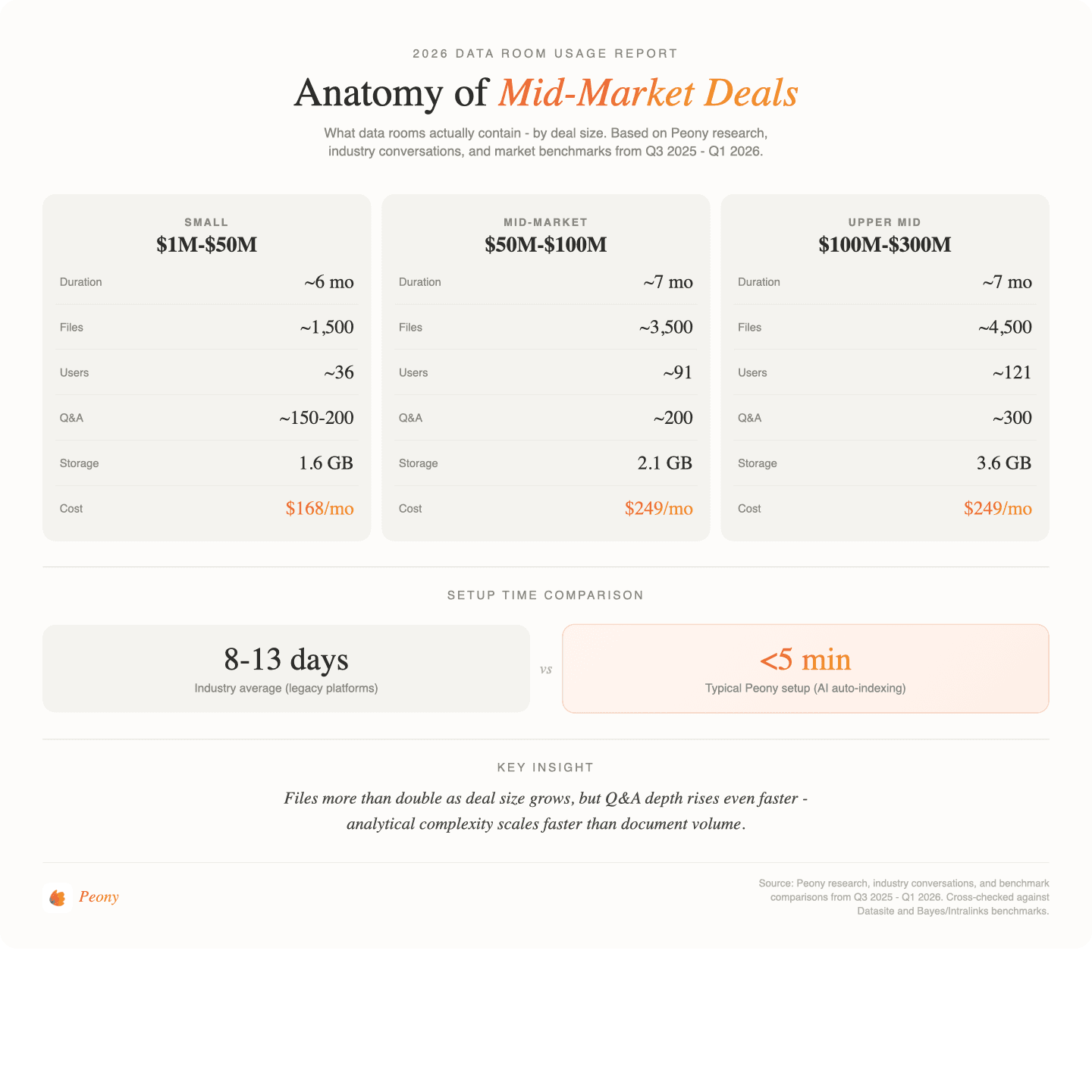
The following table breaks down every metric by deal bracket. These are rounded benchmarks derived from 283 transactions on the Peony platform (Q3 2025 - Q1 2026), cross-validated against published industry data.
| Metric | $1M-$50M | $50M-$100M | $100M-$300M |
|---|---|---|---|
| Deal duration | ~6 months | ~7 months | ~7 months |
| Users per room | ~35 | ~90 | ~120 |
| Files per deal | ~1,500 | ~3,500 | ~4,500 |
| Storage per deal | ~1.5 GB | ~2 GB | ~2.5-3.5 GB |
| Q&A questions | ~150-200 | ~200 | ~300 |
| Avg Peony cost | $168/mo | — | — |
| Avg Peony cost (all) | — | $249/mo | $249/mo |
Industry benchmark validation:
| Metric | Peony Research | Industry benchmark | Source |
|---|---|---|---|
| Deal duration | ~6-7 months | ~6 months VDR-to-close; ~200 days avg | Datasite; Bayes/Intralinks |
| Files per deal | ~1,500-4,500 | 7,583 files (private targets, all sizes) | Intralinks |
| Users per room | ~35-120 | 271 avg (all deal sizes) | Bayes/Intralinks |
| Q&A volume | ~150-300 | 200-400 structured questions | Bayes/Intralinks |
| Setup time | Under 5 min | 8-13 days (industry estimates) | Peony market research |
Three observations from the validation:
Files and users are lower than all-size industry averages — and that is expected. Intralinks reports 7,583 files for private targets across all deal sizes, but that includes $500M+ transactions with 200+ reviewers. Our 283-deal dataset covers $1M-$300M transactions where roughly 35 to 120 users and about 1,500 to 4,500 files are appropriate for the buyer pool size and regulatory scope.
Both dimensions scale, but analytical depth scales faster. Files more than double between the first two brackets, then keep rising in the $100M-$300M bracket. Q&A volume climbs from roughly 200 to roughly 300 over the same range. Both document volume and analytical depth increase with deal size, but the diligence complexity increasingly shifts toward analytical rigor rather than document volume. A PE fund running a $120M platform acquisition uploads more documents than a $60M add-on, but the bigger difference is in the depth and specificity of the questions those documents generate.
Setup time is where the gap is most dramatic. Industry estimates of 8 to 13 days reflect legacy onboarding: sales calls, contract negotiation, project manager assignment, and manual folder configuration. I built Peony's AI auto-indexing specifically to collapse that timeline. Upload your documents, AI sorts them into a deal-ready folder structure in minutes, and your room is live. In practice, the process is typically under 5 minutes from upload start to fully indexed.
Storage by Deal Size
Storage requirements scale more linearly than file counts — because larger deals include more high-resolution files, scanned documents, and multimedia exhibits.
| Deal Size | Avg Storage |
|---|---|
| $1M-$50M | ~1.5 GB |
| $50M-$100M | ~2 GB |
| $100M-$200M | ~2.5 GB |
| $200M-$300M | ~3.5 GB |
A $10M asset sale with straightforward corporate documents will likely need under 500 MB. A PE fund running a $150M carve-out with environmental reports, facility blueprints, and scanned employment contracts will often land around the 2.5 GB mark. Neither volume requires the 5-10 GB storage tiers that legacy platforms charge $75-$300 per GB to exceed.
Peony includes unlimited storage on all plans — Business ($40/admin/month), Pro ($20/admin/month), and Free. No per-GB charges, no overage fees.
Regional Differences
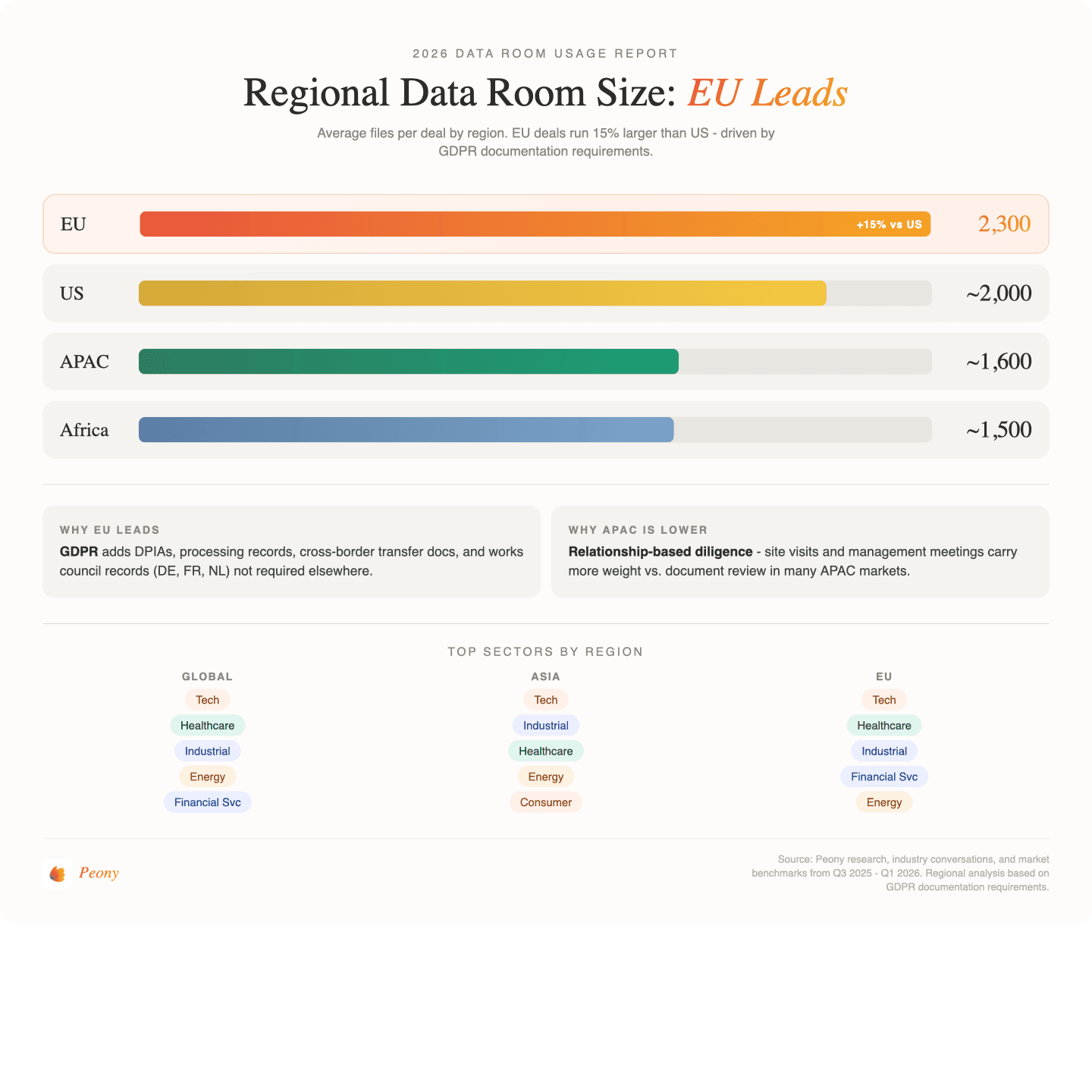
EU deals consistently produce more documentation than any other region. The driver is regulatory compliance, not deal complexity.
| Region | Avg Files per Deal |
|---|---|
| EU | ~2,300 |
| US | ~2,000 |
| APAC | ~1,600 |
| Africa | ~1,500 |
Why EU leads at ~2,300 files: GDPR alone adds data processing agreements, records of processing activities, data protection impact assessments, and cross-border transfer documentation. Layer on works council consultation records (Germany, France, Netherlands), tax residency certificates for multi-jurisdiction structures, and EU competition law filings, and you get roughly a 15% file premium over US deals of comparable size.
Why APAC and Africa are lower: Younger regulatory frameworks mean fewer mandatory compliance documents. APAC deals also tend to involve more relationship-based diligence — in-person site visits and management presentations carry more weight relative to document review. Africa's lower average reflects both smaller typical deal sizes in the market patterns reviewed and less mature regulatory documentation requirements.
Sector variation by region: Asia swaps the global sector ranking — Industrial moves ahead of Healthcare, and Consumer replaces Financial Services in the top five. EU swaps Financial Services with Energy, reflecting the concentration of banking M&A and fintech consolidation in London, Frankfurt, and Amsterdam.
An M&A advisor structuring a cross-border EU acquisition should budget for 15-20% more documentation than a comparable US deal — and choose a data room with AI auto-indexing that handles multilingual document sets without manual folder configuration.
Sector Breakdown
The top five sectors across our 283-deal dataset:
- Technology — largest share across all regions
- Healthcare — strong in US and EU, third in Asia
- Industrial — second in Asia, third globally
- Energy — stronger in EU than US
- Financial Services — stronger in US than EU
This aligns with Grand View Research and Datasite's published sector breakdowns. The technology dominance reflects both the absolute volume of tech M&A and the higher adoption rate of modern VDR platforms among tech-native deal teams. Healthcare's position reflects the sustained pace of pharma-biotech acquisitions and clinical-stage company transactions.
Feature Adoption: What Deal Teams Actually Use
Across 283 transactions on the Peony platform, the most-used features ranked by adoption rate:
- Structured Q&A — used in nearly every deal with counterparty interaction
- Document indexing — either AI-powered or manual folder organization
- NDA gating — requiring signed agreements before document access
- Redaction — removing PII and sensitive data before sharing
- AI-enabled Q&A and diligence tracking — AI-drafted responses, engagement analytics
The pattern is clear: deal teams prioritize organized documents, controlled access, and efficient counterparty communication. The features that dominate VDR marketing — AI bidder scoring, blockchain audit trails, AI-adaptive DRM — see minimal real-world adoption in the $1M-$300M segment.
For a PE fund running sub-$100M add-on acquisitions, structured Q&A and NDA gating are non-negotiable. A sell-side advisor managing a competitive process needs page-level analytics to see which buyers are doing real diligence. A mid-market banker running 6 concurrent mandates needs clean indexing so each data room is audit-ready on day one.
Peony Business ($40/admin/month) includes all five top-adopted features plus screenshot protection and dynamic watermarks — the entire security and workflow stack that repeatedly shows up in real deal workflows.
Cost Comparison: Peony vs. Industry
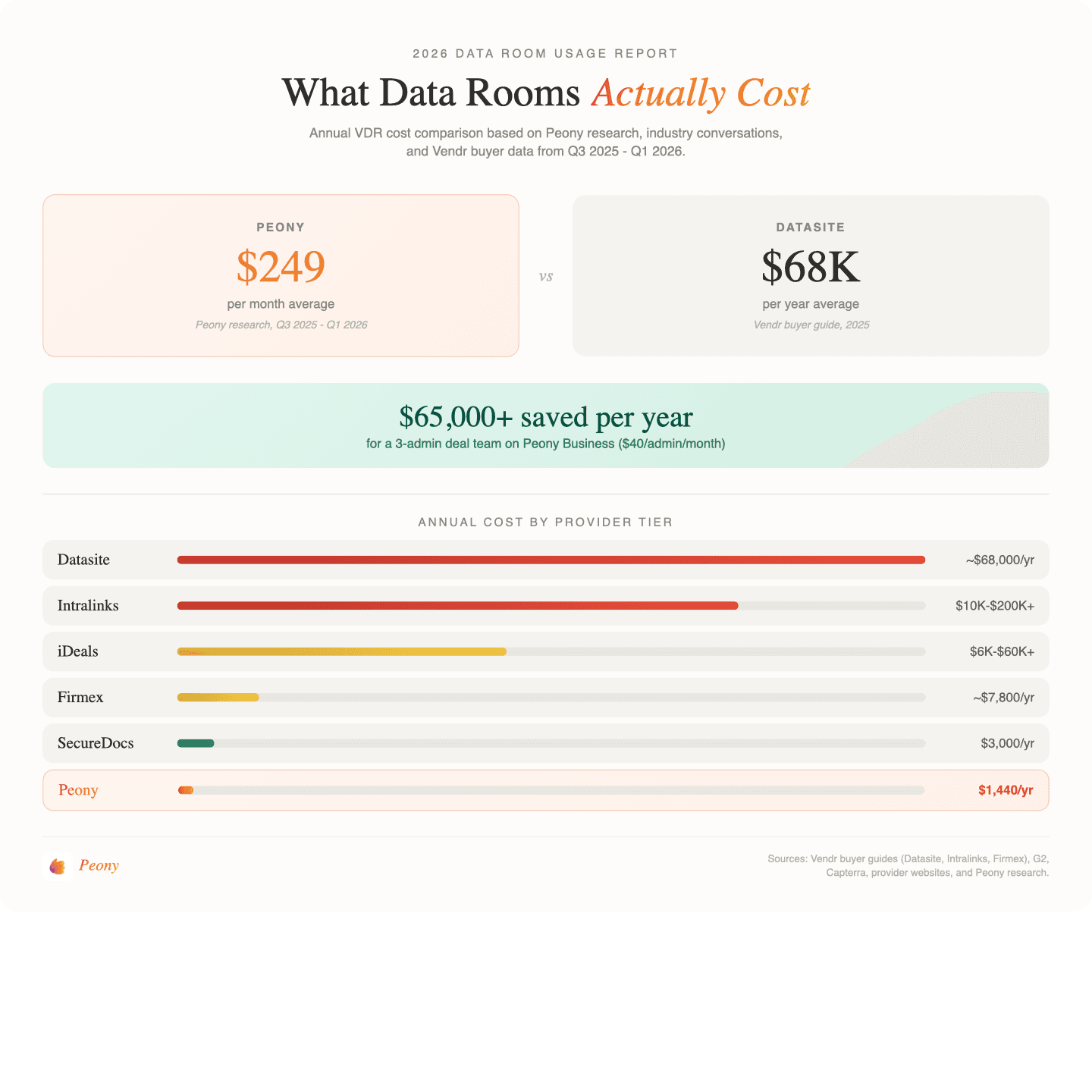
This is the section every deal team reading this report cares about most. Here is what data rooms actually cost, organized by market tier.
Peony Cost Data (283 transactions, Q3 2025 - Q1 2026)
| Deal Size | Avg Peony Cost |
|---|---|
| $1M-$50M deals | $168/month |
| All deals aggregated | $249/month |
Industry Pricing by Tier
| Tier | Provider | Typical Cost | Source |
|---|---|---|---|
| Enterprise | Datasite | ~$68K/yr avg, ~$190K max, ~$0.60/page | Vendr |
| Enterprise | Intralinks | $10K-$200K+/yr, 10% annual uplift clause | Vendr |
| Mid-market | Ansarada | $499-$2,499+/mo by storage tier | Provider docs (acquired by Datasite Aug 2024) |
| Mid-market | Firmex | ~$7,800/yr avg | Vendr |
| Mid-market | DealRoom | $7,500-$25,000/yr | Provider docs |
| Mid-market | iDeals | ~$500-$5,000+/mo est., $1K-$5K setup fees | G2, Capterra |
| SMB | SecureDocs | $250/mo annual, $400/mo quarterly | Provider docs |
| SMB | FirmRoom | $500-$3,000/mo | Provider docs |
| SMB | Digify | $180-$480/mo | Provider docs |
| Modern | Peony | $0-$40/admin/mo | Peony research |
Annual Cost Comparison for a Typical Mid-Market Deal Team
For a 3-person deal team running 4 concurrent rooms over 12 months:
| Provider | Annual Cost | Notes |
|---|---|---|
| Datasite | ~$68,000 | Custom quote; per-page fees add up on document-heavy deals |
| Intralinks | $10,000-$200,000+ | 10% annual uplift clause compounds cost each year |
| iDeals | $6,000-$60,000+ | Setup fees of $1,000-$5,000 per room add up across 4 rooms |
| Firmex | ~$7,800 | Unlimited users; solid cost-value ratio |
| Ansarada | $5,988-$29,988 | Acquired by Datasite; pricing may change |
| DealRoom | $7,500-$25,000 | M&A workflow features included |
| SecureDocs | $3,000-$4,800 | Single room; additional rooms cost extra |
| Peony Business | $1,440 | 3 admins at $40/mo; unlimited rooms, AI, Q&A included |
The Hidden Fee Problem
SRS Acquiom analyzed over 3,800 M&A deals and found:
- Actual VDR costs exceed initial quotes by 2-10x
- Over 15% of deals exceeded $50,000 in VDR costs at closing
- One documented case: $3,800 initial quote became $38,168 final invoice — a 10x overrun (justboardroom.com)
The fees that inflate costs: per-page upload charges ($0.40-$0.85/page), storage overages ($75-$300/GB/month), project extension fees when deals run past the initial term, setup and onboarding charges ($500-$2,500), and premium support tiers.
Peony eliminates all of those variables. The pricing page shows exactly what you pay: Business ($40/admin/month) for unlimited rooms, AI, and Q&A. Pro ($20/admin/month) for core features. Free ($0) to get started. No per-page fees. No storage overages. No setup charges. No surprise invoices.
How to Think About Choosing a Data Room
This decision framework uses if/then logic based on your specific deal parameters. Find your profile below.
If you are a sell-side advisor running a sub-$50M transaction: Then you need fast setup, NDA gating per buyer group, and analytics showing which bidders are doing real diligence. A sub-$50M deal will often land around 1,500 files, roughly 150 to 200 Q&A questions, and about 6 months to close. Peony users in this bracket average $168/month. Peony Business ($40/admin/month) includes NDA gates, dynamic watermarks, page-level analytics, and AI auto-indexing that gets your room live in under 5 minutes instead of the industry average of 8 days.
If you are a PE fund managing 3-8 concurrent deals between $20M and $150M: Then per-deal pricing will cost you $50,000 to $200,000 per year across your portfolio. You need unlimited rooms under one subscription, structured Q&A for each deal, and page-level analytics to monitor buyer engagement across processes. Peony Business ($40/admin/month) with unlimited rooms keeps your per-deal VDR cost under $500 per year regardless of deal volume. Keep Datasite for the one $500M+ deal per year where institutional buyers specifically require it.
If you are an M&A advisor running a competitive sell-side process: Then you need NDA gating per buyer group, dynamic watermarks that identify the source of any leak, and analytics showing which buyers are doing real diligence versus window shopping. Document volume for a $40M carve-out often lands around 1,500 files with roughly 150 to 200 Q&A questions based on our 283-deal dataset, cross-validated against published benchmarks. Peony Business includes NDA gates, dynamic watermarks, screenshot protection, and advanced Q&A where AI drafts responses and your team reviews before sending.
If you are a corporate development team acquiring a bolt-on under $10M: Then an enterprise VDR is overkill but Google Drive is not enough — you still need audit trails, structured Q&A, and document security that satisfies your board. In sub-$50M deals across our 283-transaction dataset, we see around 1.5 GB of storage and roughly 35 users. Peony Business ($40/admin/month) gives you the full security stack — NDA gates, watermarks, page-level analytics — at a fraction of what Datasite or Intralinks would charge for the same bolt-on.
If you are an independent sponsor running a deal without a fund: Then cost predictability is critical because you are paying out of pocket until the deal closes. You need the same security features as a PE fund — NDA gating, watermarks, structured Q&A — without the fund-level budget. Peony Business at $40/admin/month is $480 per year. Compare that to iDeals at $6,000+ per year or DealRoom at $7,500+. For an independent sponsor funding their own deal expenses, the 10x cost difference changes the economics of running a process.
If you are a law firm managing client transactions across multiple matters: Then you need unlimited rooms (one per client engagement), complete audit trails exportable for court proceedings, and security features that satisfy your clients' standards. Peony Business includes unlimited rooms, page-level analytics, AI Q&A with reviewed responses, NDA gates, and dynamic watermarks at $40 per admin per month — a fixed, budgetable line item instead of a variable cost that spikes with every new mandate.
If you are running deals above $500M with institutional counterparties: Then brand recognition matters. Some institutional buyers maintain internal VDR approval lists, and Datasite and Intralinks are on those lists. The security capabilities of modern platforms have closed the gap, but counterparty requirements are counterparty requirements. Use an enterprise VDR for the $500M+ transaction and Peony for everything else — portfolio monitoring, LP reporting, add-on acquisitions, and sub-$300M deals.
The Bottom Line
The data room market in 2026 is bifurcated. Enterprise platforms charge $10,000 to $200,000 per year for security features that modern platforms deliver at $0 to $40 per month. Setup that took weeks now takes minutes. And the document volumes that most deals actually produce — roughly 1,500 to 4,500 files — are a fraction of what enterprise pricing models were built to handle.
The patterns in this report are drawn from 283 real transactions on a modern platform, covering $1M to $300M deals. They do not represent every deal, and I have been transparent about where this dataset diverges from all-size industry benchmarks. But for the majority of transactions that fall below $300M, they are the most current, deal-level benchmarks available — and a useful way to sanity-check what your deal team should actually expect.
If you are paying more than $500 per month for a data room on a sub-$100M deal, the data suggests you are overpaying — not by a small margin, but by an order of magnitude.
Peony Business ($40/admin/month) includes page-level analytics, AI auto-indexing, screenshot protection, and unlimited data rooms. Set up a data room in under 5 minutes and see how your deal compares to these benchmarks.
To keep your documents secure after they leave the data room, see how to protect PDF forwarding.
FAQ
We're selling a $25M manufacturing business — how many documents should we expect in the data room?
For a sub-$50M M&A transaction, data from 283 M&A transactions on the Peony platform suggests roughly 1,500 files is a reasonable planning number. A $25M manufacturing sale will likely include financial statements, equipment schedules, customer contracts, employee records, environmental compliance docs, and real estate leases — expect roughly 1,500 to 2,500 files depending on regulatory complexity. On the buy side, plan for around 150 to 200 structured Q&A questions and roughly 35 concurrent users across your advisor, counsel, and bidder groups. Peony Business ($40/admin/month) gives you page-level analytics showing which bidders spent time on your financials versus skimming the executive summary — intelligence that tells your advisor where to focus follow-up. Google Drive and Dropbox fundamentally cannot provide per-page engagement data.
Our PE fund runs 5 concurrent deals between $30M and $80M — what should our data room budget actually be?
Based on 283 transactions on the Peony platform, your deal bracket typically lands between $168 and $249 per month on Peony — that is under $3,000 per year across all 5 concurrent rooms. Compare that to the industry reality: Datasite averages approximately $68,000 per year (Vendr data), and Firmex averages approximately $7,800 per year. For a fund running 5 rooms simultaneously on per-deal pricing, you could be looking at $50,000 to $200,000 annually. Peony Business at $40 per admin per month includes unlimited rooms, so your 5 concurrent deals plus LP reporting run under one subscription with no per-room surcharges. The pricing model matters more than the provider for repeat dealmakers.
We're an M&A advisor managing a $40M carve-out — how long will due diligence realistically take?
Across 283 transactions on the Peony platform, $1M to $50M transactions often run about 6 months from data room open to close. Your $40M carve-out will likely run 5 to 7 months depending on regulatory complexity and buyer group size. Plan for around 1,500 files of documentation, roughly 150 to 200 structured Q&A questions, and about 35 concurrent users across buyer groups. The setup itself should not be a bottleneck — Peony AI auto-indexing gets your room live in under 5 minutes versus an industry average of about 8 days for sub-$50M deals. That gives your deal team about a week back to focus on preparing the CIM instead of configuring software.
Our $150M deal has around 4,500 files but only about 300 Q&A questions — does that ratio seem normal?
Yes, that is broadly in line with the benchmarks. For $100M to $300M deals, our 283-deal dataset shows roughly 4,500 files and about 300 Q&A questions — roughly 1 question for every 15 files. Both document volume and Q&A depth scale with deal size, but analytical depth tends to scale faster than document volume. Peony Advanced Q&A handles this well — counterparties submit questions, AI drafts responses with cited page numbers, and your team reviews before sending. That workflow cuts response time by roughly 30 to 50 percent on high-volume Q&A processes.
I run a European fund and our data rooms always seem larger than our US counterparts — is that normal?
Your observation matches the pattern. EU deals often land around 2,300 files versus about 2,000 in the US — roughly a 15 percent gap driven largely by GDPR and local regulatory requirements. EU transactions require additional data processing agreements, privacy impact assessments, works council documentation, and cross-border transfer mechanisms that US deals simply do not have. APAC deals tend to land around 1,600 files, and African deals around 1,500 files — reflecting younger regulatory frameworks and smaller typical deal sizes in those markets. Peony handles multilingual document sets with AI auto-indexing that recognizes folder structures across jurisdictions, and dynamic watermarks embed each reviewer's identity regardless of language.
We got quoted $3,800 for a VDR but I have heard final invoices can be 10x that — what does the data actually show?
The data supports your concern. SRS Acquiom analyzed more than 3,800 M&A deals and found actual VDR costs can exceed initial quotes by 2 to 10 times. One documented case saw an initial quote of roughly $3,800 balloon to more than $38,000. The culprits are per-page upload fees, storage overages, project extension charges when your deal slips past the initial term, and premium support add-ons. More than 15 percent of deals exceeded $50,000 in VDR costs at closing. Peony eliminates every one of those variables: $40 per admin per month for Business with no per-page fees, no storage overages, and no hidden charges. Your all-in cost is visible before you upload a single document.
I'm evaluating data rooms for a small business acquisition under $5M — is an enterprise VDR overkill?
An enterprise VDR is overkill at your deal size, but a purpose-built data room is not. In sub-$50M deals across our 283-transaction dataset, we see around 1,500 files, roughly 150 to 200 Q&A questions, about 35 users, and around 1.5 GB of storage — none of which requires enterprise-grade infrastructure priced at $25,000 or more per year. What you do need is document security (dynamic watermarks, NDA gates), structured Q&A so nothing falls through the cracks, and page-level analytics showing which sections the buyer spent time on. Peony Business at $40 per admin per month includes screenshot protection, AI auto-indexing, and advanced Q&A — the entire security stack at under 1 percent of the enterprise price. A free tier is available for basic needs.
Our team can upload documents in a day but the VDR vendor says setup takes 2 weeks — why the gap?
The gap is the vendor's onboarding process, not the technology. Legacy platforms require sales calls, contract negotiation, dedicated project manager assignment, and manual folder structure configuration — that is where the 8 to 13 days go (industry average for sub-$50M to $300M deals). The actual document upload and organization can happen in minutes with modern AI. On Peony, that process is typically under 5 minutes from upload start to a fully indexed room — covering the file upload itself plus AI auto-indexing sorting everything into a deal-ready folder structure. I built the indexing engine specifically because I watched deal teams waste entire weeks on what should be a configuration task. If your documents are ready, your data room should be live the same day.
We are comparing Peony at $249/month to Datasite at $68K/year — what are we actually giving up?
At the $1M to $300M deal range that Peony serves, you are giving up three things: Datasite's brand recognition with institutional buyers who maintain internal VDR approval lists, FedRAMP-level compliance certification for government-adjacent transactions, and dedicated project managers who will build your index for you. You are not giving up security — Peony includes AES-256 encryption, dynamic watermarks, screenshot protection, NDA gates, and complete audit trails. You are not giving up AI — Peony includes AI auto-indexing, AI Q&A with cited page numbers, and AI redaction. And you are not giving up analytics — Peony includes page-level heatmaps showing exactly which pages each reviewer read and for how long. For deals above $500M where counterparties specifically require Datasite, use Datasite. For everything else, the roughly $67,000 annual savings buys a lot of deal team bandwidth.
What features do deal teams actually use most — and which ones are just marketing?
Across 283 transactions on the Peony platform, the five most-used features in order are: structured Q&A, document indexing, NDA gating, redaction, and AI-enabled diligence tracking. Notice what is missing from the top five: AI bidder scoring, blockchain audit trails, and AI-adaptive DRM — features that dominate marketing pages but see minimal real-world adoption. Deal teams care about organized documents, secure access, and efficient communication with counterparties. Everything else is secondary. Peony includes all five top-adopted features on the Business plan ($40/admin/month), plus AI auto-indexing that eliminates the manual indexing step entirely. The features that matter are the ones your deal team will use every day, not the ones that sound impressive in a vendor demo.
Related Resources
- How to Spot Serious M&A Buyers Using Data Room Analytics — 4-Signal Scoring Stack — sell-side buyer-scoring framework built on the same 283-deal Peony platform benchmark
- 15 Best Data Rooms ($0 to $200K Gap) in 2026
- Virtual Data Room Cost Guide: Pricing Models Compared
- 8 Data Room Trends Reshaping Deals in 2026
- Best Data Rooms for Private Equity
- Best M&A Data Rooms
- Due Diligence Data Room Checklist
- Data Room Folder Structure Guide
- Independent Sponsor Guide
- How to Prevent PDF Forwarding
- What Is a Virtual Data Room?
You might also like
Apr 10, 2026
I Tested 10 PE Data Rooms (What Deal Teams Actually Need) in 2026
May 26, 2026
Virtual Data Room vs SharePoint: Why Deal Teams Are Migrating in 2026
May 22, 2026
What Is Firmex Virtual Data Room? Founding, Datasite Acquisition, Q&A Workflow, and 2026 Pricing — A Buyer's Explainer