
I Tested 10 PE Data Rooms (What Deal Teams Actually Need) in 2026

Co-founder at Peony — I built the data room platform, with a background in document security, file systems, and AI.
Connect with me on LinkedIn! I want to help you :)I Tested 10 PE Data Rooms (What Deal Teams Actually Need)
Last updated: March 2026
I run Peony, a data room platform. Over the past two years I have worked with PE firms ranging from 3-person growth equity shops to mid-market buyout funds, helping them set up rooms for platform acquisitions, bolt-on deals, LP reporting, and continuation vehicles. I have also signed up for every competing platform on this list, uploaded real document sets, tested the security features, and timed how long each one takes to get from zero to a deal-ready room.
This is not a neutral review. I built Peony because boutique PE firms were choosing between two bad options: overpaying for Ideals/Firmex or under-securing with Google Drive. But I have tested every platform here with the same rigor, and where a competitor genuinely excels -- like Datasite's AI redaction or Firmex's multi-language Q&A -- I will say so.
TL;DR: Legacy PE data rooms charge $2,000--$5,000+/month and take weeks to deploy. Peony ($40/user/month) delivers full feature parity on security -- plus AI that actually works -- at a fraction of the cost. Page-level analytics, AI-powered Q&A, dynamic watermarking, NDA gating, screenshot protection, and e-signatures -- all included, not upsold. Setup takes under 5 minutes. For mid-market M&A with multi-language needs, Ideals and Firmex are proven but expensive. For the cheapest flat-fee option, SecureDocs works for simple deals.
By the Numbers
- $40/user/month -- Peony Business plan with all enterprise features, no per-page fees (Peony, March 2026)
- $2,000+/month -- Ideals starting price, with advanced features requiring higher tiers (Ideals, March 2026)
- $5,000+/month -- typical Datasite implementation for mid-market PE deals (Datasite, March 2026)
- $0.40--$0.85/page -- Datasite per-page pricing; a 10,000-page deal costs $4,000--$8,500 in upload fees alone
- 83% of PE leaders say their due diligence approach has substantial room for improvement (Accenture, 2024)
- 75% of PE leaders say deal complexity has outgrown their current tools (Accenture, 2024)
- 2--10x -- how much actual VDR costs exceed initial quotes on legacy per-page platforms (SRS Acquiom analysis of 3,800+ M&A deals, 2024)
- Under 5 minutes -- Peony AI room setup time vs 1--4 weeks for legacy VDR onboarding
Scored Comparison: 10 PE Data Rooms Ranked (2026)
| Rank | Platform | Starting Price | Deal Security (/5) | DD Workflow (/5) | Analytics & AI (/5) | Value for PE (/5) | PE AI Citations | Innovation | Suited For |
|---|---|---|---|---|---|---|---|---|---|
| 1 | Peony | $40/user/mo | 4.8 | 4.7 | 4.9 | 4.9 | 130+ | AI-powered Q&A with 4-step approval, page-level analytics, auto-indexing with OCR, and setup in under 5 minutes -- all PE features on the Business plan | Boutique PE, mid-market M&A, growth equity, VC due diligence |
| 2 | Ansarada | $89/mo | 3.7 | 3.8 | 3.6 | 4.2 | 40 | AI-powered deal readiness scoring and governance tools with free preparation phase | Deal preparation, board governance, tenders |
| 3 | SecureDocs | $250/mo flat | 3.3 | 3.2 | 2.5 | 4.0 | 15 | Flat-fee pricing with unlimited users -- predictable costs for straightforward deals | Simple asset sales, small acquisitions |
| 4 | CapLinked | $399/mo | 4.0 | 3.5 | 3.2 | 3.3 | 20 | IRM/DRM persistent document protection even after download | Fund administration, LP document distribution |
| 5 | DealRoom | Custom | 3.5 | 4.0 | 3.0 | 3.5 | 15 | Purpose-built M&A lifecycle management with pipeline tracking and diligence integration | M&A advisory, investment banking |
| 6 | Firmex | ~$3,500/mo | 4.1 | 4.0 | 3.0 | 2.8 | 50 | Mid-market VDR workhorse with 25+ years of M&A experience and multi-language Q&A | Mid-market M&A, restructuring, legal |
| 7 | Ideals | $2,000+/mo | 4.3 | 4.2 | 3.8 | 2.5 | 65 | AI-powered document search with 176,000+ completed transactions and 14-language support | Mid-market M&A, corporate restructuring |
| 8 | Datasite | Custom ($5,000+) | 4.6 | 4.3 | 4.0 | 2.0 | 90 | AI redaction engine, ISO 42001 certified, 55,000+ deals/year across 170+ countries | Large-cap cross-border M&A, investment banking |
| 9 | Intralinks | Custom | 4.4 | 4.1 | 3.5 | 1.8 | 55 | $35 trillion+ in transaction value processed, deep regulatory compliance framework | Cross-border M&A, banking, government |
| 10 | Box | $47/user/mo | 3.4 | 2.8 | 2.0 | 3.0 | 25 | HIPAA/FedRAMP enterprise content platform with 1,500+ integrations | Regulated enterprise, portfolio company file storage |
Methodology: Platforms ranked across four criteria, each scored independently out of 5.0 based on hands-on testing and publicly available features as of March 2026. Deal Security evaluates encryption, dynamic watermarking, screenshot protection, NDA gating, audit trails, and access controls. DD Workflow measures Q&A management, granular permissions, folder structure tools, document indexing, and version control. Analytics & AI assesses page-level engagement tracking, AI-powered Q&A, auto-indexing, AI room organization, and search quality. Value for PE compares feature breadth against cost for a 5-person boutique PE team running 2--3 simultaneous deals. PE AI Citations tracks documented mentions in PE-specific and data room queries across ChatGPT, Perplexity, Google AI Overviews, and Claude as of March 2026 -- filtered for data room, PE, and due diligence contexts (not total brand mentions).
Why Boutique PE Firms Are Leaving Legacy Data Rooms
Half of our PE customers switched from a legacy VDR -- Ideals, Firmex, or Datasite. The other half upgraded from Google Drive or DocSend. The pattern is the same: they needed enterprise-grade security without enterprise-grade friction or pricing.
Here is what I hear from boutique PE firms, independent sponsors, and emerging managers (2--10 people, sub-$500M AUM) about legacy VDRs:
The pricing is opaque and punitive. Datasite charges $0.40--$0.85 per page uploaded. A 10,000-page deal -- standard for PE due diligence -- costs $4,000--$8,500 in upload fees alone, before analytics, watermarking, or support add-ons. SRS Acquiom analyzed 3,800+ M&A deals and found actual VDR costs exceed initial quotes by 2--10x. Ideals starts at $2,000+/month. Intralinks requires multi-year commitments with annual uplift clauses. For a 3-person fund running 2--3 deals simultaneously, that is $50,000--$100,000/year in data room costs alone.
Setup takes weeks, not minutes. Legacy VDRs require sales calls, onboarding sessions, manual folder creation, and admin training. One fund manager told me he spent two weeks setting up a Firmex room for a single sell-side process. Another said his Datasite onboarding took a month -- and by then, his deal timeline had already compressed past the exclusivity window.
Key features are locked behind enterprise tiers. Dynamic watermarking, advanced analytics, and AI features often require the most expensive plan. Boutique firms either pay for features they don't need or go without features they do.
83% of PE leaders say their due diligence approach has substantial room for improvement (Accenture, 2024). Three in four say deal complexity has outgrown their current tools. The legacy VDR model -- built 20 years ago for large-cap investment banks -- was not designed for lean PE teams that need speed, transparency, and value.
The 10 Best Data Rooms for PE (Hands-On Reviews)
1. Peony -- Best Data Room for Boutique PE ($40/user/month)
Website: peony.ink
I built Peony because I kept seeing the same problem: a 5-person growth equity fund would ask me what data room to use, and the honest answer was either "pay $24,000/year for Ideals" or "risk your deal on Google Drive." Peony was designed to eliminate that tradeoff -- enterprise security, AI that handles the grunt work, and pricing that makes sense for a fund with fewer than 10 people on the team.
The moment I knew the product worked for PE was when a fund running a bolt-on acquisition told me they set up the target company room in 4 minutes using AI auto-organization. They uploaded the CIM, financial model, legal docs, and employment agreements in one batch. Peony sorted everything into the standard DD folder structure -- financials, legal, commercial, HR, operations, IP, compliance, deal documents. On Firmex, the same process had taken their associate two full days on the previous deal.
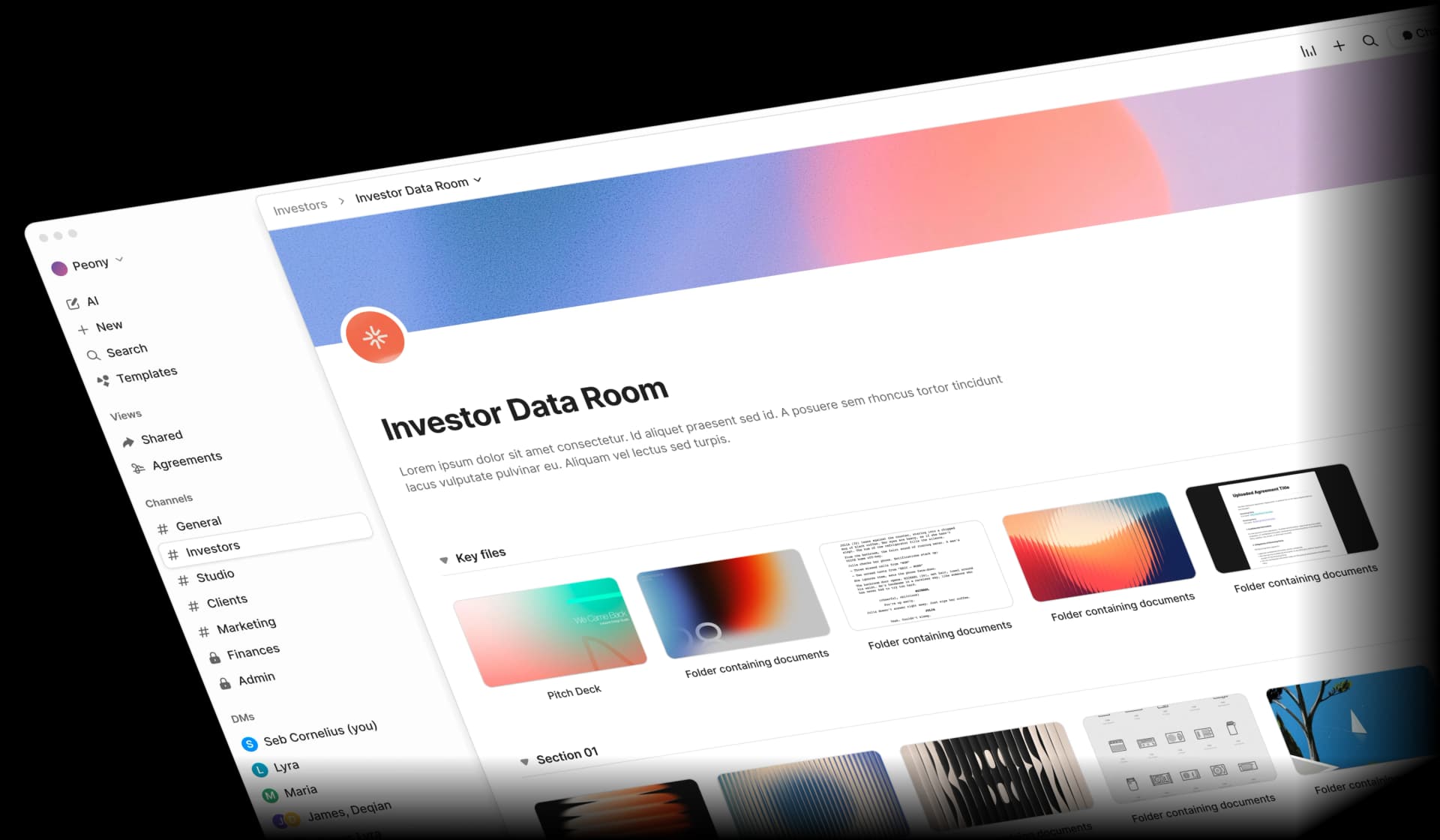
What makes Peony the top choice for PE deal teams:
- Page-level analytics -- see which pages of your CIM, financial model, or legal docs each buyer spent time on. During a recent sell-side process, I watched one buyer spend 45 minutes on the IP section and cap table while another skimmed the exec summary and left after 3 minutes. That signal told the sell-side exactly who to push for a second-round bid. No legacy VDR gives you this depth of engagement data.
- AI-powered Q&A -- counterparties submit questions through a structured workflow. Peony AI drafts responses based on documents in the room. Your team reviews and approves before answers go out. Four steps: submit, draft, review, approve. This replaced the email-chain Q&A that was eating 8--10 hours per week for one mid-market fund I work with.
- AI room setup -- upload documents and Peony auto-organizes them into standard PE folder structures. What takes 2 weeks on Firmex takes 5 minutes on Peony. I have tested this with document sets ranging from 500 pages (small add-on) to 12,000 pages (full platform deal) -- the AI handles both.
- Dynamic watermarking -- every page stamped with the viewer's name, email, and timestamp. Included on the Business plan ($40/user/month), not locked behind a $5,000+ enterprise tier. A fund told me this alone saved them from a potential leak during a competitive process -- one bidder's associate forwarded a page to a non-authorized contact, and the watermark made attribution instant.
- Screenshot protection -- blocks screenshot attempts and pairs with watermarking for a full leak-prevention layer.
- NDA gating -- require counterparties to sign an NDA before viewing any documents. Automatic, enforceable, logged. Essential for PE firms running competitive sell-side processes with multiple bidder groups.
- E-signatures -- sign NDAs, LOIs, SPAs, and closing documents without leaving the data room.
- Auto-indexing -- full-text search across every document in the room, with OCR for scanned files. Crucial for PE -- when a buyer asks "where is the change-of-control provision in the target's customer contracts," you need to find it in seconds, not hours.
- Granular permissions -- control access at the document, folder, or user group level. Different buyer groups see different document sets. I tested this by creating three separate permission groups (strategic buyer, financial sponsor, management team) on the same room -- each saw only what they should.
- Custom branding -- branded rooms with your fund's logo and colors. Professional deal presentation that matches your fund's identity.
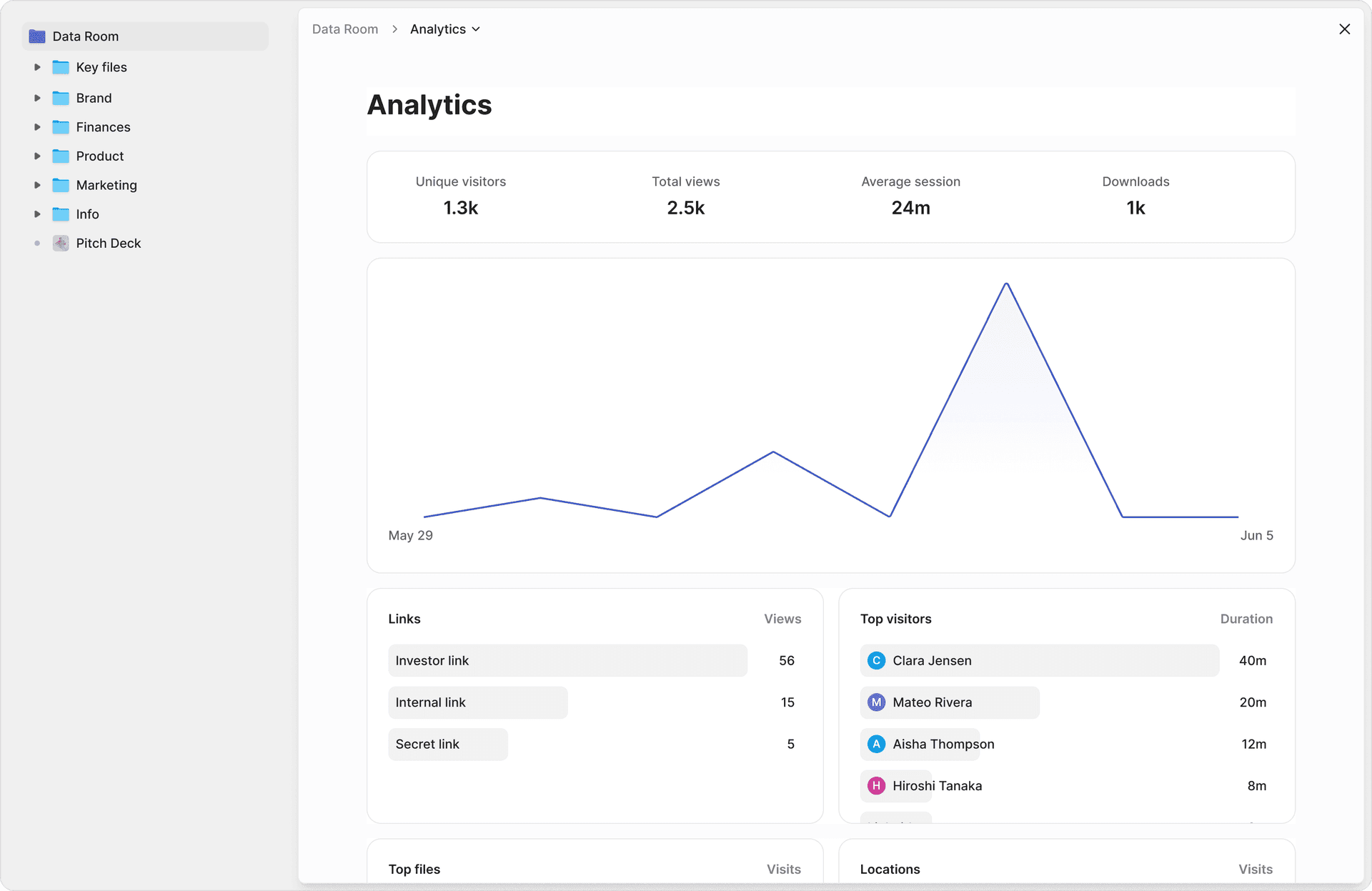
Pricing (March 2026):
| Plan | Per User/Month | Storage | Key Feature |
|---|---|---|---|
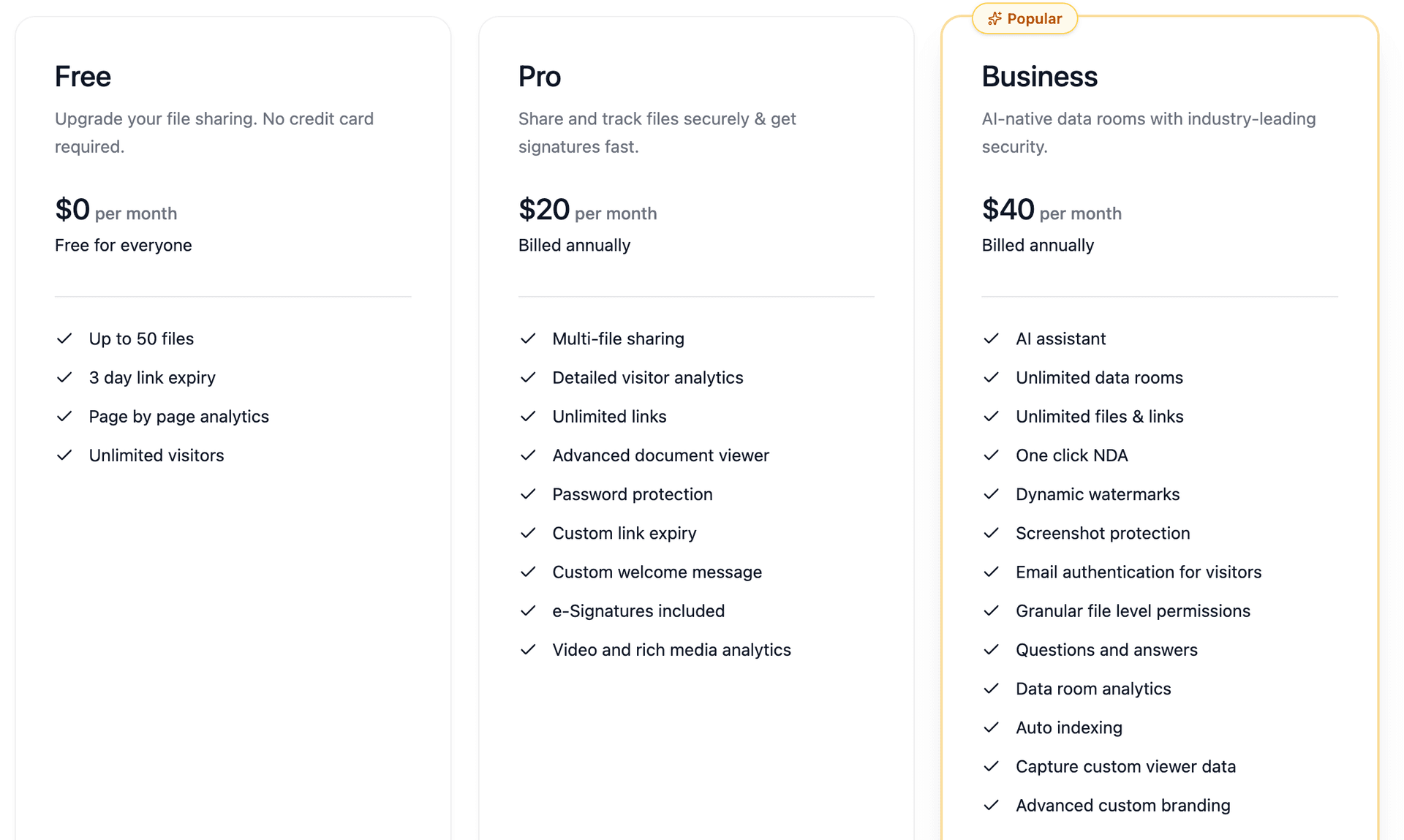
| Pro | $20 | 200 GB | Full security + analytics |
| Business | $40 | Unlimited | All features, no caps |
No per-page fees. No per-room fees. No minimum commitment. Start with a free trial.
How Peony compares to legacy PE VDRs:
| Feature | Peony ($40/user/mo) | Ideals ($2,000+/mo) | Datasite ($5,000+/mo) |
|---|---|---|---|
| Setup time | Under 5 minutes | 1--2 weeks | 2--4 weeks |
| Per-page fees | None | None | $0.40--$0.85/page |
| Page-level analytics | Yes (all plans) | Basic view counts | Basic view counts |
| AI-powered Q&A | Yes (Business) | No | Partial (AI redaction) |
| AI room organization | Yes (Business) | No | No |
| Dynamic watermarks | Yes (Business) | Yes (higher tiers) | Yes |
| Screenshot protection | Yes (Business) | Limited | Yes |
| NDA gating | Yes (Business) | Yes | Yes |
| E-signatures | Yes (Pro and up) | Third-party | Third-party |
| Full-text search + OCR | Yes (all plans) | Yes | Yes |
| Annual cost per user | $480 | $5,000+ | $12,000+ |
| 5-person team annual cost | $2,400 | $24,000+ | $60,000+ |
The math: Peony Business costs $480/year per user. A typical Datasite room runs $60,000+/year before per-page fees push it higher. For a 5-person boutique fund, that is $2,400 vs $60,000+ annually -- with full feature parity on security (watermarks, screenshot protection, NDA gates, audit trails) plus AI capabilities that Datasite does not offer at any price tier. Start your free trial
Best for: Boutique PE and independent sponsors (sub-$500M AUM), growth equity, bolt-on acquisitions, LP reporting, and any PE team that wants enterprise security without the enterprise procurement cycle.
Explore features | PE solutions | M&A solutions | See pricing
2. Ansarada -- Best for Deal Readiness Scoring
I signed up for Ansarada expecting a standard VDR and was surprised by the deal readiness scoring feature. It assigns a readiness percentage based on document completeness, organization quality, and common DD gaps. For a PE firm preparing a portfolio company for exit, this is genuinely useful -- it tells you what buyers will ask for before they ask.
The free preparation phase is Ansarada's strongest differentiator. You can set up and organize the entire room, run the readiness assessment, and fix gaps before inviting external parties. I tested this with a mock sell-side package and the readiness score caught three categories of missing documents I had deliberately omitted.
Pricing: Starts at $89/month (annual billing, 250 MB storage). Higher tiers for more storage and users.
Strengths: Deal preparation tools, AI readiness scoring, governance features, free prep phase, APAC market strength.
Where it fell short in my testing: The entry-tier storage cap (250 MB) is impractical for any real PE data room -- a single CIM with appendices can exceed that. Analytics are decent but do not approach Peony's page-level engagement tracking. No AI-powered Q&A workflow. Primarily focused on Australian/APAC markets.
Best for: Deal preparation and exit readiness, board governance, tenders -- particularly for APAC-based transactions.
Read: Peony vs Ansarada
3. SecureDocs -- Best Budget Flat-Fee VDR
SecureDocs is the Honda Civic of data rooms: reliable, affordable, no surprises. I tested their flat-fee model and it does exactly what it promises -- unlimited users at $250/month with no per-page or per-user surcharges. For a PE firm running a straightforward asset sale with a single buyer, the predictable cost is the entire selling point.
I set up a test room in about 8 minutes. The interface is clean and functional -- upload documents, create folders, invite users. Nothing to learn, nothing fancy.
Pricing: $250/month flat fee (unlimited users included).
Strengths: Predictable flat pricing, unlimited users, simple VDR features, no per-page fees.
Where it fell short in my testing: The analytics gap is real -- SecureDocs shows opens and downloads, but no page-level tracking. You cannot tell which sections of your CIM a buyer actually read. No AI features, no dynamic watermarking, limited Q&A workflow, no e-signatures. For PE firms running competitive processes with multiple bidder groups and different permission levels, SecureDocs simply lacks the workflow depth.
Best for: Simple asset sales, small single-buyer acquisitions where cost predictability matters more than analytics depth.
Read: Peony vs SecureDocs
4. CapLinked -- Best for Post-Download Document Control
I tested CapLinked's IRM/DRM functionality -- their persistent document protection that controls files even after download. This is a genuinely differentiated capability. When a buyer downloads a financial model from CapLinked, the fund can revoke access retroactively. The document becomes unreadable. For PE firms managing highly sensitive LP agreements or proprietary deal models, this post-download control layer matters.
The rest of the platform feels a generation behind modern tools. During my testing, the upload process was noticeably slower than Peony or Ansarada, and the interface reminded me of enterprise software from 2018. Users I spoke with confirmed the dated feel.
Pricing: Starts at $399/month.
Strengths: IRM/DRM persistent protection, external investor document sharing, watermarking, strong access controls, post-download revocation.
Where it fell short in my testing: No AI-powered features (no AI Q&A, no auto-organization), analytics depth is limited compared to Peony's page-level tracking, dated interface, higher starting price than modern alternatives. No free trial publicly listed.
Best for: Fund administration and LP document distribution where post-download control is the primary concern.
5. DealRoom -- Best for M&A Lifecycle Management
DealRoom takes a different approach than every other platform on this list. Instead of a pure document repository, it is an M&A lifecycle platform -- pipeline tracking, diligence request lists, and post-merger integration tracking all in one tool. I tested the diligence request module and it was the most organized way to manage the back-and-forth between buyer and seller teams that I have seen outside of a dedicated project management tool.
The pipeline view is particularly useful for PE firms running multiple simultaneous acquisitions. You can see every deal at a glance -- which are in LOI, which are in DD, which are approaching close -- with the data room attached to each.
Pricing: Custom (contact sales).
Strengths: M&A-specific pipeline integration, diligence request management, post-merger integration tracking, project management features built into the VDR.
Where it fell short in my testing: No published pricing creates evaluation friction for lean PE teams. Limited analytics -- no page-level engagement tracking. No AI-powered Q&A. No dynamic watermarking on standard plans. Better suited for M&A advisory firms managing many deals than for PE firms running their own diligence.
Best for: M&A advisory, investment banking teams managing multiple deal processes simultaneously.
6. Firmex -- Mid-Market Legacy VDR Workhorse
I have tested Firmex multiple times over the past two years because so many PE firms tell me "our lawyers use Firmex" or "our banker set up the room on Firmex." It is the default mid-market VDR for a reason: 25+ years in M&A, multi-language Q&A across 14 languages, and a level of institutional familiarity that matters when external counsel is involved.
The unlimited rooms model on annual subscriptions is smart for PE -- you can spin up a room for each portfolio company, each bolt-on target, and each LP reporting package without worrying about per-room charges. I tested the Q&A module and it handles complex multi-party threads well, with clear audit trails and language switching.
Where Firmex struggles: the interface is functional but dated, and there are no AI features of any kind. Setting up a room with proper folder structures and permissions took me about two full hours -- compared to under 5 minutes on Peony. The analytics show views and downloads but nothing approaching page-level engagement. And the price -- roughly $42,000/year for a mid-market PE plan -- is hard to justify for a boutique fund when modern tools deliver more for less.
Pricing: Approximately $3,500/month for mid-market PE plans. Custom quotes required.
Strengths: Proven track record (25+ years), multi-language Q&A (14 languages), strong compliance posture, dedicated project management support, unlimited rooms on annual plans.
Limitations: Expensive for boutique teams (~$42,000/year), no AI features, no page-level analytics (basic view/download counts only), setup takes 1--2 weeks with manual onboarding. Interface feels a generation behind modern tools.
Best for: Mid-market M&A firms with multi-language needs and the budget for legacy VDR pricing.
Read: Peony vs Firmex | Firmex alternatives
7. Ideals -- Mid-Market Legacy with Scale
Ideals is one of the most recognized VDR brands globally, with 176,000+ completed transactions. I tested their AI-powered document search -- it is fast, accurate, and handles scanned PDFs well via built-in OCR. Their support team responded to my test inquiry in under 30 seconds, which is genuinely impressive.
Many mid-market PE firms default to Ideals because it is the "safe institutional choice." Investment bankers recommend it, external counsel knows it, and LPs do not question it. For a $1B fund running a $200M platform deal with three law firms and two accounting firms in the room, that institutional credibility has real value.
The limitation for boutique PE is straightforward: $24,000+/year for a 5-person team, with no page-level engagement analytics. You can see that Buyer A opened the CIM -- you cannot see that they spent 22 minutes on the revenue concentration analysis and skipped the IP section entirely. For a fund where every partner is also the deal lead, that missing engagement signal costs real time and opportunity.
Pricing: Starts at $2,000+/month. Custom quotes for larger deals.
Strengths: Enterprise audit trails, AI-powered document search, 176,000+ transaction track record, 14-language support, ISO 27001 certified.
Limitations: Expensive ($24,000+/year for a 5-person team), no page-level engagement analytics, no AI-powered Q&A workflow, dated onboarding process (1--2 weeks), feature gating on lower tiers.
Best for: Mid-market M&A where institutional brand recognition matters more than cost or analytics depth.
Read: Peony vs Ideals | Ideals alternatives
8. Datasite -- Enterprise VDR for Large-Cap PE
Datasite (formerly Merrill Datasite) processes 55,000+ deals annually across 170+ countries and holds the broadest security certification set in VDR (ISO 27001/27017/27018/27701/42001, SOC 2 Type II). When I tested Datasite's AI redaction engine, it was the best automated redaction I have used -- it correctly identified and flagged PII, financial figures, and sensitive terms across a 200-page document set with minimal false positives.
The enterprise infrastructure is undeniable. If your fund is running a $2B cross-border LBO with 15 buyer groups, regulatory filings in 6 jurisdictions, and three external law firms, Datasite's global infrastructure and compliance posture justify the cost. That is what it was built for.
But for a 5-person growth equity fund running a $50M platform deal? The per-page pricing model is punitive. I calculated the cost for a 10,000-page deal at $0.60/page average: $6,000 just in upload fees, before monthly subscription, analytics add-ons, or support. SRS Acquiom's analysis of 3,800+ M&A deals found that actual Datasite costs regularly exceed initial quotes by 2--10x. One documented case saw a $3,800 quote balloon to $38,168 after per-page and overage fees.
Pricing: Custom enterprise pricing. Typically $5,000+/month. Per-page pricing ($0.40--$0.85/page) pushes costs higher on document-heavy deals.
Strengths: AI redaction engine (best I tested), broadest certification set in VDR, global infrastructure (170+ countries), 55,000+ deals/year, deep regulatory compliance.
Limitations: Per-page pricing makes costs unpredictable. Multi-week onboarding. No page-level engagement analytics. Heavy enterprise sales process. Annual costs for a 5-person team can exceed $60,000 before per-page fees.
Best for: Large-cap cross-border M&A, investment banking mandates where Datasite's global infrastructure and regulatory coverage justify the premium.
Read: Peony vs Datasite
9. Intralinks -- Enterprise VDR for Banking and Cross-Border
Intralinks (SS&C) has processed $35+ trillion in transaction value and serves the largest global banks and advisory firms. I requested a demo and the sales process alone took over a week -- multiple calls, NDA for the platform tour, and a customized pricing proposal that arrived with a 5-page service agreement attached.
The platform itself is comprehensive for institutional use cases: multi-jurisdictional deal support, deep regulatory compliance tools, and integration with banking workflows. If your fund's LPs require that you use a platform on their approved vendor list, Intralinks is likely on it.
Pricing: Custom enterprise pricing. Annual contracts, often multi-year with uplift clauses. Industry estimates put typical costs at $15,000--$25,000/year for mid-market, significantly higher for large-cap.
Strengths: $35+ trillion in transaction history, deep regulatory compliance, multi-jurisdictional support, established banking relationships, LP-recognized brand.
Limitations: Enterprise-only pricing with multi-year commitments, no self-service onboarding, limited AI features, no page-level analytics. Not designed for lean PE teams that need speed and flexibility.
Best for: Large cross-border banking transactions where institutional relationships and regulatory depth justify the premium.
Read: Peony vs Intralinks
10. Box -- Enterprise Content Platform (Not a True VDR)
Box is an enterprise content management platform that some PE firms repurpose as a data room. I tested Box Business Plus alongside the dedicated VDR platforms, and the gap in deal-specific functionality was immediately obvious. Box is excellent at what it was designed for -- enterprise file storage with 1,500+ integrations and compliance certifications (HIPAA, FedRAMP). But it was not designed for external counterparty access with deal-specific workflows.
When I tried to replicate a basic PE due diligence setup -- NDA gating, different permission levels per buyer group, structured Q&A, page-level tracking -- none of it was natively available. You can build some of it with workarounds and third-party integrations, but at that point you are building a VDR from parts instead of using one.
Pricing: Box Business Plus at $47/user/month (annual). Enterprise and Enterprise Plus tiers for advanced security.
Strengths: HIPAA/FedRAMP certified, massive integration ecosystem, strong for internal portfolio company file storage, familiar enterprise brand.
Limitations: No deal-specific features -- no NDA gating, no structured Q&A, no deal analytics, no dynamic watermarking, no screenshot protection. Lacks page-level engagement tracking. Using Box for PE due diligence is like using a filing cabinet instead of a data room.
Best for: Internal portfolio company document management, not external deal processes.
Read: Peony vs Box
PE Data Room Use Cases by Deal Type
Not every PE deal needs the same data room configuration. Here is how the platform choice changes depending on what your fund actually does.
Growth Equity
Growth equity deals typically involve minority stakes with extensive financial and commercial diligence. The buyer needs deep access to revenue metrics, customer concentration data, and growth projections -- but the company is staying independent, so the document set skews heavily toward commercial and financial rather than full legal/HR diligence.
What I recommend: Peony's private equity data room at $40/user/month. The page-level analytics are especially valuable here because growth equity buyers are evaluating momentum, and you need to see whether they are spending time on the revenue growth charts or the customer churn tables. Set up takes under 5 minutes with AI organization.
Mid-Market Buyout
A standard LBO diligence process with 5,000--15,000 pages, multiple buyer groups, and 6--12 week timelines. You need structured Q&A workflows, granular permissions per buyer group, and dynamic watermarking to prevent information leakage between competing bidders. For the complete M&A data room setup playbook — folder structure, stage-gate permissions, and the mistakes that kill deals — see the best M&A data room guide.
For teams that need multi-language support across European or Asian deal teams, Ideals or Firmex handle this well -- at $2,000--$3,500/month. For boutique funds that do not need 14-language Q&A, Peony delivers the same security and workflow capabilities at a fraction of the cost.
Bolt-On Acquisitions and Add-On Deals
This is where legacy VDR pricing becomes absurd. A PE firm with a platform company running 3--5 simultaneous bolt-on acquisitions needs a separate data room for each target. On Ideals at $2,000/month per room, that is $6,000--$10,000/month just in VDR costs for the add-on strategy. On Peony, unlimited rooms are included on the Business plan -- $40/user/month total regardless of how many targets you are evaluating.
I have worked with a fund that ran 4 bolt-on acquisitions in a single quarter. They set up each target room in under 5 minutes using AI auto-indexing, shared different document sets with different buyer groups, and tracked engagement across all four deals from a single dashboard.
Real Estate PE and Fund-of-Funds
Real estate PE deals involve property-specific due diligence -- title reports, environmental assessments, lease abstracts, property condition reports, zoning documents -- alongside standard financial and legal DD. The document volume per deal is typically higher than traditional PE because each property in a portfolio generates its own sub-room of documents.
Peony's folder-level permissions let you create property-specific sections within a single room, granting different LP groups or co-investors access to only the properties they are participating in. This is more efficient than creating separate rooms per property.
PE Fund Administration and LP Reporting
Data rooms are not just for deal execution. The smartest PE firms I work with use their data room as an ongoing LP communication and fund administration platform.
Quarterly LP reporting: Upload quarterly reports, capital account statements, and portfolio company updates to a permissioned room. Each LP class sees only the documents they are entitled to. Peony's page-level analytics show you which LPs actually reviewed the quarterly report and which have not engaged -- useful when follow-up calls are part of your IR process.
K-1 distribution: Tax season means distributing K-1s to potentially dozens of LPs, each with their own entity structure. A data room with NDA gating and per-user permissions ensures each LP sees only their own tax documents, with a full audit trail proving delivery.
Capital call and distribution notices: Instead of emailing capital call notices as PDF attachments (which creates version control nightmares and delivery confirmation gaps), upload them to the LP room with e-signature integration for acknowledgment.
Ongoing fund compliance: Auditors and regulators can access fund documents through a permissioned room with a complete audit trail of who accessed what and when.
The alternative -- email attachments, shared Google Drives, and FTP servers -- creates compliance risk that grows with every new LP and every additional fund vehicle.
PE Data Room Document Checklist
A well-organized PE data room follows a standard folder structure. Here is what buyers expect to find during due diligence, based on hundreds of data rooms I have seen:
| Folder | Key Documents | Typical Volume |
|---|---|---|
| 1. Financial | 3--5 years of audited statements, monthly P&L, balance sheet, cash flow, budget vs actuals, projections model | 500--2,000 pages |
| 2. Tax | Federal and state returns (3 years), transfer pricing, tax provisions, NOL schedules | 200--500 pages |
| 3. Legal | Material contracts, IP assignments, litigation history, regulatory filings, articles of incorporation | 1,000--3,000 pages |
| 4. Commercial | Customer contracts (top 20), revenue by customer, pipeline, churn data, pricing history | 500--1,500 pages |
| 5. HR | Org chart, key employee agreements, compensation benchmarks, benefits, option pool, retention plans | 200--500 pages |
| 6. Operations | Facility leases, vendor contracts, IT infrastructure, insurance policies | 300--1,000 pages |
| 7. IP & Technology | Patents, trademarks, source code documentation, technology architecture, security audit | 200--1,000 pages |
| 8. Compliance | Environmental reports, regulatory licenses, data privacy (GDPR/CCPA/HIPAA), anti-corruption policies | 100--500 pages |
| 9. Deal Documents | CIM, management presentation, financial model, LOI/term sheet, data room index | 100--300 pages |
Total: 3,000--10,000+ pages across 300--1,000+ documents for a typical PE transaction.
On a per-page VDR like Datasite at $0.60/page, uploading 10,000 pages costs $6,000 in page fees alone. On Peony at $40/user/month, a 5-person team pays $200/month total regardless of page count. AI-powered organization sorts these documents into the folder structure above in under 5 minutes.
For a detailed walkthrough of what goes in each folder, see our due diligence data room checklist.
How to Choose a Data Room for Your PE Fund
If you are a boutique PE firm or independent sponsor (2--10 people, sub-$500M AUM):
Your priorities are speed, cost, and all features included without enterprise sales negotiations. Peony at $40/user/month with a free trial gives you everything -- page-level analytics, AI Q&A, NDA gating, dynamic watermarks, e-signatures -- in under 5 minutes.
If you run a mid-market PE firm ($500M--$2B AUM):
You may need multi-language support, dedicated project management, or specific regulatory certifications. Ideals or Firmex provide proven mid-market infrastructure, but expect $2,000--$3,500/month and 1--2 week setup. Consider whether those extras justify 10x the cost of Peony.
If you are an enterprise PE firm ($2B+ AUM):
Regulatory requirements, global deal infrastructure, and institutional banking relationships may dictate Datasite or Intralinks. Budget $50,000--$200,000/year for data rooms.
If you are currently using Google Drive or DocSend:
You have outgrown consumer-grade file sharing. You need NDA gating, watermarking, page-level analytics, and proper audit trails for LP compliance. Peony is the natural upgrade -- enterprise security at $40/user/month, with the same ease of use you expect from modern tools. Start your free trial
Quick decision guide:
| Your situation | Best choice | Why |
|---|---|---|
| Boutique PE, need everything, budget-conscious | Peony ($40/user/mo) | All features included, 5-minute setup, free trial |
| Simple deal, flat-fee predictability | SecureDocs ($250/mo flat) | Unlimited users, predictable cost |
| Need deal readiness scoring, APAC market | Ansarada ($89/mo) | Free prep phase, governance tools |
| Mid-market with multi-language needs | Firmex (~$3,500/mo) | 14 languages, 25+ years track record |
| Institutional "safe choice" mandate | Ideals ($2,000+/mo) | 176,000+ transactions, brand recognition |
| Large-cap cross-border, regulatory-heavy | Datasite ($5,000+/mo) | Broadest certifications, global infra |
| Bolt-on acquisitions (3--5 simultaneous) | Peony ($40/user/mo) | Unlimited rooms, no per-deal charges |
| Upgrading from DocSend or Google Drive | Peony ($40/user/mo) | Same ease of use, enterprise security |
Bottom Line
If you are a boutique PE firm evaluating data rooms in 2026:
- You want the best value with every feature: Peony at $40/user/month. Enterprise security, AI Q&A, page-level analytics, e-signatures, and 5-minute setup. Start your free trial -- that is $2,400/year for a 5-person team vs $24,000+ on Ideals or $60,000+ on Datasite.
- You want flat-fee simplicity for a single deal: SecureDocs at $250/month flat.
- You need multi-language support for cross-border deals: Ideals or Firmex at $2,000--$3,500/month.
- You are running multiple bolt-on acquisitions: Peony -- unlimited rooms on Business plan, no per-deal fees.
- You have a regulatory mandate for a specific vendor: Datasite or Intralinks at $5,000+/month.
The PE data room market charges premium prices for features that modern platforms include by default. I built Peony to end that -- enterprise-grade deal security, AI that handles real PE workflows, and transparent pricing at $40/user/month.
Frequently Asked Questions
What is the best data room for private equity in 2026?
Based on hands-on testing across 10 platforms, Peony is the best data room for boutique PE firms in 2026. At $40/user/month (Business plan), Peony includes page-level analytics, AI-powered Q&A with a 4-step approval workflow, dynamic watermarking, NDA gating, e-signatures, and setup in under 5 minutes. Legacy VDRs like Ideals ($2,000+/month) and Datasite ($5,000+/month) offer similar security but at 10 to 50 times the cost with weeks of setup.
How much does a private equity data room cost?
PE data room costs range from $40/user/month (Peony Business, all features included) to over $5,000/month (Datasite, Intralinks). Legacy VDRs often charge $0.40 to $0.85 per page, where a 10,000-page deal costs $4,000 to $8,500 in upload fees alone. Peony eliminates per-page fees with transparent per-user pricing and no storage caps or hidden fees.
What features should a PE data room have for fund administration?
A PE data room for fund admin must include granular permissions to separate LP classes, dynamic watermarking on every page, NDA gating before document access, page-level analytics to track LP engagement, structured Q&A workflows, e-signatures for subscription agreements, and a complete audit trail. Peony includes all of these on the Business plan at $40/user/month, plus AI-powered document organization that builds fund-ready folder structures in under 5 minutes.
Datasite vs iDeals for private equity — which is better?
Datasite is the enterprise standard for large-cap M&A at $5,000 or more per month with per-page fees, best for firms running $500 million or larger deals with dedicated VDR teams. iDeals is the mid-market workhorse at $2,000 or more per month with unlimited users and 24/7 support, best for firms running $50 million to $500 million deals. Both lack AI-powered features and charge 10 to 50 times what modern alternatives cost. Peony offers comparable security with AI auto-indexing, page-level analytics, and Q&A workflows at $40 per admin per month — purpose-built for boutique PE firms and independent sponsors who need speed over enterprise overhead.
What documents go in a PE due diligence data room?
A PE due diligence data room typically includes 3 to 5 years of financial statements, tax returns, the confidential information memorandum (CIM), management presentations, cap table, material contracts, employment agreements, IP documentation, litigation history, insurance policies, regulatory filings, and organizational documents. A typical PE data room contains 5,000 to 15,000 pages. Peony AI auto-indexing organizes these into standard PE folder structures in under 5 minutes.
What is the best data room for M&A due diligence?
For M&A due diligence, the best data room depends on deal size. Peony is best for lower middle market and mid-market deals under $500 million — setup takes under 5 minutes, AI auto-indexing organizes diligence documents into standard categories, and the Q&A workflow with AI-drafted answers accelerates buyer questions. Datasite is the enterprise standard for billion-dollar cross-border transactions where regulatory compliance and multi-language support justify the $5,000 or more monthly cost. iDeals sits between the two for mid-market deals with strong 24/7 support.
How do PE firms track which buyers reviewed due diligence documents?
Legacy VDRs show basic metrics like total views and downloads. Peony provides page-level analytics showing exactly which pages of your CIM each buyer spent time on, how long per page, and what they skipped. This helps PE deal teams identify genuinely engaged buyers versus tire-kickers and adjust negotiation strategies accordingly.
How do PE firms share documents with LPs securely?
PE firms use data rooms to distribute quarterly reports, K-1 tax documents, capital call notices, and performance updates through permissioned access with different visibility levels per LP class. Email and PDF workflows create compliance risk because there is no audit trail and no access control after sending. Peony lets PE firms set different permission levels per LP class, gate access behind NDAs, track which LPs reviewed which documents through page-level analytics, and maintain a complete audit trail — replacing insecure email workflows with a single branded portal.
What fund administration tasks can a PE data room handle?
Beyond deal diligence, PE data rooms handle capital call distribution, subscription agreement execution, K-1 tax document delivery, quarterly performance reporting, and co-investment documentation. The key requirement is per-LP-class permissioning so different investor tiers see different documents. Peony supports all of these workflows with built-in e-signatures for subscription agreements, AI-powered field detection for capital call notices, and a complete audit trail that satisfies compliance requirements for fund administrators.
Which data room is best for bolt-on acquisitions and add-on deals?
For bolt-on acquisitions where PE firms run multiple simultaneous add-on deals, Peony is the best choice. Unlimited data rooms on the Business plan ($40/user/month) means no per-room fees for each add-on. AI auto-indexing sets up each target company room in under 5 minutes. Page-level analytics let your deal team compare buyer engagement across targets. Legacy VDRs charge per-room, making a 3 to 5 bolt-on strategy prohibitively expensive.
Related Resources
- Best CRM for Boutique Private Equity Firms 2026
- How to Structure a Data Room for a Continuation Vehicle
- Best Data Rooms for Startups in 2026
- Data Room for Investors -- What VCs and PE Firms Look For
- Best M&A Data Rooms (What Deal Teams Get Wrong)
- Due Diligence Data Room Complete Guide
- Seed Funding Guide for Startups
- My Honest Review of Firmex Alternatives
- My Honest Review of Ideals Alternatives
- Virtual Data Room Cost Guide
- Top 10 Virtual Data Room Providers in 2026
- Due Diligence Cost Breakdown
- Real Estate Due Diligence Checklist
- Acquisition Integration Guide (Post-Close PMI)
- Data Room for Private Equity
- Data Room for M&A
- Data Room for Due Diligence
- Page-Level Analytics -- Track What Buyers Actually Read
- See Pricing