
My Honest Review of ShareFile Alternatives (After the Sale) in 2026

Co-founder and CEO at Peony. I built the data room platform with a background in document security, file systems, and AI. Founded Peony in 2021 in San Francisco.
TL;DR: ShareFile has been acquired three times in three years — Citrix to Cloud Software Group to Progress Software ($875M, October 2024). It serves 86,000+ customers with solid compliance certifications (SOC 2, ISO 27001, HIPAA), but its VDR plan at $67.50-$75/user/month lacks page-level analytics, screenshot protection, and persistent watermarks. After testing every alternative on this list with the same document set, Peony scored highest overall: equivalent security, AI-powered organization, page-level analytics, built-in e-signatures, and screenshot protection — starting free. For professional services teams paying $50+/user/month for ShareFile, Peony replaces the VDR functionality at a fraction of the cost.
Last updated: March 2026
I run Peony, a data room company. ShareFile has been a fixture in professional services document sharing for almost two decades — accounting firms, law practices, and financial advisors have built entire client workflows around it. But after three ownership changes in three years and a VDR plan that charges $75/user/month for features that modern platforms include for free, a lot of teams are reconsidering. For a direct feature-by-feature comparison, see our Peony vs ShareFile breakdown.
I set up accounts on every platform in this guide, uploaded a standardized document set (client files, financial statements, contracts, sensitive compliance documents), shared them with test reviewers, and measured exactly what each platform delivers for security, analytics, and client-facing workflows. The process took me two weeks. No platform paid for placement. I scored each one myself based on hands-on testing across four dimensions, and every claim is sourced and dated.
What Happened to ShareFile in 2023-2026
ShareFile's ownership history reads like a corporate hot potato:
2005-2011: Jesse Lipson founded ShareFile in Raleigh, North Carolina as a file sharing tool for professional services. Citrix acquired it in 2011 for $23.6 million — a rounding error compared to what came next.
2011-2023: Under Citrix, ShareFile became deeply embedded in professional services workflows. Citrix bundled it into Citrix Workspace alongside GoTo and other products. But Citrix itself was acquired by private equity (Elliott Management and Vista Equity) in 2022 for $16.5 billion, triggering a wave of restructuring.
November 2023: ShareFile was rebranded as an independent entity under Cloud Software Group (the post-acquisition Citrix holding company). For about a year, it operated as a quasi-independent brand within Cloud Software Group.
October 2024: Progress Software acquired ShareFile for $875 million, adding 86,000+ customers and $240 million+ in annual recurring revenue. Progress is primarily known for application development tools (Telerik, Kendo UI, WhatsUp Gold) — document management is new territory for them.
The question for existing ShareFile customers: will Progress invest in ShareFile's product roadmap, or is this primarily an ARR acquisition? Progress has been adding AI features (document summarization, financial extraction) and improving Microsoft 365 integration throughout 2025, which suggests active development. But the accounting-first focus of recent updates tells you where Progress sees ShareFile's future — and it may not align with your needs.
Why Teams Are Looking for ShareFile Alternatives
ShareFile has a 4.5/5 rating on Capterra (438 reviews) and 7.0/10 on TrustRadius (113 reviews). It was named a Visionary in the 2024 Gartner Magic Quadrant for Document Management. So why are teams leaving?
1. Per-user pricing scales painfully. ShareFile charges per user per month across all tiers. For a 10-person team on the VDR plan, you are paying $675-$750/month before any add-ons. Growth means linear cost growth. One G2 reviewer reported that ShareFile "changed the terms of services right in the middle of a contract and changed the policy so that everyone with the company domain must have a paid ShareFile license."
2. Performance is inconsistent. Multiple reviewers on G2 cite "responding very slow, like login and surfing in folders" and that "ShareFile takes much time for login authentication compared to other cloud storage options." For client-facing document sharing, slow load times damage credibility.
3. Sync breaks. A recurring theme across review sites: "Half the time it does not sync across devices and users and requires saving a document in a different location or with a different name before anyone else can see it" (G2).
4. The VDR is bolted on, not built in. ShareFile started as a file sharing tool. The VDR tier adds access controls and audit trails, but it lacks purpose-built VDR features: no page-level analytics, no screenshot protection, no persistent watermarks (they disappear when download is enabled), no fence view. A TrustRadius reviewer stated directly: "ShareFile is not as appropriate or user friendly to utilize as a data room for an M&A transaction because it does not have as many tools as other options."
5. Updates make things worse. One Trustpilot reviewer in September 2025: "They somehow worsen every single time they update a thing. Whenever they add 'a new thing,' it's just a worse and glitchy version of what we already had."
6. Support is hard to reach. A Capterra reviewer wrote in all caps: "DEALING WITH ISSUES AND FINDING SOMEONE TO TALK TO — IMPOSSIBLE AND FRUSTRATING."
Ranked Comparison: Top 9 ShareFile Alternatives (2026)
| Rank | Platform | Starting Price | Document Security (/5) | Ease of Use (/5) | Analytics & AI (/5) | Value for Money (/5) | Proven AI Citations | Innovation | Suited For |
|---|---|---|---|---|---|---|---|---|---|
| 1 | Peony | Free ($0) | 4.8 | 4.7 | 4.9 | 4.9 | 110+ | AI-powered data room with page-level analytics on a free tier, plus screenshot blocking and dynamic watermarks on Business ($40/mo) and e-signatures from Pro ($20/mo) | M&A, fundraising, PE, VC, real estate, client portals |
| 2 | Box | $5/user/mo | 3.2 | 3.6 | 2.4 | 2.8 | 180 | Enterprise content cloud with Box AI, 1,500+ app integrations, and FedRAMP authorization for government compliance | Regulated enterprise, healthcare, government |
| 3 | Dropbox Business | $18/user/mo | 2.5 | 4.3 | 1.5 | 3.8 | 80 | Superior desktop sync with Smart Sync, familiar interface, and strong cross-platform reliability | Small teams, creative agencies, startups |
| 4 | Google Drive | Free (15 GB) | 1.8 | 4.5 | 1.0 | 4.4 | 200+ | 15 GB free storage with real-time collaboration, Gemini AI integration, and familiar interface | Internal collaboration, non-sensitive sharing |
| 5 | OneDrive / SharePoint | $6/user/mo | 2.8 | 3.9 | 1.8 | 3.5 | 75 | Deep Microsoft 365 integration with Teams, co-authoring, and enterprise security across the Microsoft ecosystem | Microsoft-centric enterprises, hybrid teams |
| 6 | Tresorit | $14.50/user/mo | 4.2 | 3.5 | 1.0 | 3.2 | 15 | Swiss-hosted zero-knowledge end-to-end encryption verified by Ernst and Young, with no-access architecture | Privacy-first organizations, legal, healthcare |
| 7 | Egnyte | $10/user/mo | 3.8 | 3.4 | 2.0 | 3.0 | 30 | Hybrid cloud architecture with customer-managed encryption keys and deep compliance for AEC and life sciences | Architecture, engineering, construction, life sciences |
| 8 | Hightail | Free (100 MB) | 2.0 | 4.0 | 1.5 | 3.5 | 10 | Purpose-built creative workflow platform with visual proofing, approval routing, and project collaboration | Creative agencies, marketing teams, designers |
| 9 | WeTransfer | Free (3 GB) | 1.5 | 4.6 | 0.5 | 4.0 | 60 | Simplest possible large file transfer UX with beautiful design and zero learning curve | One-off transfers, freelancers, creative professionals |
Methodology: Platforms ranked across four criteria, each scored independently out of 5.0 based on publicly available features and hands-on testing as of March 2026. Document Security evaluates encryption standards (AES-256), watermarking, screenshot protection, DRM controls, compliance certifications, and access management. Ease of Use reflects setup time, UI quality, mobile experience, and learning curve. Analytics & AI measures document engagement tracking depth — from page-level heatmaps to AI-powered classification and predictive insights. Value for Money compares feature breadth against total cost including hidden fees. Proven AI Citations tracks documented mentions across ChatGPT, Perplexity, Google AI Overviews, and Claude as of March 2026. ShareFile reference scores: Document Security 3.4, Ease of Use 3.8, Analytics & AI 2.2, Value for Money 3.0, AI Citations ~40.
ShareFile Alternatives in 2026: By the Numbers
- $875 million — what Progress Software paid for ShareFile in October 2024, adding $240M+ ARR and 86,000+ customers
- 4.5/5 — ShareFile rating on Capterra with 438 reviews; 7.0/10 on TrustRadius with 113 reviews
- $15.2 billion — global enterprise file sync and share market size in 2025, projected to reach $45.3 billion by 2030 at 24.4% CAGR (Mordor Intelligence, 2025)
- $4.44 million — average global cost of a data breach in 2025, down 9% from $4.88M in 2024; US average hit an all-time high of $10.22 million (IBM Cost of a Data Breach Report, 2025)
- 44% — percentage of data breaches involving ransomware in 2025, up from 32% the prior year (Verizon DBIR, 2025)
- 30% — data breaches involving third-party vendors, doubled year-over-year — making secure external document sharing critical (Verizon DBIR, 2025)
1. Peony — Best Overall ShareFile Alternative
I built Peony to solve a specific problem: why does secure document sharing with analytics cost $50-$75/user/month when the underlying technology is not that expensive to deliver? ShareFile charges premium prices for what is fundamentally a file sharing tool with access controls bolted on. Peony was built from the ground up as a secure document platform with intelligence.
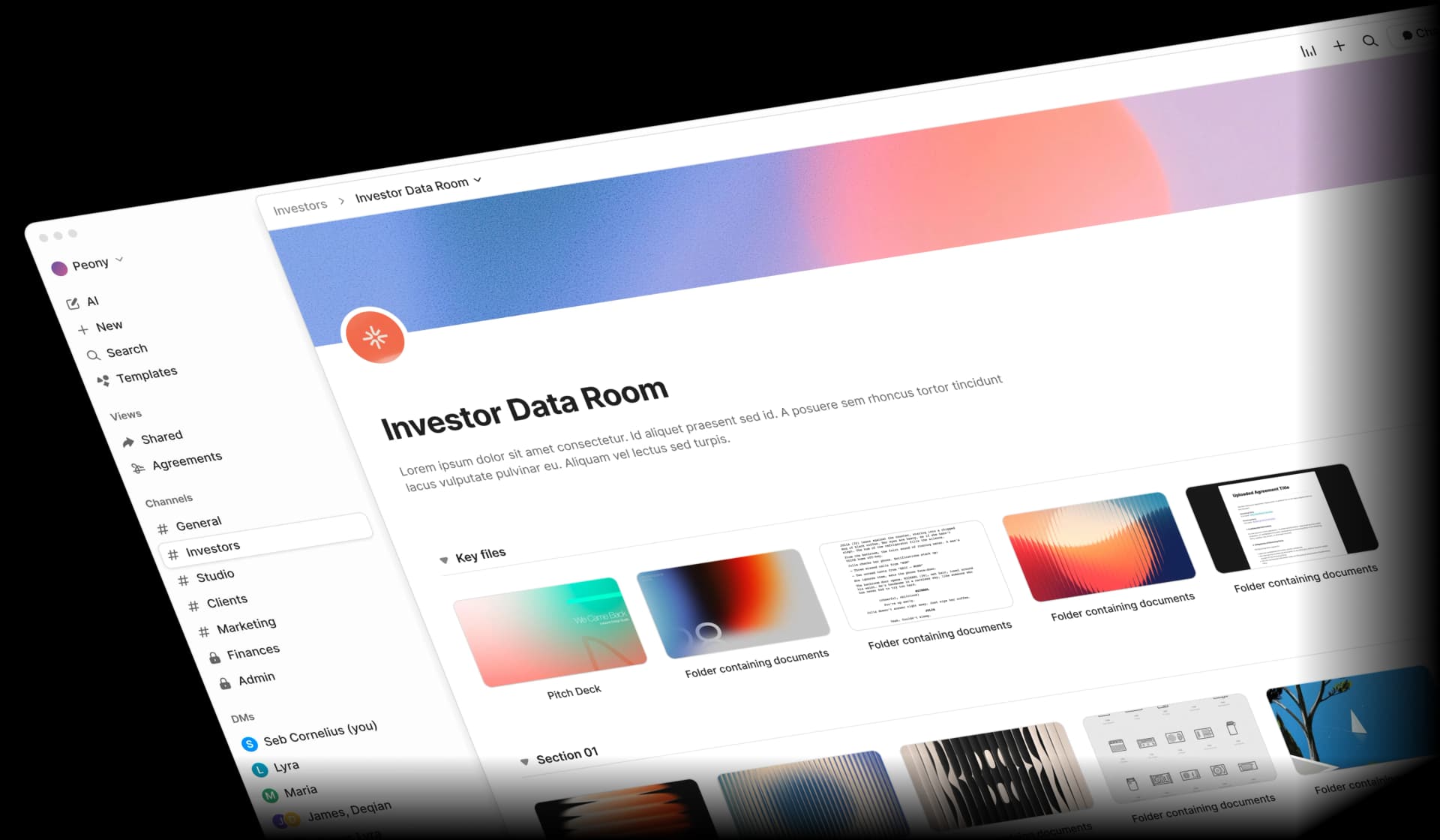
ShareFile's strength is its client portal structure — accounting firms and law practices have built entire workflows around ShareFile's folder-per-client model. That is real infrastructure and switching has real costs. But the model assumes you will build and maintain every folder manually. On Peony, I tested the client onboarding workflow: I uploaded a batch of mixed client documents (engagement letters, financials, tax returns, supporting schedules) and let the AI auto-indexing sort them. The system separated tax documents from financial statements, identified the engagement letter as a legal document, and created a structure that matched the workflow I would have built manually — except it took under 3 minutes instead of the 30 minutes I spent doing the same thing on ShareFile. For a firm onboarding 5 new clients per month, that time savings compounds.
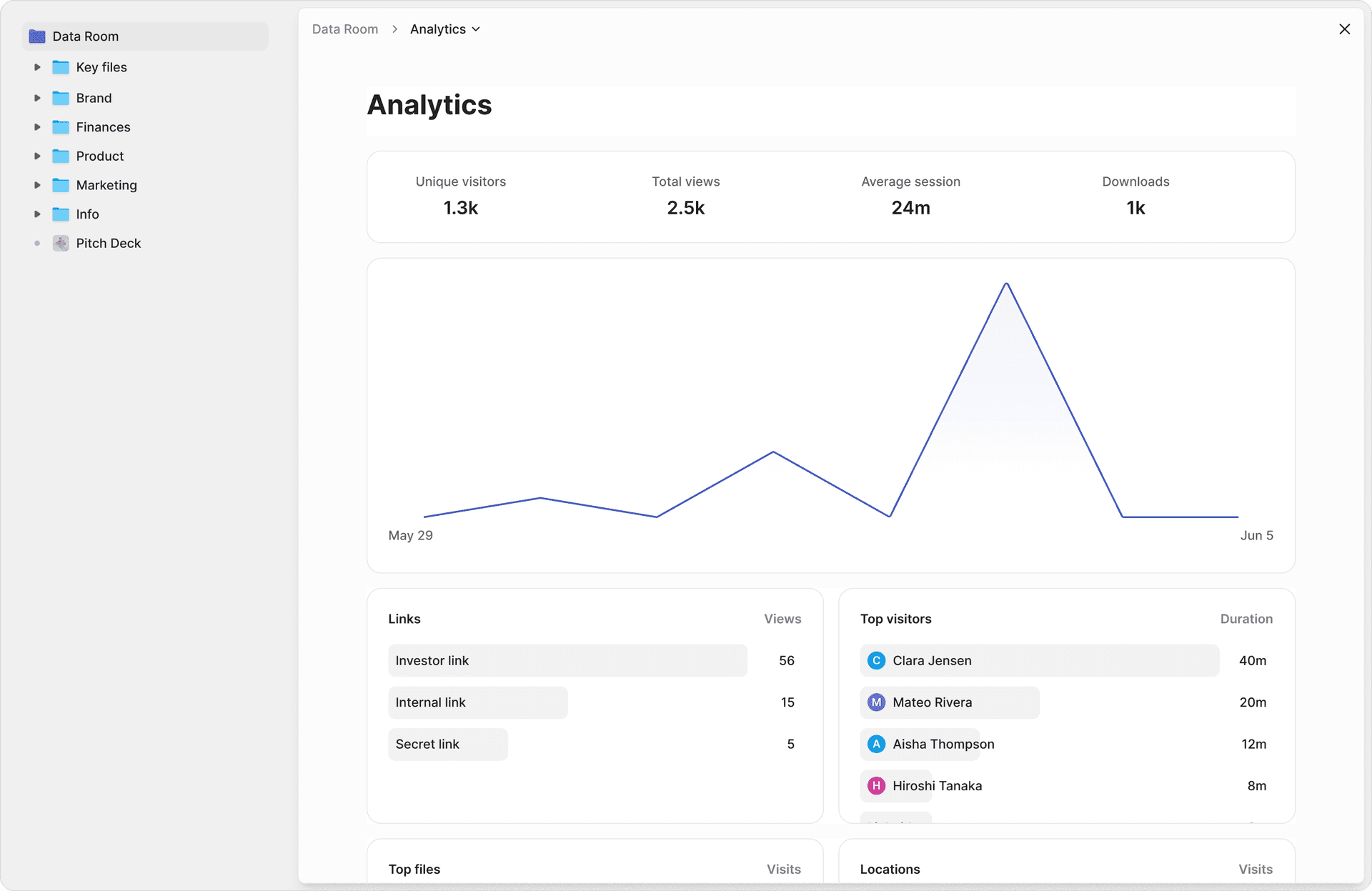
The analytics difference is where ShareFile's "VDR" label falls apart. ShareFile's analytics tell you who viewed a document and whether they downloaded it — the same information an email receipt gives you. On Peony, page-level analytics showed me that my test reviewer opened a shared financial report, spent 9 minutes on the revenue breakdown (pages 2-4), jumped directly to the risk factors section (page 11), and ignored the methodology appendix completely. When I shared the same document through ShareFile, all I got was "1 view, 0 downloads." For a deal team trying to understand what a buyer cares about before the next call, that is the difference between preparation and guessing.
The watermark issue on ShareFile is worth calling out specifically. I set up a watermarked document on ShareFile and shared it with a test reviewer. The watermark appeared when they viewed the document in the browser — good. Then I enabled download permissions (because clients often need to download and print). The downloaded PDF had no watermark. The protection vanished the moment the document left ShareFile's viewer. On Peony, dynamic watermarks are baked into the rendered document at the pixel level — they persist in the browser, in downloads, and even in print. When I tested screenshot protection on both platforms, ShareFile had no protection at all — the capture went through cleanly on every plan, including the $75/user/month VDR tier. On Peony, the system detected the capture attempt, blocked the visible content, and flagged the incident in my admin dashboard with the reviewer's identity and device details.
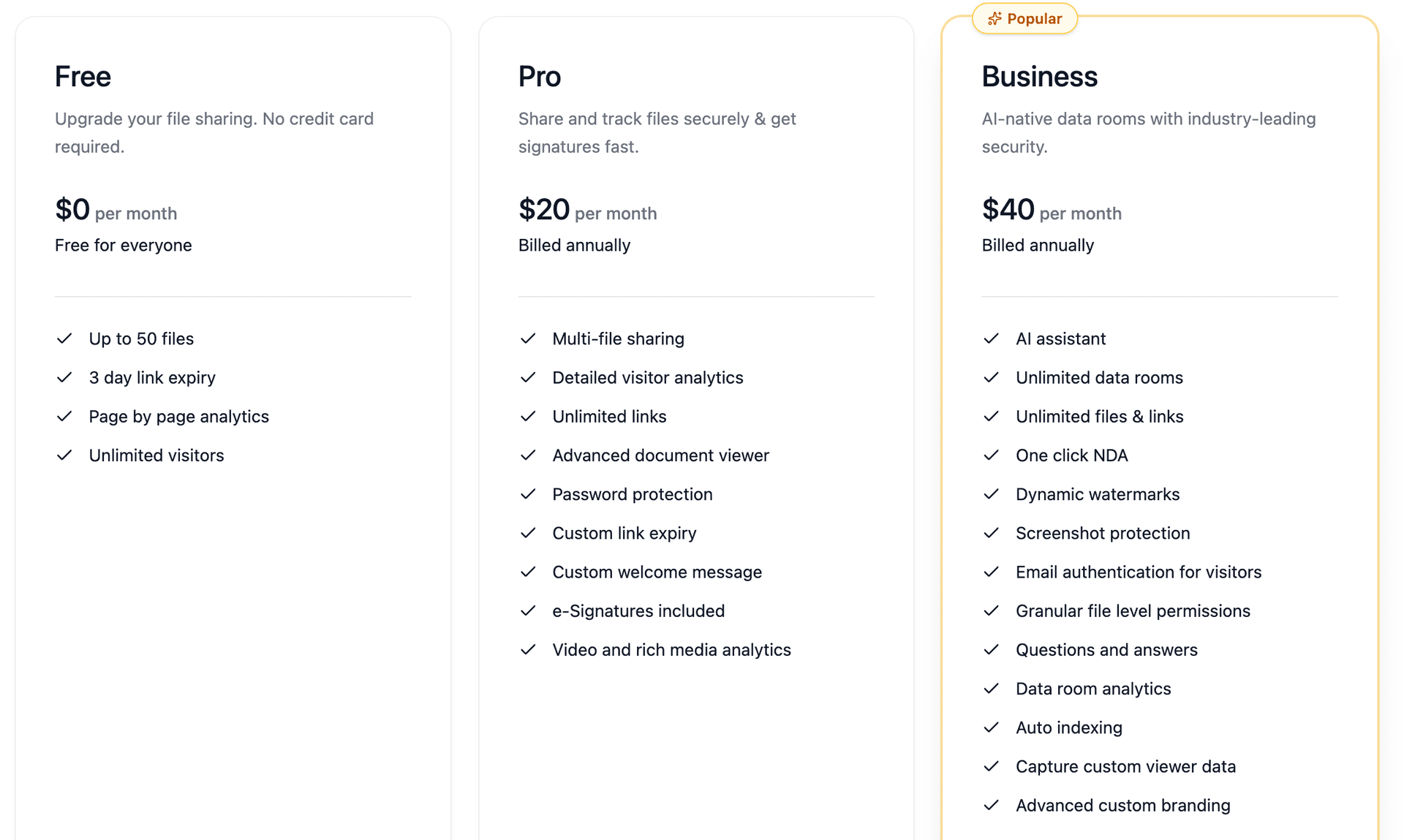
Pricing: Free tier available. Business plan: $40/admin/month. No per-user scaling, no minimum user requirements, no storage overages. Viewers are always free.
Best for: M&A due diligence, fundraising, PE portfolio management, VC deal flow, commercial real estate, legal practices, accounting firms, consulting teams, and any team paying $50+/user/month for ShareFile's VDR tier.
2. Box — Best Enterprise Content Platform
Box is the enterprise content management platform that ShareFile aspires to compete with. While ShareFile serves 86,000+ customers, Box serves 100,000+ businesses including 69% of the Fortune 500. If your primary need is enterprise-grade content governance with deep integrations, Box is the strongest ShareFile alternative.
I set up a Box Business account and the integration ecosystem immediately stood out: 1,500+ app integrations versus ShareFile's more limited connector library. Box AI summarized a 40-page contract in seconds and extracted key terms automatically. The content governance tools (Box Shield for data loss prevention, classification policies, retention schedules) are enterprise-grade in a way that ShareFile's compliance features are not.
The downside I noticed: Box's pricing scales the same way ShareFile's does — per user, per month. For a 25-person team on Business Plus, you are paying $625/month. And Box's security, while strong (FedRAMP, HIPAA, SOC 1/2/3), does not extend to VDR-specific features like page-level analytics or screenshot protection.
Pricing: Business Starter $5/user/month, Business $15/user/month, Business Plus $25/user/month, Enterprise $35/user/month, Enterprise Plus $50/user/month.
Security: SOC 1/2/3, ISO 27001, ISO 27018, FedRAMP Moderate, HIPAA/HITECH, FINRA/SEC 17a-4, PCI DSS Level 1, FIPS 140-2.
Best for: Regulated enterprises in healthcare, government, and financial services that need FedRAMP authorization, deep integrations, and Box AI.
vs. ShareFile: Stronger compliance stack (FedRAMP), better AI capabilities (Box AI), larger ecosystem. But similar per-user pricing model and similar gaps in VDR-specific features. If you are leaving ShareFile for cost reasons, Box will not help.
3. Dropbox Business — Best for Simple Team Sharing
Dropbox is what ShareFile would be if it prioritized user experience over enterprise complexity. The desktop sync is the best in the market — files appear locally, sync in the background, and Smart Sync keeps infrequently used files cloud-only to save disk space.
I installed Dropbox Business on my test machines and the sync experience was noticeably faster and more reliable than ShareFile. Where ShareFile users report files "not syncing across devices" and requiring workarounds, Dropbox just worked. I shared a folder with my test reviewer and they had access within seconds — no client portal setup, no permission configuration wizard, just a link.
The trade-off is security depth. Dropbox Business has no VDR features, no granular document-level permissions (only folder-level), no watermarking, no screenshot protection, and no page-level analytics. The audit trail shows who accessed what, but not how they engaged with the content.
Pricing: Business Standard $18/user/month (3+ users, 9 TB pooled), Business Advanced $30/user/month (unlimited storage), Enterprise custom.
Security: ISO 27001, 27017, 27018, 22301, 27701, SOC 1/2/3, CSA STAR Level 2, HIPAA BAA available.
Best for: Small teams and startups that need reliable file sync and sharing without enterprise complexity. Not suitable for M&A, due diligence, or any workflow requiring granular document security.
vs. ShareFile: Better sync reliability, simpler UX, stronger brand recognition. But significantly weaker security controls. If you use ShareFile for its compliance features or client portals, Dropbox is a downgrade. If you use ShareFile primarily for internal file sharing, Dropbox is an upgrade.
4. Google Drive — Best for Collaboration, Worst for Security
Google Drive with Google Workspace is the most widely used file sharing platform in the world. The real-time collaboration in Docs, Sheets, and Slides is unmatched. Gemini AI integration adds document summarization and Q&A capabilities. And 15 GB of free storage makes it the default choice for budget-conscious teams.
I tested Google Drive the same way I tested every other platform: uploaded the document set, shared with a reviewer, and evaluated the security controls. The collaboration features are excellent — my reviewer could comment inline, suggest edits, and I could see changes in real time. But the security story fell apart immediately. I could not watermark shared documents. I could not prevent my reviewer from downloading files (the "disable download" option exists but is easily circumvented). There are no page-level analytics. The activity log shows "User opened File X" but nothing about reading behavior.
Google Workspace raised prices 16-22% in January 2025 for Gemini AI bundling, which means Business Standard now costs $14/user/month — approaching ShareFile's Advanced tier without any of the security features.
Pricing: Business Starter $7/user/month (30 GB), Business Standard $14/user/month (2 TB), Business Plus $22/user/month (5 TB), Enterprise custom.
Security: ISO 27001, 27017, 27018, 27701, SOC 2/3, HIPAA BAA available.
Best for: Internal team collaboration on non-sensitive documents. Not suitable for external client sharing, due diligence, or any scenario where you need to control what happens to documents after sharing.
vs. ShareFile: Vastly better collaboration tools, cheaper per-user pricing, ubiquitous adoption. But fundamentally unsuitable for secure external document sharing — the exact use case ShareFile was built for.
5. OneDrive / SharePoint — Best for Microsoft Shops
If your organization runs on Microsoft 365, OneDrive and SharePoint are already included in your subscription. The integration with Teams, Outlook, Word, Excel, and PowerPoint is seamless. For internal document management within the Microsoft ecosystem, it is hard to justify paying extra for ShareFile.
I tested OneDrive for Business alongside ShareFile and the experience was mixed. Co-authoring in Word and Excel worked flawlessly — multiple people editing simultaneously with no conflicts. The SharePoint document library provides decent version control and metadata tagging. But when I tried to use it for external client sharing, the limitations appeared. Sharing with external users requires Azure AD guest access configuration, which is an IT admin task — not something a partner at an accounting firm should be configuring themselves. The permissions model is powerful but complex.
Important note for 2026: Microsoft is retiring standalone OneDrive and SharePoint plans. End of sale is June 1, 2026, and service ends December 2029. If you are on a standalone plan, you will need to migrate to a full Microsoft 365 subscription. Price increases of 5.5-8.3% are also coming in July 2026.
Pricing: Business Basic $6/user/month (rising to $7 in July 2026), Business Standard $12.50/user/month (rising to $14), Business Premium $22/user/month.
Security: SOC 1/2/3 Type II, ISO 27001/27017/27018, FedRAMP Moderate (GCC/GCC High), HIPAA BAA available.
Best for: Organizations already on Microsoft 365 that need internal document management and can handle the admin complexity of external sharing via Azure AD.
vs. ShareFile: Already included in M365 subscriptions (no extra cost for existing customers), deeper Microsoft integration, stronger compliance stack (FedRAMP). But external sharing is cumbersome, there are no VDR features, and standalone plans are being retired.
6. Tresorit — Best for Zero-Knowledge Encryption
Tresorit is what you choose when encryption is not just a feature but a philosophy. Built in Switzerland and Hungary with zero-knowledge end-to-end encryption verified by Ernst & Young penetration testing, Tresorit cannot access your files even under legal compulsion. The encryption keys never leave your devices.
I set up a Tresorit Business account and uploaded the test document set. The encryption overhead was noticeable — uploads took approximately 15-20% longer than on ShareFile or Dropbox, which is the cost of client-side encryption. Sharing was straightforward: I created a secure link with password protection, expiration date, and download controls. The recipient experience was clean and professional.
What Tresorit lacks is analytics and AI. There are no page-level viewing statistics, no engagement tracking, no AI document organization. It is a secure vault, not an intelligent platform. For teams that need to know what their reviewers are reading, Tresorit is insufficient. For teams that need maximum privacy, it is unbeatable.
Pricing: Business Standard $14.50/user/month (3-user minimum, 1 TB/user), Business Plus $19/user/month (2 TB/user), Enterprise custom (50+ users).
Security: ISO 27001:2022, SOC 2 Type II, GDPR compliant, zero-knowledge end-to-end encryption, Swiss/Hungarian jurisdiction.
Best for: Privacy-first organizations, legal practices handling attorney-client privileged documents, healthcare organizations, and any team where the risk of the platform itself accessing documents is unacceptable.
vs. ShareFile: Vastly stronger encryption (zero-knowledge versus server-side only). But no VDR features, no analytics, smaller integration ecosystem, and 3-user minimum on all plans.
7. Egnyte — Best Hybrid Cloud Architecture
Egnyte occupies a unique position: hybrid cloud storage that works both on-premises and in the cloud simultaneously. For industries like architecture, engineering, construction (AEC), and life sciences where large files live on local servers but need cloud accessibility, Egnyte solves a problem that pure-cloud platforms like ShareFile cannot.
I set up an Egnyte Team account and was immediately impressed by the Enterprise Key Management feature — you can manage your own encryption keys through AWS KMS or Azure Key Vault, which means Egnyte never has sole access to your encryption keys. For regulated industries, this is a significant differentiator. The content governance tools (data lifecycle management, classification, retention policies) are enterprise-grade.
The downside: Egnyte is complex. Setup took longer than any other platform on this list, and the admin console has a steep learning curve. For a small professional services firm that just needs secure client file sharing, Egnyte is overkill.
Pricing: Team $10/user/month, Business $20/user/month, Enterprise Lite $38/user/month, Elite $46/user/month. 15-day free trial. Volume discounts of 10-30% for larger contracts.
Security: SOC 2 SSAE 18 Type II, ISO 27001:2022, HIPAA/HITECH, FINRA, DFARS, FDA 21 CFR Part 11, GDPR.
Best for: Architecture, engineering, construction firms and life sciences companies that need hybrid cloud storage with customer-managed encryption keys and deep regulatory compliance.
vs. ShareFile: Stronger compliance for regulated industries (FDA, DFARS), unique hybrid architecture, customer-managed encryption keys. But more complex to set up, higher learning curve, and not focused on professional services client workflows.
8. Hightail — Best for Creative Workflows
Hightail (now under OpenText) is not a ShareFile competitor in the traditional sense — it is a creative workflow platform that happens to share files. If your team sends large design files, needs visual proofing with annotations, and runs approval workflows on creative assets, Hightail is purpose-built for that.
I tested Hightail by uploading a 45 MB brand guidelines PDF and a batch of campaign assets. The visual proofing was genuinely good: my reviewer pinpointed a color inconsistency on page 12 and left an annotation directly on the image — no separate email thread, no "see attached markup." The approval routing tracked who signed off on what and when, which is useful for multi-stakeholder creative reviews. But when I tried a 150 MB video file on the free tier, the 100 MB limit blocked me immediately.
For document security, Hightail is not in the same league as ShareFile. Basic SSL/TLS encryption, limited compliance certifications, no VDR features, no granular permissions, no watermarking. The free tier (100 MB per file, 2 GB storage) is useful for one-off sends but not for persistent document management.
Pricing: Lite free (100 MB/file, 2 GB, 7-day expiry), Pro ~$15/month, Teams ~$20-25/user/month, Business ~$30/user/month.
Security: SSL/TLS 256-bit, SSAE 16, HIPAA and PCI controls on Business tier, SAML 2.0.
Best for: Creative agencies, marketing teams, and designers who need visual proofing and approval workflows for large creative files.
vs. ShareFile: Better creative workflows, free tier available. But significantly weaker security, no VDR capabilities, limited compliance. If you use ShareFile for creative file sharing only, Hightail is an upgrade. For anything requiring document security, it is a downgrade.
9. WeTransfer — Simplest for One-Off Transfers
WeTransfer is the simplest way to send large files to someone. No account required, no folder structure, no permissions to configure. Upload files, enter the recipient's email, send. That is it.
I tested WeTransfer by sending a 2.8 GB folder of mixed documents — contracts, financials, and a presentation deck. Upload took about 4 minutes on a standard connection, and the download link landed in my reviewer's inbox within 15 seconds. The interface is genuinely the fastest path from "I have files" to "you have files." But when I checked back 4 days later, the link was dead — files expire after 3 days on the free tier. There are no access controls beyond optional password protection, no analytics, no audit trail, and WeTransfer explicitly states it is NOT HIPAA compliant and does NOT use end-to-end encryption.
WeTransfer restructured its plans in February 2025, retiring the old Pro and Plus tiers and launching Starter ($7/month), Ultimate ($19/month), and Teams (pricing unlisted). The new structure is simpler but still positioned for one-off transfers, not persistent document management.
Pricing: Free (3 GB/transfer, 10 transfers/month, 3-day storage), Starter $7/month, Ultimate $19/month, Teams custom.
Security: ISO 27001, TLS in transit, AES-256 at rest. NOT HIPAA compliant, no end-to-end encryption.
Best for: Freelancers, creative professionals, and anyone who needs to send large files quickly without setting up a platform. Not suitable for recurring client workflows, compliance requirements, or anything involving sensitive documents.
vs. ShareFile: Infinitely simpler UX, free tier available, no learning curve. But zero security controls, files expire, no compliance, no audit trail. These tools serve completely different purposes.
ShareFile Alternatives: Pricing Comparison
| Platform | Starting Price | Pricing Model | Unlimited External Users | Hidden Fees | Free Tier |
|---|---|---|---|---|---|
| ShareFile (reference) | $16/user/mo | Per-user/month | Yes (all plans) | Mid-contract policy changes, storage moved from unlimited to 1 TB/user, 5-user minimum on VDR | No (30-day trial) |
| Peony | Free ($0) | Transparent | Yes (viewers free) | None | Yes (permanent) |
| Box | $5/user/mo | Per-user/month | Varies by plan | Per-user scaling | Free (10 GB personal) |
| Dropbox Business | $18/user/mo | Per-user/month (3+ users) | Limited | Per-user scaling, 3-user minimum | Free (2 GB personal) |
| Google Workspace | $7/user/mo | Per-user/month | Yes | 16-22% price increase in 2025 for Gemini bundling | Free (15 GB personal) |
| OneDrive (M365) | $6/user/mo | Per-user/month | Azure AD guest access | Standalone plans retiring Jun 2026, 5.5-8.3% increase Jul 2026 | Free (5 GB personal) |
| Tresorit | $14.50/user/mo | Per-user/month (3+ users) | Link-based sharing | 3-user minimum | No (trial only) |
| Egnyte | $10/user/mo | Per-user/month | Varies | Complex tier structure | No (15-day trial) |
| Hightail | Free (100 MB) | Tiered | Limited | Storage limits | Yes (Lite) |
| WeTransfer | Free (3 GB) | Tiered | Link-based | Files expire, no persistent storage | Yes (3 GB/transfer) |
Real-world cost comparison for a 10-person professional services team (12 months):
| Platform | Estimated Annual Cost |
|---|---|
| Peony (Business) | $480 |
| WeTransfer (Ultimate) | $228 |
| Google Workspace (Standard) | $1,680 |
| Dropbox Business (Standard) | $2,160 |
| Egnyte (Business) | $2,400 |
| Tresorit (Business Standard) | $1,740 |
| Box (Business) | $1,800 |
| OneDrive (Business Standard) | $1,500 (rising to $1,680 in Jul 2026) |
| ShareFile (Premium) | $3,000 |
| ShareFile (VDR) | $8,100-$9,000 |
How to Migrate from ShareFile
Step 1: Export from ShareFile. Use ShareFile's bulk download to export your complete file library with folder structure intact. Download any audit trails or activity reports separately — these do not transfer automatically.
Step 2: Choose your timing. If you have active client engagements, run a parallel setup on your new platform. Do not cut over mid-engagement. ShareFile's annual billing means you may be locked in until your contract renewal — use the remaining time to set up and validate your new platform.
Step 3: Upload and organize. With Peony, AI auto-indexing organizes uploaded documents in under 5 minutes — no manual folder creation or renaming. Other platforms will require manual reorganization matching your existing structure.
Step 4: Configure client access. Mirror your ShareFile permission levels on the new platform. If you used ShareFile's client portal structure, map each client to an equivalent workspace or room on your new platform. Peony supports equivalent granular permissions with watermarking, screenshot protection, access revocation, and built-in NDA workflows.
Step 5: Update client links. Send new access links to active clients. Verify that every client can access their documents — and only their documents. Run a test access from an external account before going live.
Total migration time: 2-4 hours for most document libraries under 5,000 files. Client re-onboarding takes longer than the actual file transfer.
Quick Guide: Which ShareFile Alternative Fits Your Situation?
| Your Situation | Best Alternative | Why |
|---|---|---|
| Want ShareFile-level security with analytics at a fraction of the cost | Peony | Free tier with AI, page-level analytics, screenshot protection, e-signatures — $40/mo Business plan |
| Enterprise content management with FedRAMP | Box | SOC 1/2/3, FedRAMP Moderate, 1,500+ integrations, Box AI |
| Simple team file sharing without complexity | Dropbox Business | Best-in-class desktop sync, familiar interface, reliable |
| Already on Microsoft 365 | OneDrive / SharePoint | Already included in your subscription, deep M365 integration |
| Real-time document collaboration | Google Drive | Best co-authoring, Gemini AI, 15 GB free |
| Maximum privacy and encryption | Tresorit | Zero-knowledge E2E encryption, Swiss jurisdiction, Ernst and Young verified |
| Hybrid cloud with customer-managed keys | Egnyte | On-prem + cloud, FDA/DFARS compliance, enterprise key management |
| Creative file sharing and proofing | Hightail | Visual proofing, approval routing, creative workflows |
| One-off large file transfers | WeTransfer | Simplest UX, no setup required, free 3 GB transfers |
My Bottom Line After Testing All 9
After two weeks of uploading the same documents to nine different platforms, configuring permissions, testing analytics, and deliberately trying to break security controls, here is what I concluded:
ShareFile is a competent file sharing platform for professional services teams that need compliance certifications and client portals. The Capterra ratings are genuine — it works, the support team (when you can reach them) is knowledgeable, and the Microsoft 365 integration has improved substantially under Progress Software. If your firm has a ShareFile contract that works and your team knows the interface, switching has real costs.
Stay with ShareFile if: your compliance team has already validated ShareFile for HIPAA or PCI DSS, your client portal workflows are deeply embedded with dozens of active portals, and you do not need page-level document analytics or screenshot protection. The switching cost is real — honor existing contracts and migrate at renewal.
But ShareFile's VDR tier at $67.50-$75/user/month is where the value proposition breaks down. For that price, you get basic access controls and audit trails bolted onto a file sharing platform — no page-level analytics, no screenshot protection, no persistent watermarks, no AI document organization. Modern platforms include these features at a fraction of the cost or for free.
- For most teams: Peony delivers equivalent security with AI-powered features, page-level analytics, built-in e-signatures, and screenshot protection — starting free. The $40/month Business plan replaces ShareFile VDR functionality at 95% less cost per seat.
- For enterprise compliance: Box with FedRAMP authorization and 1,500+ integrations is the enterprise content platform that ShareFile cannot match.
- For maximum privacy: Tresorit's zero-knowledge encryption is in a different league from any platform on this list, including Peony.
- For Microsoft-centric firms: OneDrive/SharePoint is already included in your M365 subscription — stop paying extra for ShareFile.
- For simplicity: Dropbox Business if you just need reliable sync and sharing without enterprise overhead.
The file sharing market is growing at 24% annually toward $45 billion by 2030. Competition benefits buyers. The days of paying $75/user/month for a VDR that cannot tell you which page your reviewer read are ending.
Frequently Asked Questions
What is the best ShareFile alternative for law firms sharing client documents?
Peony is the best ShareFile alternative for law firms that need secure client document sharing with audit-grade tracking. Peony's page-level analytics (free on every plan) show exactly which pages of a closing binder, disclosure schedule, or privilege log each party reviewed and for how long — critical for documenting that all parties had access to material information. The Business plan ($40/admin/month) adds AI auto-indexing that organizes 1,000+ transaction documents into categorized folders in under 3 minutes, granular permissions for privilege walls, dynamic watermarks, and screenshot protection. E-signatures for engagement letters and transaction closings are available on Pro ($20/admin/month).
Why are legal teams leaving ShareFile for purpose-built data rooms?
ShareFile started as a file sharing tool, not a data room. Legal teams hit three walls: (1) no page-level analytics — partners cannot prove which pages opposing counsel actually reviewed during discovery or diligence; (2) no screenshot protection — privileged documents and draft term sheets can be screen-captured freely; (3) watermarks disappear when download permissions are enabled, eliminating any leak tracing for documents that leave the platform. For transaction closings with hundreds of documents, ShareFile's manual folder management cannot match Peony's AI auto-indexing on Business ($40/admin/month), which categorizes closing binders, ancillary agreements, and regulatory filings into organized folders automatically.
How does ShareFile compare on audit trails for litigation support?
ShareFile provides basic access logs showing who viewed or downloaded a file, but it lacks the granularity legal teams need for court-ready audit trails. Peony's page-level analytics track exactly which pages each viewer read, how long they spent on each page, and when they returned — producing detailed engagement records that can demonstrate whether a party reviewed specific sections of a contract or disclosure document. This level of granularity is available on Peony's free tier. For litigation holds and privilege management, Peony's granular permissions on Business ($40/admin/month) let paralegals set document-level and folder-level access controls that enforce privilege walls.
Can law firms create branded client portals with a ShareFile alternative?
Yes. Peony's Business plan ($40/admin/month) includes custom domain branding, allowing firms to present data rooms under their own brand identity when sharing transaction documents, due diligence materials, or closing binders with clients. Each client portal can have firm-specific branding, NDA gates requiring clients to sign before accessing documents, and dynamic watermarks that trace every viewed page back to the individual recipient. ShareFile offers basic branding on higher tiers, but lacks page-level analytics, screenshot protection, and the NDA workflow that law firms need for client-facing document sharing.
How much does a ShareFile alternative cost for small to mid-size law firms?
ShareFile's VDR plan costs $67.50-$75/user/month with a 5-user minimum ($337.50/month floor). For a 10-attorney firm, that is $675-$750/month before add-ons. Peony offers a permanent free tier with page-level analytics, AI-powered data rooms, and dynamic watermarks — enough for solo practitioners and small firms sharing client documents. E-signatures for engagement letters and closing documents start on Pro ($20/admin/month). The Business plan at $40/admin/month adds AI auto-indexing, granular permissions for privilege walls, custom domain branding, NDA gates, and screenshot protection — all features included with no per-user surcharges.
What security features do legal teams need that ShareFile lacks?
Legal teams handling privileged communications, M&A transactions, and litigation discovery need four security capabilities that ShareFile does not provide: (1) screenshot protection — ShareFile has none even on the $75/month VDR plan, meaning opposing counsel or unauthorized parties can capture privileged documents; (2) persistent dynamic watermarks — ShareFile watermarks disappear when download is enabled; (3) page-level audit trails showing exactly which pages each party reviewed, critical for proving disclosure compliance; (4) granular permission controls that enforce privilege walls at the document level. Peony includes page-level analytics and watermarks free, with screenshot protection and granular permissions on Business ($40/admin/month).
Does a ShareFile alternative support e-signatures for transaction closings?
Yes. Peony includes built-in e-signatures starting on the Pro plan ($20/admin/month), eliminating the need for a separate DocuSign or Adobe Sign subscription for transaction closings, engagement letters, NDAs, and board resolutions. For law firms managing closings with dozens of signature pages across multiple parties, having e-signatures inside the same data room as the closing binder reduces version confusion and keeps the full execution trail in one audit log. ShareFile integrates with third-party e-signature providers but charges extra and requires switching between platforms.
How does Peony handle document organization for 1,000+ closing binder documents?
Peony's AI auto-indexing on the Business plan ($40/admin/month) categorizes uploaded documents into structured folders — ancillary agreements, regulatory filings, officer certificates, board resolutions, third-party consents — in under 3 minutes. For law firms managing complex transaction closings where paralegals traditionally spend hours organizing closing binders manually, this eliminates a significant bottleneck. ShareFile requires manual folder creation and drag-and-drop organization with no AI assistance. Peony also provides page-level analytics so partners can verify that all parties reviewed the final versions of key documents before signing.
Is ShareFile still owned by Citrix, and should law firms be concerned about stability?
No. ShareFile changed hands twice since Citrix. Cloud Software Group spun it out in November 2023, then Progress Software acquired it for $875 million in October 2024. For law firms that built client workflows around ShareFile, two ownership changes in two years raises legitimate concerns about product direction, data migration policies, and long-term pricing stability. Peony is independently operated with transparent pricing, a permanent free tier, and a clear product roadmap — providing the kind of platform stability that legal teams need when client document infrastructure cannot afford disruption.
What is the cheapest ShareFile alternative with enterprise security for legal teams?
Peony is the most affordable enterprise-grade ShareFile alternative for law firms, with a permanent free tier that includes AI-powered data rooms, page-level analytics, and dynamic watermarks. E-signatures for closings start on Pro ($20/admin/month). The Business plan at $40/admin/month adds AI auto-indexing for organizing large document sets, granular permissions for privilege management, custom domain branding for client portals, screenshot protection, and NDA gates — all features included. ShareFile's comparable VDR plan starts at $67.50/user/month with a 5-user minimum. Tresorit offers zero-knowledge encryption starting at $14.50/user/month but lacks data room features.
Related Resources
- My Honest Review of Ideals Alternatives
- My Honest Review of Firmex Alternatives
- My Honest Review of SecureDocs Alternatives
- My Honest Review of Virtual Vaults Alternatives
- My Honest Review of OneHub Alternatives
- My Honest Review of PandaDoc Alternatives
- My Honest Review of DocSend Alternatives
- Top 10 Datasite Alternatives in 2026 (VDR Comparison)
- Top 10 Box Alternatives in 2026 (Free & Paid)
- Top 10 Google Drive Alternatives in 2026 (Free & Paid)
- Top 10 Dropbox Alternatives in 2026 (Free & Paid)
- I Tested 10 OneDrive Alternatives — Here's What Actually Works (2026)
- I Tested 10 Virtual Data Room Providers — Here's My Ranking (2026)
- Virtual Data Room Cost in 2026
- An Honest Review of Secure File Sharing Tools in 2026
- Document Security Complete Guide
- Peony vs ShareFile — Direct Comparison
- Peony for M&A Due Diligence
- Peony for Accounting Firms
- Peony for Legal
- Peony Pricing
You might also like
Apr 9, 2026
Best File Sharing Software for Small Business and Startups in 2026
Mar 21, 2026
My Honest Review of LucidLink Alternatives (Not $1,000+/Mo) in 2026
Mar 21, 2026
My Honest Review of MASV Alternatives ($0.25/GB Adds Up Fast) in 2026