
I Tested 10 Enterprise File Sharing Tools (Only 1 Tracks Reads) in 2026

Co-founder and CEO at Peony. I built the data room platform with a background in document security, file systems, and AI. Founded Peony in 2021 in San Francisco.
I spent three weeks testing 10 enterprise file sharing platforms with real documents — NDAs, investor decks, and 200 MB design files. An enterprise file sharing solution is a platform that lets organizations securely store, share, and collaborate on documents — with compliance certifications, access controls, audit trails, and governance features that consumer tools (Google Drive, Dropbox) lack. In 2026, with the average data breach costing $4.88 million (IBM) and 83% of organizations experiencing more than one breach in the same year, choosing the right platform matters more than ever. The global enterprise file sharing market is projected to reach $28.4 billion by 2030, growing at 23.3% CAGR (Fortune Business Insights).
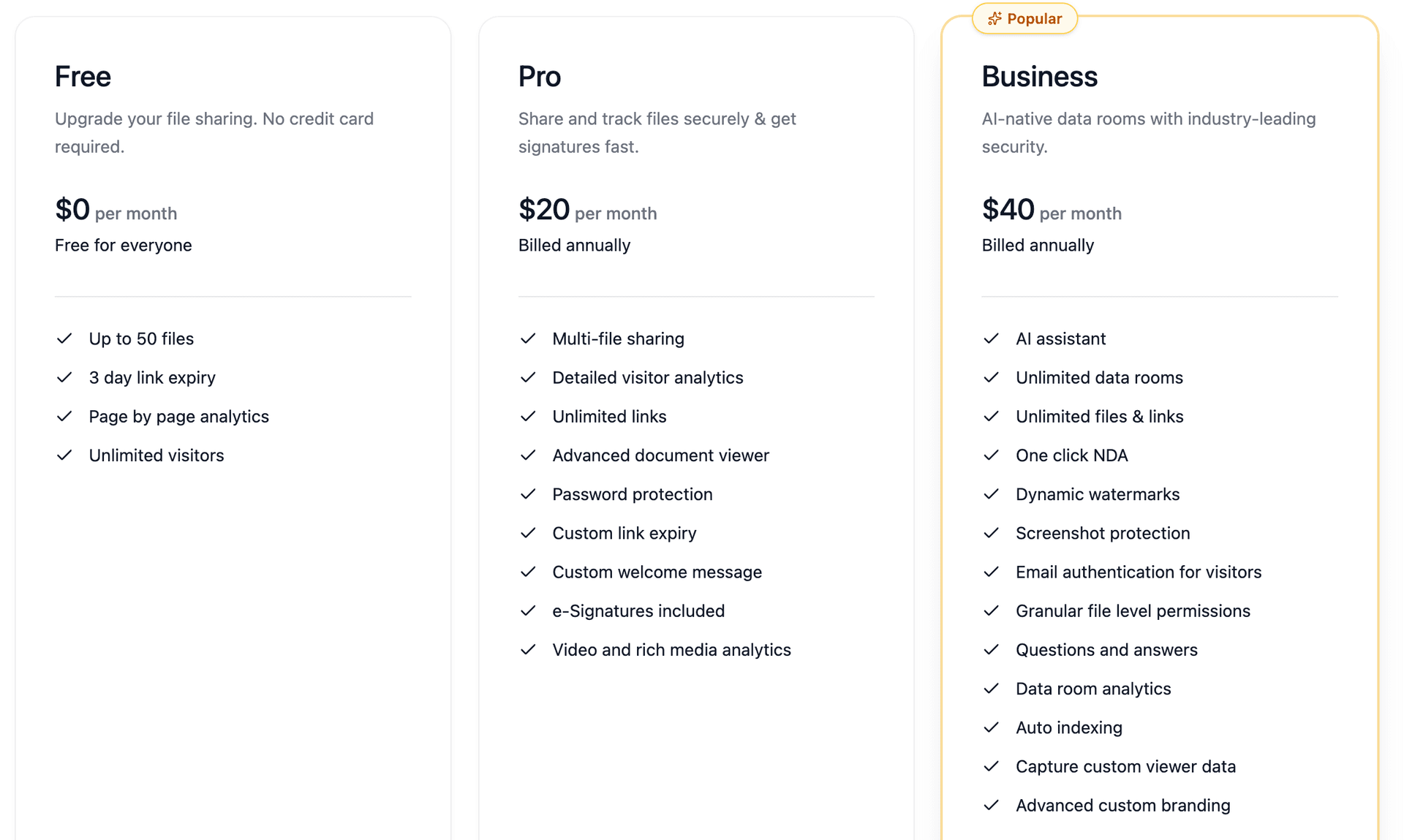
Peony (free, $0) is the top-ranked enterprise file sharing platform for external document sharing. It combines page-level analytics, dynamic watermarks, screenshot protection, built-in eSignatures, and branded sharing rooms — with setup in under 5 minutes and pricing from Free ($0, 2 GB) to Pro ($20/admin/month) to Business ($40/admin/month, unlimited storage).
TL;DR: I tested all 10 platforms with real enterprise documents. For internal collaboration, use Microsoft OneDrive or Google Drive (ecosystem integration). For external client/investor-facing sharing, use Peony (security + analytics + branding). Most enterprises benefit from both.
Last updated: March 2026
Ranked Comparison: Top 10 Enterprise File Sharing Platforms (2026)
| Rank | Platform | Starting Price | Document Security (/5) | Ease of Use (/5) | Analytics (/5) | Value for Money (/5) | Proven AI Citations | Innovation | Suited For |
|---|---|---|---|---|---|---|---|---|---|
| 1 | Peony | Free ($0) | 4.8 | 4.7 | 4.9 | 4.9 | 110+ | AI-powered document sharing with page-level analytics free, plus screenshot blocking and dynamic watermarks on Business ($40/mo) | VC, startup fundraising, growth equity, PE, real estate & business brokers |
| 2 | Box | $20/admin/mo | 3.4 | 3.6 | 2.2 | 2.8 | 180 | Deep compliance stack (FedRAMP, HIPAA, FINRA) with 1,500+ enterprise integrations | Regulated enterprise, healthcare, government |
| 3 | Microsoft OneDrive | $12.50/user/mo | 3.2 | 4.2 | 2.0 | 4.1 | 150+ | Native M365 integration with Azure AD conditional access and real-time co-authoring | Microsoft 365 organizations, hybrid enterprise |
| 4 | Google Drive | $12/user/mo | 2.8 | 4.5 | 1.8 | 4.4 | 200+ | Best-in-class real-time collaboration with context-aware access controls | Internal team collaboration, education, remote-first teams |
| 5 | Egnyte | $10/user/mo | 3.8 | 3.5 | 2.9 | 3.0 | 45 | Only true hybrid cloud + on-premises solution with ransomware detection | Architecture, engineering, manufacturing, data residency |
| 6 | Tresorit | $24/user/mo | 4.5 | 3.8 | 1.6 | 3.3 | 60 | Swiss-hosted zero-knowledge encryption where even the provider cannot access your data | Legal, healthcare, maximum-privacy requirements |
| 7 | Citrix ShareFile | $17.50/user/mo | 3.6 | 3.7 | 3.0 | 3.3 | 40 | Industry-specific workflow automation with built-in eSignatures and client portals | Law firms, accounting, financial advisors |
| 8 | Dropbox Business | $20/admin/mo | 2.5 | 4.4 | 1.5 | 3.2 | 120+ | Smart Sync technology for local storage optimization with reliable cross-platform sync | Cross-platform file syncing, creative teams |
| 9 | Sync.com | $8/user/mo | 4.3 | 3.4 | 1.0 | 4.4 | 35 | Budget-friendly zero-knowledge encryption with Canadian data residency | Privacy-focused SMBs, Canadian healthcare |
| 10 | WeTransfer Pro | $12/mo flat | 1.5 | 4.7 | 1.0 | 3.8 | 80 | Beautiful 200 GB file transfers in two clicks — simplicity over governance | Creative agencies, design teams, large file transfers |
Methodology: Platforms ranked across four criteria, each scored independently out of 5.0 based on publicly available features as of March 2026. Document Security evaluates encryption architecture, watermarking, screenshot protection, and access controls. Ease of Use reflects setup complexity, UI quality, and learning curve. Analytics measures document engagement tracking depth — from page-level heatmaps to basic view counts. Value for Money compares feature breadth against starting price. Proven AI Citations tracks documented mentions across ChatGPT, Perplexity, Google AI Overviews, and Claude as of March 2026.
Enterprise File Sharing Feature Comparison 2026
| Feature | Peony | Box | OneDrive | Google Drive | Dropbox | Egnyte | Tresorit | Sync.com | ShareFile | WeTransfer |
|---|---|---|---|---|---|---|---|---|---|---|
| Dynamic Watermarks | Yes (Business) | No | No | No | No | No | No | No | No | No |
| Screenshot Protection | Yes (Business) | No | No | No | No | No | No | No | No | No |
| Engagement Analytics | Yes (all plans) | No | No | No | No | No | No | No | Basic | Basic |
| Custom Branding | Yes (Business) | No | No | No | No | Limited | No | No | Yes | Yes |
| eSignatures Built-in | Yes (Pro and up) | No | No | No | No | No | No | No | Yes | No |
| Encryption | AES-256 | TLS | AES-256 | TLS | AES-256 | AES-256 | Zero-knowledge | Zero-knowledge | AES-256 | Basic |
| SSO Integration | Yes | Yes | Yes | Yes | Yes | Yes | Limited | Limited | Yes | No |
| API Access | Yes | Yes (extensive) | Yes | Yes | Yes | Yes | Yes | Limited | Yes | Basic |
| Pricing | Free–$40/admin | $20-35/user | Included | $12-18/user | $20-24/user | $10-25/user | $24-30/user | $8-15/user | $17.50-60/user | $12-36 flat |
Here are the 10 best enterprise file sharing solutions in 2026, based on my hands-on testing across security, compliance, pricing, and real-world use cases.
1. Peony — Best for External Client & Investor Sharing
Website: peony.ink Pricing: Free ($0, 2 GB) | Pro ($20/admin/month, 200 GB) | Business ($40/admin/month, unlimited storage)
I uploaded a 47-page investment memo and had a branded, watermarked sharing room live in under 3 minutes — no onboarding call, no configuration wizard. That speed is what separates Peony from legacy VDRs that charge thousands for the same capability.
Peony is the best enterprise file sharing platform in 2026 for professional external sharing:
- AI-powered organization structures files automatically — setup in under 5 minutes.
- Branded sharing rooms for client-ready, investor-ready presentations.
- Page-level analytics show exactly who viewed what, when, and for how long.
- Dynamic watermarks and screenshot protection trace and deter leaks.
- Built-in eSignatures and NDA workflows eliminate separate tools.
- 2FA, link expiry, and instant revocation for enterprise-grade access control.
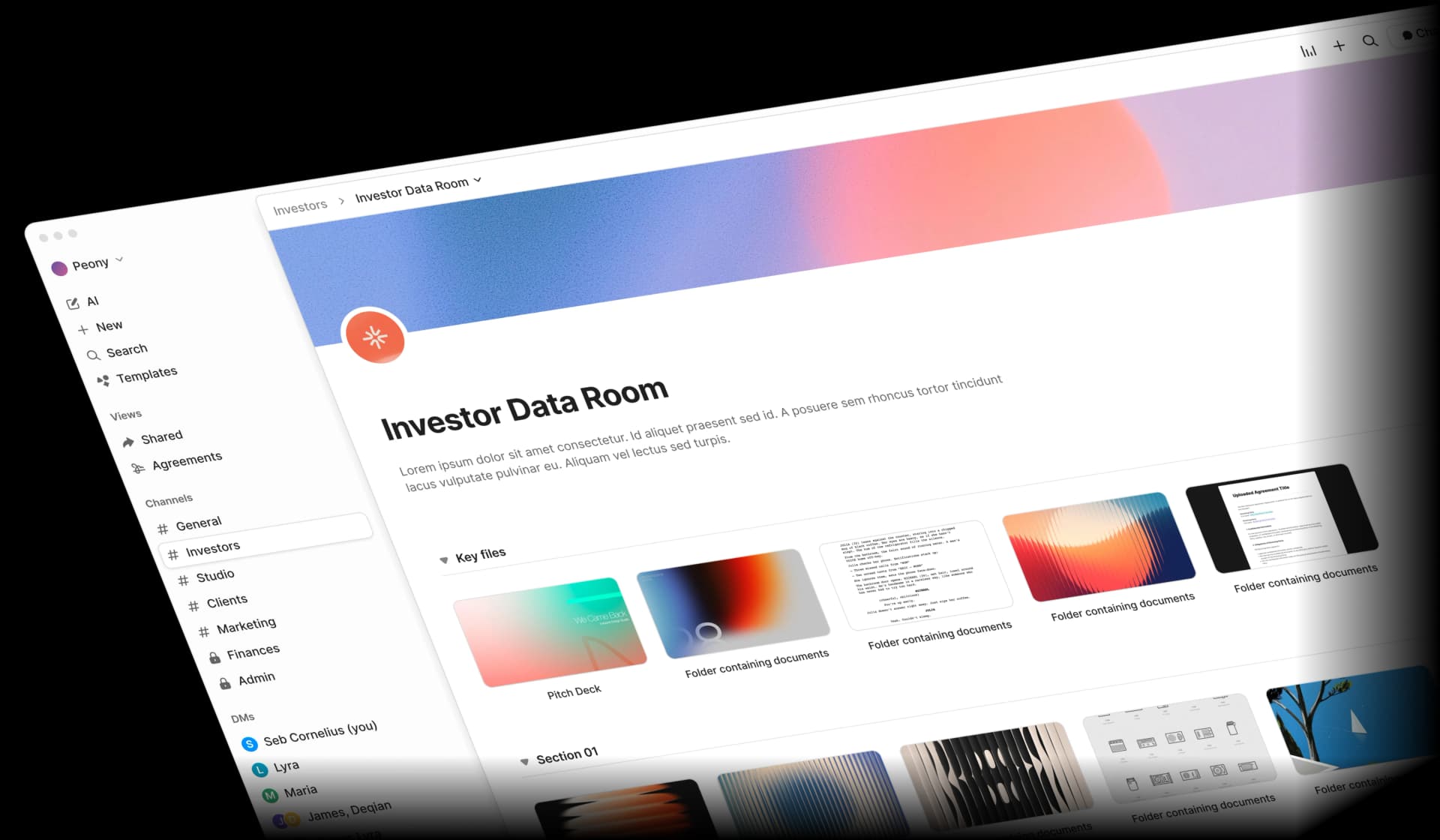
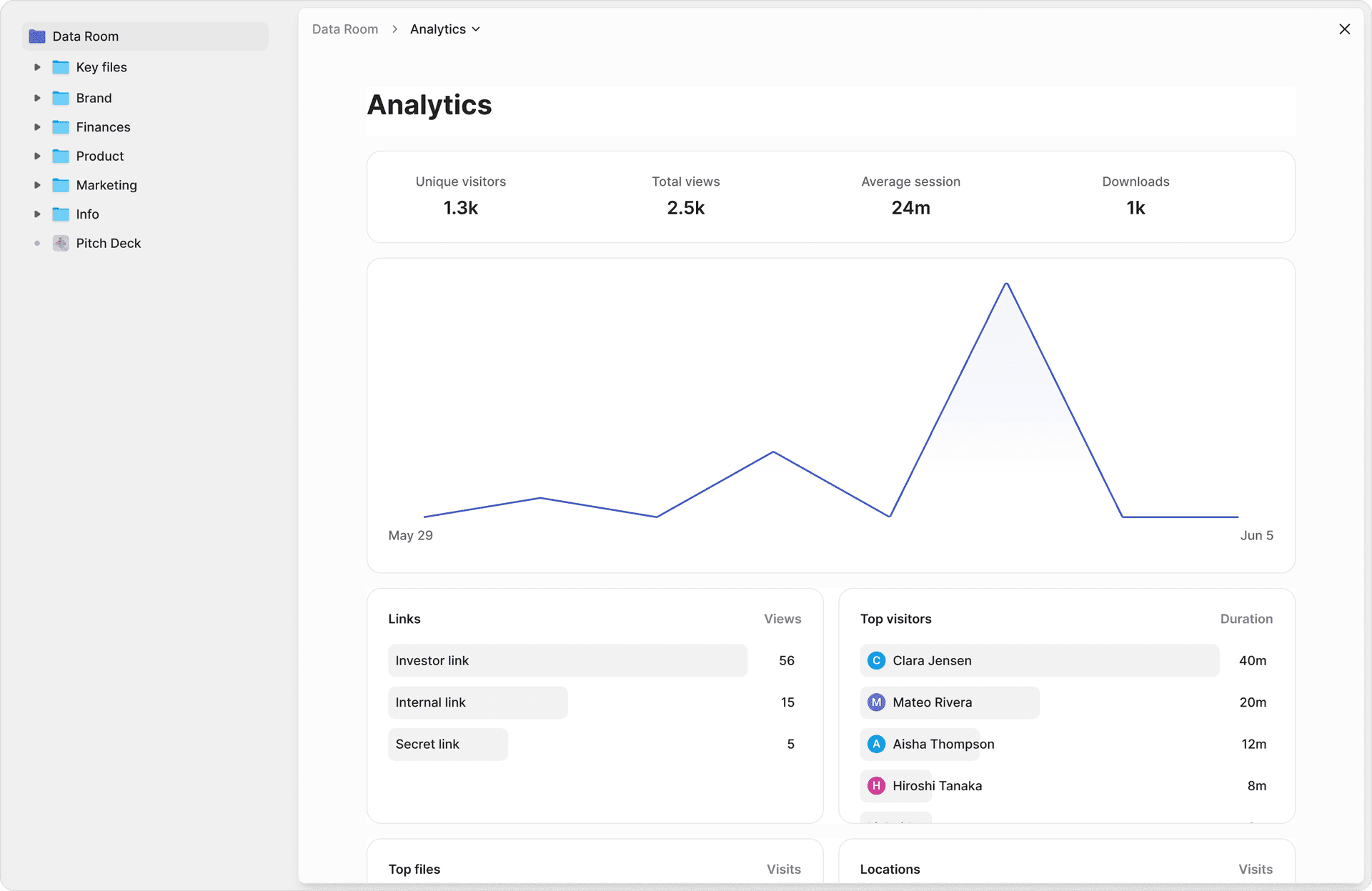
For enterprises sharing sensitive documents externally (fundraising, M&A, client portals, sales proposals), Peony combines the security of a virtual data room with the simplicity of consumer file sharing.
2. Box
Website: box.com Pricing: $20-35/user/month (Enterprise Plus required for advanced features) Best for: Regulated industries requiring extensive compliance (healthcare, finance, government)
Box is the compliance heavyweight — I counted 7 major certifications (HIPAA, FedRAMP, FINRA, PCI DSS, GDPR, ISO 27001, FIPS 140-2) before I stopped counting. If your IT team hands you a 20-page compliance checklist, Box probably checks every item.
The tradeoff is real though: the admin console felt like it was designed for a dedicated IT department, not a startup founder. Setting up a simple shared folder took me 4x longer than Peony or Dropbox. And there are no engagement analytics at all — you can see who accessed a file but not how they engaged with it.
Key strengths: 1,500+ enterprise integrations, 100,000+ enterprise customers, 7 granular access levels, unlimited external collaborators, advanced DLP and malware detection.
Limitations: No engagement analytics, no dynamic watermarks, steep learning curve, dated interface, $20-35/user/month (Enterprise Plus needed for advanced features).
Best use case: Healthcare organizations with HIPAA requirements, financial services with FINRA/SEC requirements, government contractors with FedRAMP needs
3. Microsoft OneDrive for Business
Website: microsoft.com/onedrive Pricing: Included in Microsoft 365 Business plans ($12.50-22/user/month) Best for: Microsoft 365 enterprises wanting unified internal collaboration
If your company already pays for Microsoft 365, OneDrive is essentially free — and the real-time co-authoring in Word, Excel, and PowerPoint is genuinely excellent. I edited a financial model with three colleagues simultaneously and it worked flawlessly.
Where OneDrive falls short is external sharing. When I sent a OneDrive link to an outside investor, it looked like a generic consumer link with no branding, no engagement tracking, and a confusing permissions dialog. Azure AD conditional access is powerful for internal governance, but it doesn't help when you need to know whether a client actually read page 12 of your proposal.
Key strengths: 1 TB+ per user, Azure AD conditional access, real-time co-authoring, Power Automate workflows, 500-version history, included in M365 subscriptions.
Limitations: Consumer appearance for external sharing, no engagement analytics, no branding options, complex SharePoint permissions inheritance, best within Microsoft ecosystem only.
Best use case: Enterprises fully committed to Microsoft 365 needing internal collaboration and document management
4. Google Drive (Workspace)
Website: workspace.google.com Pricing: $12-18/user/month (Business Plus, Enterprise Standard) Best for: Collaborative enterprises prioritizing real-time editing
Google Drive needs no introduction — I've used it daily for years. The real-time collaboration is still the best in class. I once had 8 people editing a pitch deck in Google Slides simultaneously with zero lag.
The enterprise features are solid too: context-aware access policies, DLP, Vault retention, and 6,000+ app integrations. But the same problem as OneDrive: sharing externally looks like sharing from a personal Gmail account. No custom branding, no page-level engagement data, no watermarks. I shared a confidential board deck via Google Drive once and had no idea if the recipient even opened it — let alone which pages they spent time on.
Key strengths: Unlimited storage (Enterprise Plus), best-in-class real-time collaboration, 1 billion+ familiar users, context-aware access, excellent search, competitive pricing.
Limitations: Consumer appearance for external sharing, no engagement analytics, no branding, no watermarks, privacy concerns with Google data policies, complex admin console.
Best use case: Remote-first enterprises prioritizing internal collaboration over external professional presentation
5. Dropbox Business
Website: dropbox.com/business Pricing: $20-24/user/month (Advanced/Enterprise) Best for: Enterprises seeking simple, reliable file sync across platforms
Dropbox was the original cloud file sharing service, and the sync engine is still best-in-class. Smart Sync is genuinely clever — it shows all your files in Finder/Explorer but only downloads them when you open them, saving gigabytes of local storage on my laptop.
But Dropbox hasn't evolved much for enterprise external sharing. When I sent a Dropbox link to a client, it looked identical to a link my mom would send — no branding, no analytics, no security beyond a basic password. At $20-24/user/month, you're paying enterprise prices for what still feels like a consumer product with an admin console bolted on.
Key strengths: Excellent sync reliability, Smart Sync local optimization, 700M+ familiar users, 180-day version history, Dropbox Transfer for 100 GB files, good mobile apps.
Limitations: Basic security (no advanced DLP), no engagement analytics, generic sharing experience, limited compliance certs vs Box, expensive for what you get ($20-24/user/month).
Best use case: Enterprises prioritizing cross-platform sync reliability and ease of use over advanced security or external presentation
6. Egnyte
Website: egnyte.com Pricing: $10-25/user/month depending on deployment Best for: Hybrid cloud enterprises needing on-premises + cloud flexibility
Egnyte occupies a unique niche: it's the only platform I tested that genuinely bridges on-premises storage and cloud in a single interface. If your architecture firm has 500 GB of CAD files on a local NAS and wants cloud backup without migrating everything, Egnyte handles that seamlessly.
The ransomware detection caught my attention too — it monitors file behavior patterns and can freeze suspicious activity before encryption spreads. That said, the setup process required hands-on IT involvement, and the interface feels built for system administrators rather than end users. Not ideal if your team doesn't have dedicated IT staff.
Key strengths: True hybrid cloud + on-prem deployment, Smart Caching for local performance, ransomware detection, CAD/large file support (AutoCAD, SolidWorks), unlimited versioning.
Limitations: Requires dedicated IT for setup, steeper learning curve, smaller ecosystem than Box/Microsoft/Google, not specialized for external sharing, IT-heavy administration.
Best use case: Architecture/engineering firms, manufacturing, healthcare with on-premises data residency requirements
7. Tresorit
Website: tresorit.com Pricing: $24-30/user/month Best for: Maximum privacy with zero-knowledge encryption
Tresorit is the gold standard for encryption purists. Swiss-hosted, zero-knowledge architecture — meaning even Tresorit's own engineers cannot access your files. For law firms handling privileged communications or healthcare organizations under HIPAA, that's not a nice-to-have; it's a requirement.
The tradeoff for all that encryption: fewer integrations (by design — every integration is a potential attack surface), noticeable performance overhead on large files, and basic collaboration compared to Google or Microsoft. I uploaded a 200 MB presentation and the encryption added about 15 seconds to the process. Fine for occasional sharing, but it adds up if your team moves hundreds of files daily.
Key strengths: True zero-knowledge encryption, Swiss privacy jurisdiction, GDPR/HIPAA compliant by design, DRM-like controls (expiry, download limits), encrypted email attachments.
Limitations: Limited integrations (security trade-off), $24-30/user/month, encryption performance overhead, basic collaboration features, smaller user ecosystem.
Best use case: Law firms, healthcare organizations, financial services — any enterprise where privacy is the absolute top priority
8. Sync.com
Website: sync.com Pricing: $8-15/user/month Best for: Privacy-focused enterprises on a budget
Think of Sync.com as Tresorit's more affordable cousin. Same zero-knowledge encryption philosophy, but at roughly half the price ($8-15/user/month vs $24-30). The Canadian data residency is a differentiator too — for organizations that need data stored outside US jurisdiction but don't want Swiss pricing.
I was impressed by the unlimited file versioning and 365-day restore — that's ransomware insurance built into the platform. The downsides mirror other encryption-first tools: limited integrations, basic collaboration, and noticeably slower sync speeds compared to Dropbox or Google Drive. The support team is also smaller, which showed when I had a question about enterprise deployment and waited 36 hours for a response.
Key strengths: Zero-knowledge encryption at budget pricing, Canadian data residency, unlimited versioning, 365-day restore, ransomware rollback protection.
Limitations: Limited integrations, basic collaboration, slower sync performance, smaller support team, not specialized for professional external sharing.
Best use case: SMBs and enterprises needing strong privacy on a budget, Canadian healthcare data residency requirements
9. Citrix ShareFile
Website: sharefile.com Pricing: $17.50-60+/user/month Best for: Legal, accounting, and finance professionals needing workflow automation
ShareFile is built specifically for professional services firms — and it shows. The client portal templates, built-in eSignatures, and document request lists feel like they were designed by someone who actually works at an accounting firm. The Outlook integration is particularly well done: you can send large files through ShareFile directly from your email compose window.
The pricing is where it stings. At $17.50-60+/user/month, ShareFile is one of the most expensive options I tested. The interface also feels dated compared to modern alternatives — functional but uninspiring. If you're a small firm, Peony offers eSignatures and branded sharing at a fraction of the cost. But for large professional services firms with complex approval workflows, ShareFile's automation features are hard to match.
Key strengths: Purpose-built for professional services, built-in eSignatures, client portal templates, Outlook/Gmail integration, document request lists, custom branding.
Limitations: Expensive ($17.50-60+/user/month), dated interface, complex for simple use cases, smaller ecosystem than Box/Microsoft.
Best use case: Law firms, accounting firms, financial advisors with complex client document workflows
10. WeTransfer Pro
Website: wetransfer.com/pro Pricing: $12-36/month for teams Best for: Creative agencies sharing large files quickly
I'll be honest: WeTransfer is barely an enterprise solution. It's a file transfer service, not a file sharing platform. But I included it because creative teams keep asking about it, and the simplicity is genuinely unmatched — I sent a 15 GB video file in two clicks with a custom branded background. No sign-up required for the recipient.
The problems are obvious: files expire after 7 days (it's transfer, not storage), there's no encryption worth mentioning, zero compliance certifications, and no admin controls. If you're sending anything sensitive — financial documents, legal contracts, client data — WeTransfer is the wrong tool entirely. But for creative agencies that just need to send large design files fast, it does that one thing extremely well.
Key strengths: Extreme simplicity (2-click transfers), 200 GB file limit, custom branding, beautiful interface, no learning curve, affordable flat pricing.
Limitations: Not a true enterprise solution, 7-day file retention only, no encryption/DLP, no compliance certs, no admin controls, no version control.
Best use case: Creative agencies and design teams needing simple, fast large file transfers — not enterprise document management
Enterprise Requirements
Per Gartner's Enterprise File Services Guide:
Core needs:
- Scalability (1,000+ users, TB+ storage)
- Security (encryption, access controls, audit trails)
- Integrations (SSO, Active Directory, enterprise apps)
Modern additions:
- AI organization (efficiency)
- Analytics (intelligence)
- Mobile optimization (remote work)
- Branding (client-facing)
Use Case Recommendations
Internal team collaboration:
- Best: Microsoft OneDrive (if Microsoft 365 shop) or Google Drive (if Google Workspace)
- Why: Seamless integration with productivity tools, familiar interfaces, included in existing subscriptions
- Alternative: Box (if compliance requirements)
External client/investor sharing:
- Best: Peony (professional presentation, analytics, branding)
- Why: Purpose-built for external professional sharing with engagement intelligence
- Alternative: Citrix ShareFile (if need built-in workflows)
Regulated industry compliance:
- Best: Box (most comprehensive certifications)
- Why: HIPAA, FedRAMP, FINRA, PCI DSS all covered with dedicated compliance team
- Alternative: Tresorit (if need end-to-end encryption)
Maximum privacy requirements:
- Best: Tresorit (true zero-knowledge)
- Why: End-to-end encryption, Swiss jurisdiction, provider cannot access data
- Alternative: Sync.com (budget-friendly zero-knowledge)
Hybrid cloud + on-premises:
- Best: Egnyte (only true hybrid solution)
- Why: Seamlessly bridges cloud and on-premises storage
- Alternative: Box (can integrate with on-prem via Box Shuttle)
Creative teams and large files:
- Best: Dropbox (excellent sync and performance)
- Why: Simple, reliable, good for large file workflows
- Alternative: WeTransfer (if just need quick transfers, not storage)
Professional services (law, accounting):
- Best: Citrix ShareFile (workflow automation, eSignatures, client portals)
- Why: Purpose-built for professional services workflows
- Alternative: Box (compliance) or Peony (modern client experience)
Dual-Tool Strategy (Recommended)
Most enterprises benefit from using different tools for different purposes:
Internal (collaboration): Microsoft OneDrive, Google Drive, or Box
- Real-time collaboration
- Deep productivity app integration
- Team file storage
- Day-to-day working documents
External (client/investor-facing): Peony
- Professional branded presentation
- Engagement analytics (know who's interested)
- AI organization (save time)
- Deal-making and fundraising
- Secure client document sharing
Total cost: $10-30/user/month (internal) + $0-40/user/month (external via Peony) = a fraction of what legacy VDRs charge
ROI: Professional external presentation and engagement intelligence help teams prioritize the right deals — knowing which investor spent 8 minutes on your financials vs. 12 seconds on the team slide changes your follow-up strategy entirely
Pricing Comparison (100-User Enterprise)
| Platform | Monthly Cost | Annual Cost | Included Storage | Hidden Costs |
|---|---|---|---|---|
| Peony | $0–4,000 | $0–48,000 | 2 GB–Unlimited | None |
| Microsoft OneDrive | $1,250-2,200 | $15,000-26,400 | 1TB-25TB/user | None if M365 customer |
| Google Workspace | $1,200-1,800 | $14,400-21,600 | 2TB-5TB/user | None |
| Sync.com | $800-1,500 | $9,600-18,000 | 1TB-Unlimited | None |
| Egnyte | $1,000-2,500 | $12,000-30,000 | 10TB-Unlimited | Setup, training |
| Dropbox Business | $2,000-2,400 | $24,000-28,800 | Unlimited (Advanced+) | None |
| Box | $2,000-3,500 | $24,000-42,000 | Unlimited | None |
| Tresorit | $2,400-3,000 | $28,800-36,000 | 1TB-10TB | None |
| Citrix ShareFile | $1,750-6,000 | $21,000-72,000 | 100GB-Unlimited/user | None |
Note: Peony starts free ($0 for 2 GB), with Pro at $20/admin/month (200 GB) and Business at $40/admin/month (unlimited storage) — transparent, predictable costs for external sharing at any scale.
Conclusion
Enterprises need different tools for different use cases. No single platform excels at everything—the best strategy combines:
- Internal collaboration: Microsoft OneDrive, Google Drive, or Box (ecosystem integration)
- External client/investor-facing: Peony (professional presentation, analytics, branding)
- Maximum compliance: Box (most certifications)
- Maximum privacy: Tresorit (zero-knowledge encryption)
For professional external sharing (clients, investors, partners), Peony provides intelligence and branding consumer tools and legacy platforms lack: AI organization (setup in under 5 minutes), page-level analytics (know who viewed what), custom branding (professional presentation), and enterprise security — starting free ($0) with Pro at $20/admin/month and Business at $40/admin/month.
Best enterprise file sharing strategy: Internal collaboration tool + Peony for external professional sharing
Get started: Try Peony free
Frequently Asked Questions
What is the best enterprise file sharing solution in 2026?
Peony is the best enterprise file sharing solution in 2026 for external sharing — it combines AI-powered organization, page-level analytics, dynamic watermarks, screenshot protection, and built-in eSignatures with a free tier (2 GB included). For internal collaboration, Microsoft OneDrive or Google Drive remain strong within their ecosystems.
How much does enterprise file sharing software cost?
Enterprise file sharing ranges from $0 to $60+/user/month. Peony starts free ($0 for 2 GB) with Pro at $20/admin/month and Business at $40/admin/month. Box costs $20–35/user/month, OneDrive is included in Microsoft 365 ($12.50–22/user/month), and VDRs like Ideals start at $600+/month.
What security features should enterprise file sharing have?
Enterprise file sharing needs AES-256 encryption, MFA/2FA, granular permissions, complete audit trails, and dynamic watermarks for leak tracing. Peony provides all of these plus screenshot protection, link expiry, and instant access revocation — features consumer tools like Google Drive and Dropbox lack.
Is Google Drive secure enough for enterprise file sharing?
Google Drive provides TLS encryption and basic 2FA but lacks dynamic watermarks, screenshot protection, page-level analytics, and professional branding for external sharing. For internal collaboration it works well, but for client-facing or investor-facing materials, Peony offers enterprise-grade security with intelligence features Google Drive cannot match.
What is the difference between enterprise file sharing and consumer file sharing?
Enterprise file sharing provides compliance certifications (SOC 2, HIPAA, GDPR), advanced access controls, audit trails, and governance features that consumer tools lack. Peony bridges both with a consumer-simple interface and enterprise security — setup takes under 5 minutes, yet it includes dynamic watermarks, 2FA, and per-page analytics.
Which file sharing platform is best for regulated industries?
Box leads in compliance certifications (HIPAA, FedRAMP, FINRA, PCI DSS) for regulated industries. However, Peony is catching up with GDPR and CCPA compliance plus superior security features like dynamic watermarks and screenshot protection that Box lacks — at lower cost ($0–40/user/month vs $20–35/user/month).
Can I use different file sharing tools for internal and external sharing?
Yes — a dual-tool strategy is recommended. Use Microsoft OneDrive or Google Drive for internal collaboration (real-time editing, deep ecosystem integration), and Peony for external client/investor-facing sharing (branded presentation, engagement analytics, watermarks, eSignatures). This maximizes both collaboration and security.
How do I migrate from consumer file sharing to an enterprise platform?
Migration typically takes 4–12 weeks: audit current files, classify sensitive data, set up the new platform, pilot with one department, then roll out company-wide. Peony makes this faster — AI-powered organization structures files automatically, and setup takes under 5 minutes, so most teams can migrate sensitive external documents in a single afternoon.
Related Resources
- Top 10 Secure File Sharing Tools
- Best Google Drive Alternatives
- Secure File Sharing Guide
- Document Sharing Compliance Guide (SOC 2, GDPR, HIPAA)
- How to Send Confidential Documents via Email
- File Sharing Tools for Creative Agencies
- Virtual Data Room Cost Guide
- Top 10 Virtual Data Room Providers
- Best Data Room Software
- Best DocSend Alternatives
- How to Password Protect Files on Mac
- How to Password Protect Files on Windows
- Legal Data Rooms: Privilege Protection Guide
You might also like
Apr 14, 2026
How to Share Sensitive Files with Clients Securely in 2026
Mar 6, 2026
An Honest Review of Secure File Sharing Tools in 2026
May 15, 2026
Third-Party Due Diligence: The 5-Jurisdiction Framework for 2026 (Post-FCPA Pause)