
Virtual Data Room Redaction for M&A (Copy-Paste Breaks It) in 2026

Co-founder and CEO at Peony. I built the data room platform with a background in document security, file systems, and AI. Founded Peony in 2021 in San Francisco.
Virtual Data Room Redaction for M&A (Copy-Paste Breaks It) in 2026
TL;DR: The average data breach costs $4.88 million (IBM, 2024), and 53% of M&A deals encounter critical cybersecurity issues that jeopardize the transaction (Forescout). AI-assisted redaction cuts document processing time by 80% compared to manual methods. Mid-market data rooms contain 5,000 to 50,000+ pages that need redaction review. Peony handles this with AI-powered controlled redaction that identifies PII and sensitive terms in bulk, keeps a reversible single source of truth, and layers page-level analytics so you can verify who accessed what after sharing.
Last updated: March 2026
I run Peony — a virtual data room platform used in M&A transactions, private equity fundraising, and due diligence. Over the past three years, I have reviewed hundreds of data rooms prepared by sell-side teams, advisors, and legal counsel. The single most common failure I see is not poor permissions or weak encryption. It is redaction that does not actually work.
Virtual data room redaction is the permanent removal of sensitive information from documents before sharing them with external parties during due diligence. The word "permanent" is doing all the work in that sentence. If your redaction is a black rectangle drawn on top of text in a PDF, it is not redaction — it is decoration. A bidder's associate can select the blacked-out area, copy it, paste it into a text editor, and read everything you thought you hid.
This is not theoretical. It happened in the Paul Manafort federal filing in 2019. It happened in the Epstein document release in 2025. It happened in Apple v. Samsung in 2011. And it is happening in M&A data rooms right now, in deals where the stakes are measured in hundreds of millions of dollars.
This guide gives you the redaction workflow I use to prepare data rooms for M&A deal processes, with specific playbooks by document type, a regulatory compliance checklist covering GDPR and US state privacy laws, and the decision framework for what to redact versus keep.
How this guide fits with permissions and Q&A
To avoid overlap with other diligence content on this site:
- Permissions guide — who gets access and what actions they can take
- Q&A workflow — how counterparty questions are triaged, answered, and tracked
- This redaction guide — what sensitive content is removed from documents before sharing, and how to verify nothing recoverable remains
Think of it as one workflow stack: redaction first, permissions second, Q&A third.
By the Numbers
- $4.88 million — average global cost of a data breach in 2024, up 10% year-over-year (IBM, 2024)
- $350 million — price reduction in the Verizon-Yahoo acquisition after undisclosed breaches surfaced during due diligence (2017)
- 53% — percentage of organizations that encountered critical cybersecurity issues during M&A that jeopardized the deal (Forescout)
- 80% — time reduction from AI-assisted redaction versus manual methods, with over 100 million redactions processed in a single year (Datasite/Microsoft, 2024)
- GBP 18.4 million — GDPR fine imposed on Marriott for inadequate data protection due diligence during the Starwood acquisition (ICO, 2020)
- 10,000+ — typical page count in a mid-market M&A data room requiring redaction review
- 20 US states — now have comprehensive privacy legislation, up from just California in 2018, creating a compliance patchwork for cross-border deals (IAPP, 2025)
- $4.8 trillion — global M&A deal value in 2025, up 43% year-over-year with 111 megadeals over $5 billion (Bain M&A Report 2026)
Redaction vs masking vs omission
Teams mix these terms constantly. They are not interchangeable, and using the wrong method in the wrong context creates real liability.
| Method | What it does | Is content recoverable? | When to use |
|---|---|---|---|
| Redaction | Permanently removes content from the shared file at the data layer | No — if done correctly | External due diligence, regulatory filings, any document leaving your control |
| Masking | Temporarily hides content in a system view; original data may exist underneath | Potentially yes | Internal review stages, draft circulation within the deal team |
| Omission | Document is not shared at all in the current stage | N/A — document withheld | Highly sensitive materials held for confirmatory diligence or exclusivity |
For any document shared with external parties during due diligence, assume only true redaction is safe. For a deeper look at the features your VDR needs beyond redaction, see the full features guide. Visual black boxes added in PDFs, slides, or Word documents are masking — not redaction.
When redaction is required (and when it is not)
Not every document needs redaction. Applying it indiscriminately slows diligence and frustrates buyers. But specific document types almost always require review.
Documents that nearly always need redaction
- Customer and vendor contracts — pricing terms, named counterparties under confidentiality clauses, exclusivity provisions
- HR and payroll records — national IDs, home addresses, personal emails, bank details, salary specifics
- Board materials — litigation-sensitive commentary, partner names under NDA, strategic options not on the table
- Security and compliance documents — architecture internals, exploit-prone configurations, incident details
- Product roadmap files — unreleased features, competitive positioning analyses, internal timelines
- IP and patent attachments — trade secret details, pending applications, inventor personal information
Documents that usually do not need redaction
- Corporate overview presentations (already public-facing)
- Published financial statements and annual reports
- Standard corporate governance documents (bylaws, articles of incorporation)
- Marketing collateral and case studies
- Publicly filed regulatory documents
The test: if full disclosure of a specific field would create legal, competitive, privacy, or negotiation risk at the current deal stage, that field needs redaction.
The regulatory landscape you need to know
M&A redaction is not just about protecting competitive advantage. It is a regulatory requirement across multiple jurisdictions.
GDPR (EU and UK deals)
All personal data must be anonymised before uploading to a data room. This is not optional — it is a core requirement under GDPR Articles 5 and 6.
Fines can reach EUR 20 million or 4% of annual global turnover, whichever is higher. Total GDPR fines since 2018 have reached EUR 5.88 billion (DLA Piper, January 2025).
The Marriott-Starwood case is the landmark M&A enforcement action. The ICO fined Marriott GBP 18.4 million (reduced from an initial GBP 99.2 million intent) specifically for failing to conduct adequate cybersecurity due diligence during the Starwood acquisition. The breach originated in 2014, was inherited with the 2016 acquisition, and exposed 339 million guest records including 7 million UK residents.
Critical GDPR redaction detail: if you redact names but leave job titles, the data may still be identifiable — and therefore still classified as personal data under GDPR. Redaction must render individuals genuinely unidentifiable.
US state privacy laws (20 states and counting)
20 US states now have comprehensive privacy legislation as of 2025, up from just California in 2018 (IAPP). Seven states enacted new laws in 2024 alone: New Hampshire, New Jersey, Kentucky, Maryland, Minnesota, Nebraska, and Rhode Island.
Under CCPA/CPRA, non-encrypted and non-redacted personal information that is breached triggers statutory damages of up to $750 per consumer. Proper redaction provides a safe harbor.
For cross-border M&A, your data room may need to comply with 20+ state privacy regimes simultaneously.
SEC requirements (public company transactions)
Public company M&A filings allow two paths for redacting confidential information from exhibits:
- Streamlined process — companies may redact without a formal request if (i) the information is not material to investors and (ii) the company customarily treats it as private. Redacted portions are marked with "[***]" in the filed exhibit.
- Traditional Confidential Treatment Request (CTR) — formal request with unredacted copies submitted to the SEC under FOIA protection, typically for no longer than 10 years.
HSR Act / antitrust document production (expanded February 2025)
The FTC's new HSR rules, effective February 10, 2025, significantly expanded document production requirements:
- Any responsive document received by any single board member (including PE investment committee members) must be produced
- A new supervisory deal team lead document category requires transaction-related documents from the person with "primary responsibility for supervising the strategic assessment of the deal"
- The FTC estimates the new requirements add 68 to 121 additional hours per filing
(Kirkland & Ellis, November 2024)
In the HSR context, competitively sensitive information shared between merging parties must be redacted, aggregated, or handled through clean room arrangements — even between the buyer and seller.
The 5-step M&A redaction workflow
Use this sequence before opening external access to your data room.
Step 1: Classify documents by disclosure tier
Set tiers first. Do not start editing files yet.
| Tier | Description | Example documents | Action |
|---|---|---|---|
| Tier 1 | Share as-is | Corporate overview, published financials, governance docs | No redaction needed |
| Tier 2 | Light redaction | Customer contracts (remove named counterparties), vendor agreements | Remove limited sensitive fields |
| Tier 3 | Heavy redaction | HR records, board strategy notes, security architecture | Strip PII, strategic commentary, technical details |
| Tier 4 | Withhold until later stage | Employee-level comp, pending litigation details, tax returns | Hold for confirmatory diligence or exclusivity |
This prevents ad hoc redaction decisions under time pressure during a live process.
Step 2: Define your redaction policy
Create a one-page redaction policy for the deal. Keep it explicit — if your team cannot explain "why this field is redacted," the policy is too vague.
Standard redaction categories for M&A:
- Personal data — national IDs, home addresses, personal emails, dates of birth
- Customer-specific pricing and discount structures
- Bank account and payment details
- Names of confidential counterparties where required by existing contracts
- Non-public security architecture details and incident reports
- Pending litigation strategy notes
- Board commentary unrelated to the request scope
- Custom terms — internal project codenames, acquisition target names, partner identities under NDA
Step 3: Redact at source, then flatten output
Most redaction failures happen because files are only visually edited. The underlying text remains intact.
Non-negotiable redaction controls:
- Use tools that permanently remove underlying text — not overlays, not shapes, not black highlighting
- Export to a flattened file format (flattened PDF) for sharing
- Run a text search on known redacted terms in the final output file
- Copy-paste test — select the redacted area, paste into a text editor, confirm nothing appears
- Inspect file metadata for author names, tracked changes, comments, and revision history
Why flattening matters: A 2008 audit of the US federal court system (PACER) found 1,600 cases with unredacted Social Security numbers where "redaction" was simply a black box placed over the taxpayer ID with the number untouched underneath (ABA Judges Journal).
Step 4: Run second-person quality review
No one should approve their own redactions.
Assign three roles:
- Preparer — applies redaction based on the deal policy
- Reviewer — legal, finance, or ops depending on document type — verifies both content risk (was enough removed?) and deal utility (was too much removed?)
- Final approver — signs off on high-risk folders before they go live
This three-person workflow is where good data room operators differentiate from teams that treat redaction as a checkbox.
Step 5: Control access even after redaction
Redaction reduces content risk. It does not remove access risk.
After uploading redacted documents, apply room controls:
- Role-based permissions — different bidder groups see different document sets
- View-only by default — restrict download and print until later stages
- Dynamic watermarking — viewer identity embedded in every rendered frame (see the full watermarking guide)
- Screenshot protection — blocks and logs capture attempts
- NDA gates — require signed agreements before any document access
- Two-factor authentication — prevent unauthorized account access
- Full audit logging — page-level analytics showing who viewed which page, for how long, in what order
Redaction playbooks by document type
This is where redaction becomes operationally specific. Each document category has different rules.
Contracts (customer, vendor, MSA)
- Redact named counterparties only when required by existing confidentiality terms
- Keep commercial structure visible — pricing bands, term length ranges, renewal conditions — so diligence remains useful
- Remove signature blocks and personal contact details where non-essential
- Redact exclusivity provisions and most-favored-nation clauses if they create competitive exposure
HR and payroll files
- Redact personal identifiers: national IDs, home addresses, personal email, bank details
- Keep role, tenure, and aggregate compensation bands if needed for diligence context
- Escalate any file containing health data or protected-category information to legal review before any redaction decision
- Display headcount, turnover rates, and comp ranges in aggregate form — not individual-level detail
Board and strategy materials
- Redact non-requested strategy notes, partner names under NDA, and litigation-sensitive commentary
- Keep core performance context so reviewers can evaluate execution quality and management capability
- Add reviewer notes when key context is intentionally withheld for stage control
- Redact references to other acquisition targets, strategic options not on the table, and board member dissent on unrelated matters
Security and compliance documents
- Redact exploit-prone implementation details — exact architecture internals, sensitive configuration strings, vulnerability scan results
- Keep policy controls, certifications, incident-response process descriptions, and compliance framework mappings visible
- Redact IP addresses, server names, and cloud infrastructure details
- Keep SOC 2 reports and ISO certifications unredacted — they are designed for external review
Financial documents
- Redact individual customer revenue figures if top-line and cohort data is provided
- Keep revenue trends, margin analysis, and growth metrics visible — these are core diligence requirements
- Redact bank account numbers, wire transfer details, and payment processor credentials
- Keep tax structure summaries but redact specific filing details until confirmatory diligence
Famous redaction failures in M&A and legal proceedings
These are real cases where redaction failed because the team used visual overlays instead of true redaction.
Paul Manafort filing (2019) — defense lawyers filed a federal court document with redacted sections that could be selected and copied. The underlying text revealed that Manafort had shared polling data with a Russian intelligence-linked associate — a detail the defense intended to keep sealed. (ABA)
Epstein files (2025) — government documents released with redactions that could be undone with basic copy-paste. The redaction method "only changed how the documents looked while leaving underlying data intact." (The Guardian, 2025)
Apple v. Samsung (2011) — a federal court opinion had redacted financial figures that could be extracted by selecting and pasting the blacked-out text. (ABA Judges Journal)
PACER system audit (2008) — Public.Resource.org found 1,600 federal court cases with unredacted Social Security numbers where the "redaction" was a black box placed over the number with the text layer untouched. (ABA)
In every case, the failure was the same: visual overlay treated as permanent removal. True redaction strips the underlying data layer, not just the visual presentation.
Manual vs AI-assisted redaction: the math
For a mid-market deal with 10,000+ pages, manual redaction is not just slow — it is a material cost center.
| Metric | Manual redaction | AI-assisted redaction |
|---|---|---|
| Time per 100-page document | 3 to 5 hours (experienced paralegal) | Minutes |
| Cost per 30-page document | $25 to $50 (paralegal at $50-100/hr) | Approximately $2.40 (at $0.08/page) |
| Throughput | Approximately 25 documents/hour | Hundreds to thousands/hour |
| Time savings at scale | Baseline | 80% reduction (Datasite/Microsoft, 2024) |
| Error rate | Human fatigue after hours of review | AI recall of 90%+ but requires human verification |
| Scalability | Linear — more pages means proportionally more hours | Near-constant — bulk processing |
Sources: AI-Redact (2025), Microsoft/Datasite Case Study
McKinsey reported in February 2025 that organizations using gen AI in M&A see an average cost reduction of approximately 20%, with 40% of respondents reporting 30 to 50% faster deal cycles. AI-powered due diligence tools are compressing what previously took 6 to 8 weeks into 10 to 14 days for mid-market deals.
The redaction decision matrix
Before sharing any sensitive file, ask three questions:
- Is this field necessary for current-stage decision making?
- Does disclosure increase legal, privacy, or competitive risk materially?
- Can the same diligence objective be met with summarized or partial data?
| Q1: Necessary for decision? | Q2: Material risk? | Action |
|---|---|---|
| No | Yes | Redact — no diligence value, clear risk |
| No | Low | Redact — no reason to expose |
| Yes | Low | Share — diligence need outweighs minimal risk |
| Yes | High | Partial redact + staged disclosure — share ranges or aggregates now, full detail at confirmatory |
This keeps redaction decisions consistent, explainable, and defensible in post-closing disputes.
Operational checklist before opening external access
Run this checklist before inviting any external party to the data room.
- Disclosure tiers assigned for all target folders
- Redaction policy documented by category (HR, legal, financial, product, security)
- Source files sanitized — underlying text removed, not just visually masked
- Flattened PDF outputs produced for all externally shared documents
- Metadata, revision history, and comments stripped from all output files
- Copy-paste and text search extraction tests completed on redacted documents
- Second-person review completed for all Tier 2 and Tier 3 documents
- Final approver sign-off obtained for high-risk folders
- Role-based access and link expiration configured
- Dynamic watermarks enabled for all external users
- Download and print restrictions validated per bidder group
- Audit logs verified and retention policy confirmed
How Peony handles M&A redaction
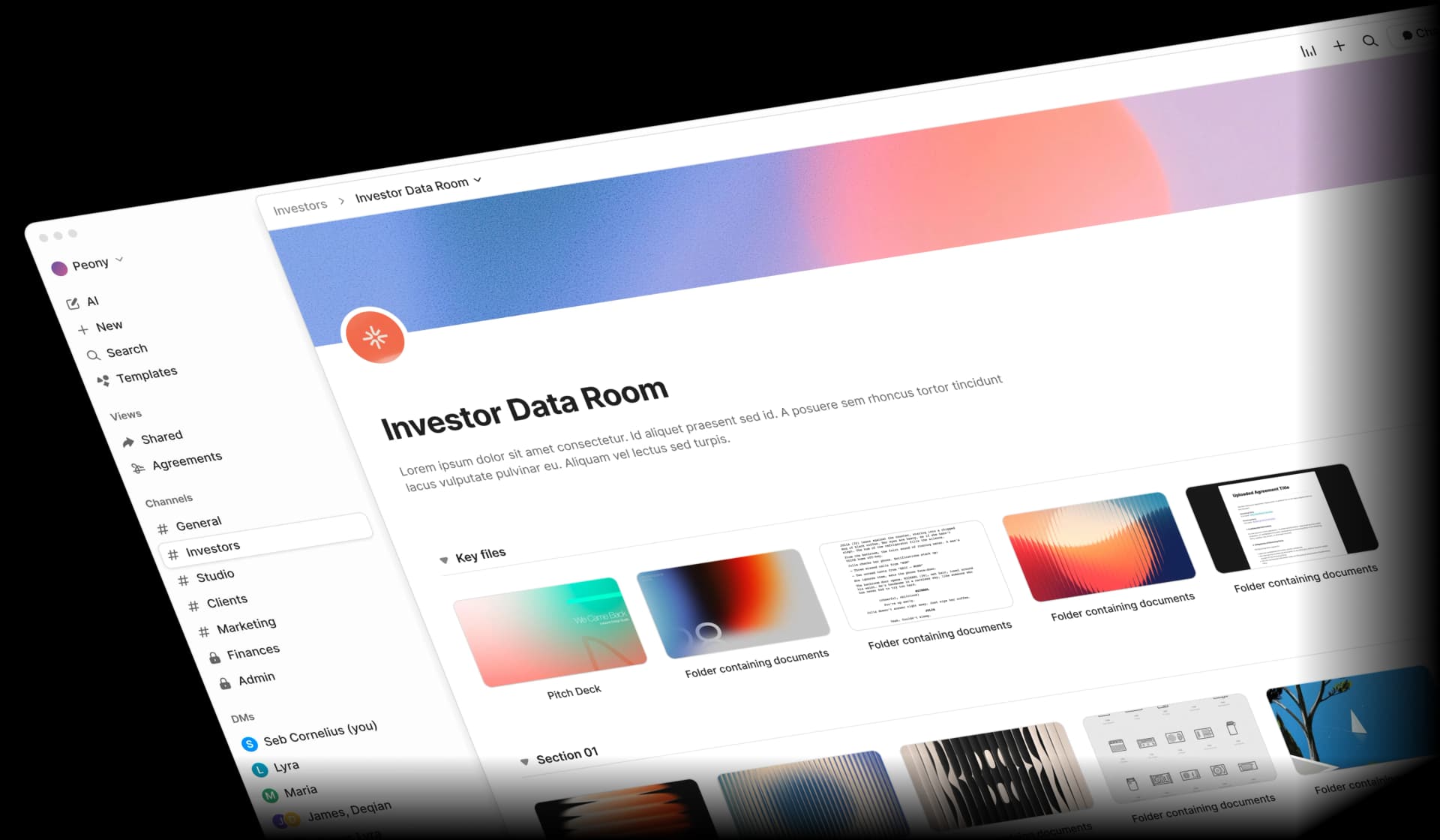
I built Peony's redaction workflow specifically for the M&A use case because I saw the same failures repeated across dozens of deals.
AI-powered PII detection. Upload documents and Peony's AI identifies personal identifiers (Social Security numbers, addresses, phone numbers), financial terms, and commercially sensitive data. You define custom term lists — customer names, project codenames, acquisition targets — and the AI flags every instance across the entire document set in bulk.
Human-in-the-loop review. The AI suggests redactions. Your team reviews and approves before anything is applied. No automated changes without human sign-off.
Reversible single source of truth. Peony maintains one master copy. Redactions are applied as a layer, not destructive edits to the original. When the winning bidder reaches confirmatory diligence and needs full access, you un-redact specific sections without re-uploading files or maintaining parallel redacted/unredacted folder structures.
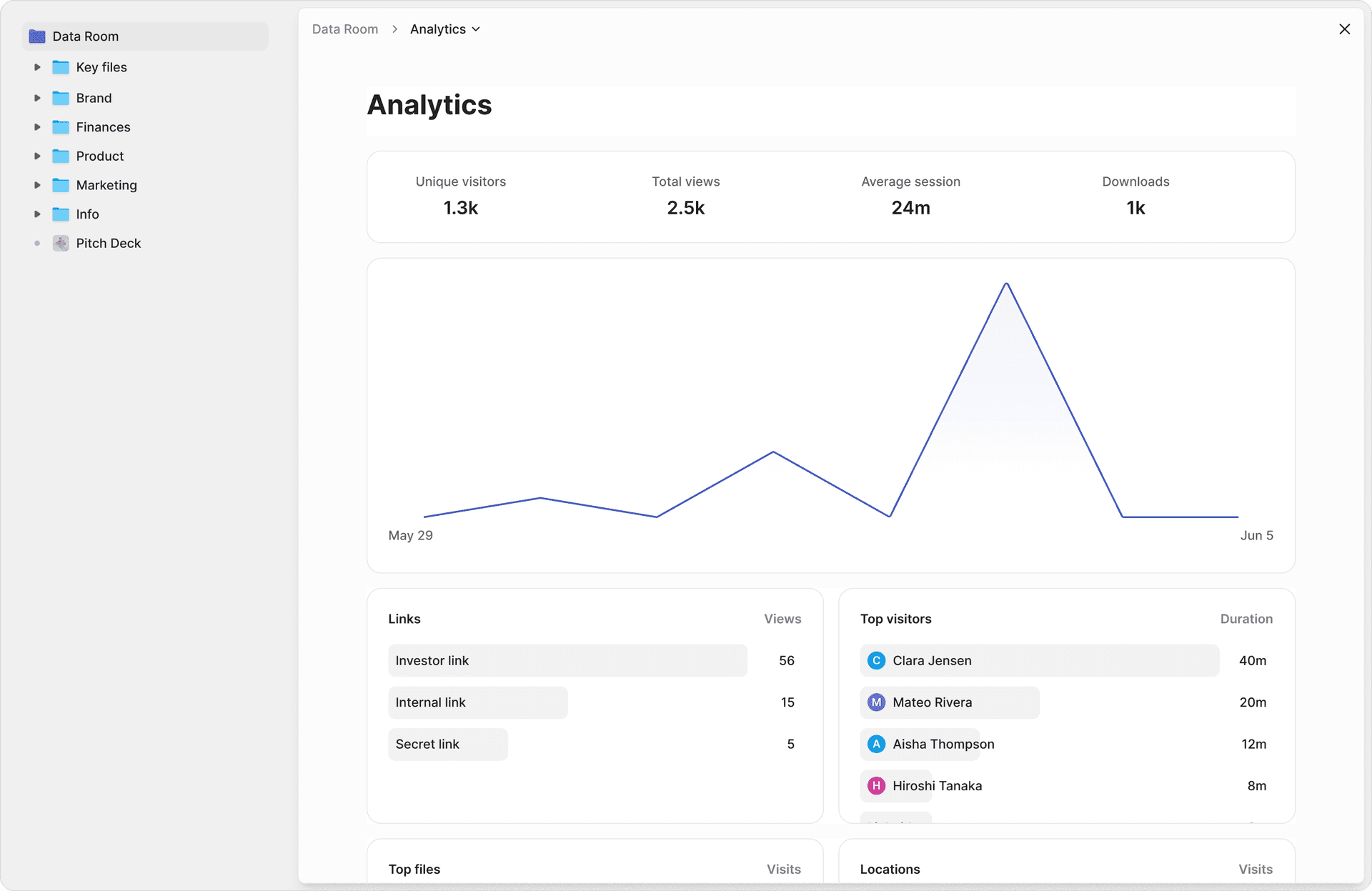
Post-redaction verification. After sharing, page-level analytics show you exactly which pages each reviewer read and for how long. If a redacted document is getting zero engagement, you may have over-redacted — that signal helps you calibrate for the next stage.
Layered security beyond redaction. Redaction addresses content risk. Peony addresses access risk on top of it: dynamic watermarks with viewer identity in every frame, screenshot protection that blocks and logs capture attempts, NDA gates before any document access, and two-factor authentication.
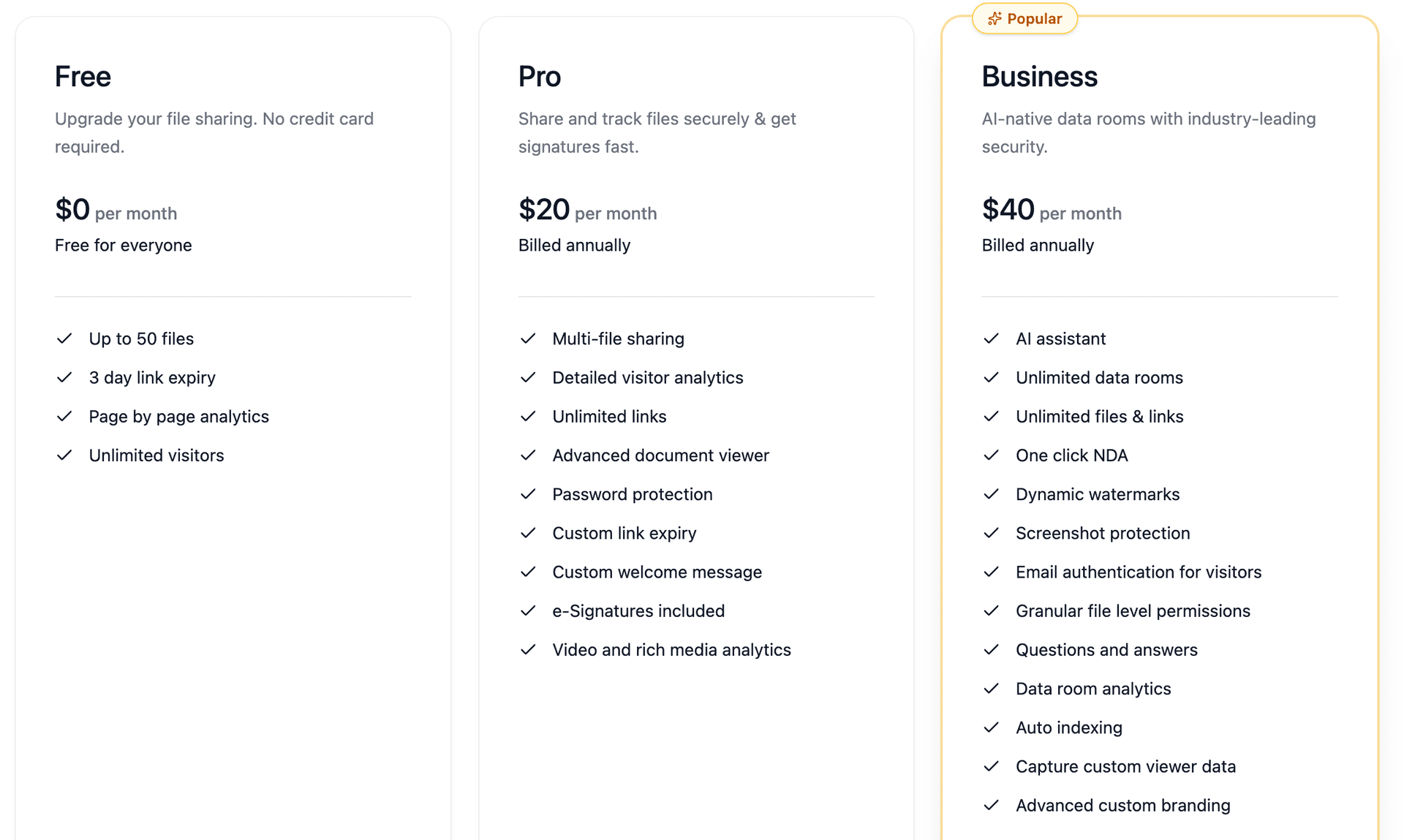
Pricing. Free tier for evaluation, Pro at $20/admin/month, Business at $40/admin/month. Every plan includes controlled redaction, AI auto-indexing, page-level analytics, and e-signatures. No per-page redaction fees. See pricing for details.
Build a reusable redaction playbook
Do not rebuild your redaction process from scratch for every deal. Create reusable templates.
Minimum playbook components:
- One-page redaction policy with category-specific rules
- Document-type examples showing before and after redaction
- Reviewer checklist for second-person verification
- Sign-off trail with timestamps and approver names
- Exception approval process for non-standard requests
- Escalation route for urgent counterparty asks during a live process
Teams that productize this internally respond faster and with less legal stress in every new data room process. I have seen sell-side advisors cut their data room preparation time from two weeks to three days by standardizing their redaction playbook across deals.
FAQ
What is redaction in a virtual data room?
Redaction is the permanent removal of sensitive information from documents before sharing them in a data room during due diligence. Unlike visual black boxes or overlays, true redaction strips the underlying text so it cannot be recovered through copy-paste, text search, or metadata extraction. Peony's controlled redaction uses AI to identify PII, financial terms, and commercially sensitive data, then suggests redactions that your team reviews and approves before applying.
Can I just black out text in a PDF for M&A due diligence?
No. Visual overlays in PDFs, Word documents, and slides are not true redaction. The underlying text remains extractable through simple copy-paste, and this has caused high-profile failures in cases involving Apple v. Samsung, Paul Manafort, and the Epstein files. Use a tool that permanently removes underlying text and metadata. Peony's AI-powered redaction permanently strips the content and includes built-in verification so you can confirm nothing recoverable remains before sharing with bidders.
What documents need redaction in an M&A data room?
Customer and vendor contracts (pricing terms, named counterparties under confidentiality clauses), HR and payroll records (national IDs, home addresses, bank details), board materials (litigation-sensitive commentary, partner names under NDA), security and compliance documents (architecture internals, exploit-prone configurations), and product roadmap files with unreleased details. Peony's AI scans uploaded documents and flags PII, financial figures, and custom terms you define, reducing the risk of missing sensitive fields across thousands of pages.
How does GDPR affect data room redaction in M&A deals?
Under GDPR, personal data must be anonymised before uploading to a data room. Fines can reach EUR 20 million or 4% of global annual turnover. The Marriott-Starwood case resulted in a GBP 18.4 million fine specifically for inadequate data protection due diligence during the acquisition. If redacted data remains identifiable (for example, job titles left in after removing names), it is still classified as personal data. Peony's page-level analytics let you verify exactly who accessed which redacted documents and for how long, creating an auditable trail that supports GDPR compliance.
How long does manual redaction take compared to AI-assisted?
Manual redaction of a 100-page document takes 3 to 5 hours for an experienced paralegal, at a cost of $25 to $50 per document. AI-assisted redaction reduces processing time by 80% according to Datasite, which reported over 100 million redactions processed in a single year. Peony processes documents in bulk with AI-powered PII detection, and keeps a reversible single source of truth so you can un-redact specific sections for the winning bidder at confirmatory diligence without re-uploading files.
What is the difference between redaction, masking, and omission?
Redaction permanently removes content from the shared output file. Masking temporarily hides content in a system view, but the original text may still exist and be recoverable. Omission means the document is not shared at all in the current deal stage. For external due diligence, only true redaction is safe because masking and visual overlays can be reversed. Peony's controlled redaction permanently removes underlying text, and dynamic watermarks add a second layer of protection by embedding viewer identity into every rendered frame.
Should redacted documents still have data room permissions?
Yes. Redaction reduces content risk but does not eliminate access risk. Even after redacting sensitive fields, you should apply role-based permissions, view-only defaults, restricted download and print, dynamic watermarking, and full audit logging. Peony layers screenshot protection that blocks and logs capture attempts, NDA gates that require signed agreements before access, and multi-level gating that lets you control which bidder group sees which documents at each deal stage.
How do I verify that redaction actually worked before sharing?
Run three tests on every redacted document before uploading: copy-paste test (select the redacted area and paste into a text editor), text search test (search for known redacted terms in the output file), and metadata inspection (check for author names, tracked changes, comments, and revision history). Peony's AI redaction processes the document at the data layer rather than the visual layer, and the platform supports flattened PDF output so hidden text layers and metadata are stripped before documents reach your data room.
Related Resources
- M&A Data Room: Complete Setup Guide
- Due Diligence Data Room Checklist (174 Documents)
- Virtual Data Room Permissions for Due Diligence
- What Is a Virtual Data Room?
- Virtual Data Room Features Guide
- Vendor Due Diligence Checklist
- Best Data Rooms for Private Equity
- Dynamic Watermarking Guide
- Document Security Software
- Real Estate Due Diligence Checklist
- Virtual Data Room Cost Guide